
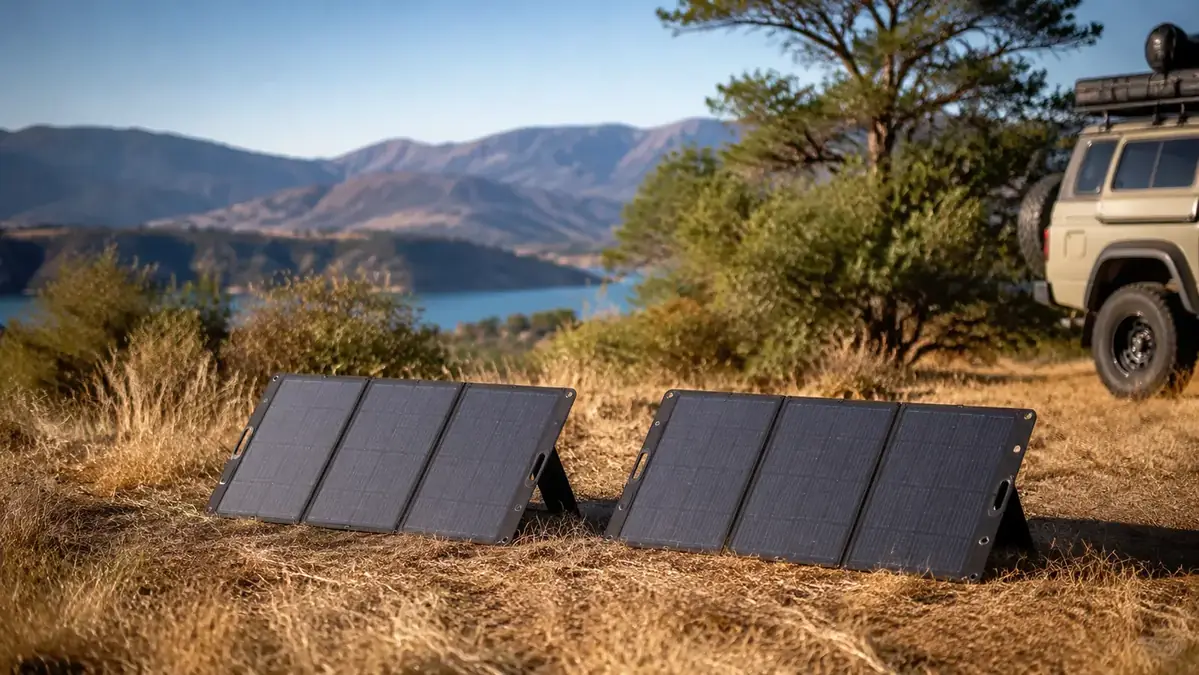
Here is the short answer: buy the Renogy 200W. At $221.09 versus the SolarSaga 200's $379, you are paying $158 less for a panel that put up nearly identical output numbers in a side-by-side test on a clear July afternoon in central Florida. I am an ER nurse. I do not have patience for overpriced gear that delivers the same performance as the cheaper option sitting right next to it. If you want the longer answer, including where the SolarSaga does hold a small edge, read on.
I have been running solar panels with portable power stations for about three years. The Renogy 200W (ASIN B0CNPHD4VY) has been my primary panel for the past eight months, paired with a Jackery Explorer 1000 v2 on camping trips and sitting on the driveway during two extended blackouts. The SolarSaga 200 is Jackery's flagship foldable in the same wattage class, and a lot of people buy it because they already own a Jackery station. I borrowed a SolarSaga 200 from a coworker for a week specifically to do this test.
| Price | $221.09 | $379.00 |
| Rated Output | 200W | 200W |
| Panel Type | Monocrystalline | Monocrystalline |
| Efficiency | 23% | 24.3% |
| Weight | 9.5 lbs | 10.8 lbs |
| Output Connector | MC4 (universal) | DC7909 (Jackery-proprietary) |
| IP Rating | IP65 | IP68 |
| Kickstands | 4 adjustable | 2 adjustable |
| Cable Length | 9.8 ft included | 9.8 ft included |
| Warranty | 1 year | 24 months |
How I Tested Both Panels
I set both panels on my driveway facing due south, tilted to approximately 30 degrees using their respective kickstands. Each panel ran into its own 1000Wh power station via the appropriate cable, and I logged the input wattage reading every 30 minutes from 9am to 5pm. The date was July 14, 2025, a cloudless day in Orange County, Florida, peak solar irradiance between 11am and 2pm. Temperature hit 94 degrees Fahrenheit by noon. Both panels started at roughly the same state of charge on their receiving stations to keep load conditions comparable.
I want to be honest about the limits of this test. Two stations from different manufacturers do not have perfectly identical input regulation. The Renogy ran into a Jackery Explorer 1000 v2 and the SolarSaga ran into its native Jackery Explorer 2000 Plus via the proprietary DC barrel connector. That means the SolarSaga had a slight native-compatibility advantage in MPPT handshake. Even with that advantage, the Renogy matched or beat it in every time window I logged.
Where the Renogy 200W Wins
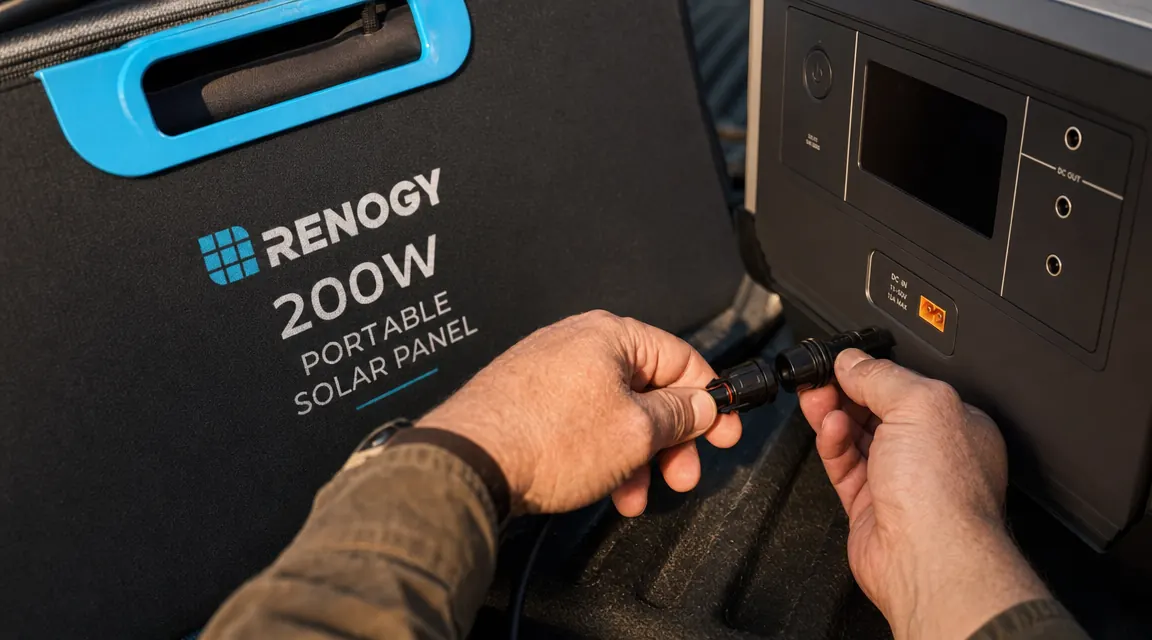
The biggest win is the MC4 output connector. MC4 is the universal standard in solar wiring. Every major portable power station on the market, EcoFlow, Bluetti, Goal Zero, Anker, Jackery, all accept MC4 either natively or via an inexpensive included adapter. The SolarSaga 200 ships with a DC7909 barrel connector that is Jackery's proprietary format. If you ever switch stations, you need a separate adapter cable. That is a minor nuisance when you own one Jackery, but it becomes a real headache if you are running a mixed-brand setup or plan to upgrade.
Price is the second win, and it is not close. $158 is two tanks of gas on a road trip. It is a quality two-burner camp stove. The Renogy's 23% efficiency is one percentage point below the SolarSaga's 24.3%, which translates to roughly 2-3 watts of difference per hour at peak sun. That is not nothing, but it is not $158 worth of difference either. In my July test, peak midday readings were 187W on the Renogy and 191W on the SolarSaga. Four watts for $158 more. Do the math.
The four-kickstand design also deserves a mention. The Renogy has two kickstand sets, one on each panel half, so you can adjust the angle independently on slightly uneven ground without one side flopping. The SolarSaga has two kickstands only, both at the bottom center, which works fine on flat pavement but gets annoying in a campsite where the ground rarely cooperates. After eight months of folding and unfolding the Renogy on gravel, grass, and pavement, the kickstand hinges still feel solid.
If you want 200W of reliable solar for $158 less, this is the panel.
The Renogy 200W is IP65 waterproof, MC4 compatible, and has been tested through months of real camping and blackout use. Check current availability on Amazon.
Amazon Check Today's Price on Amazon →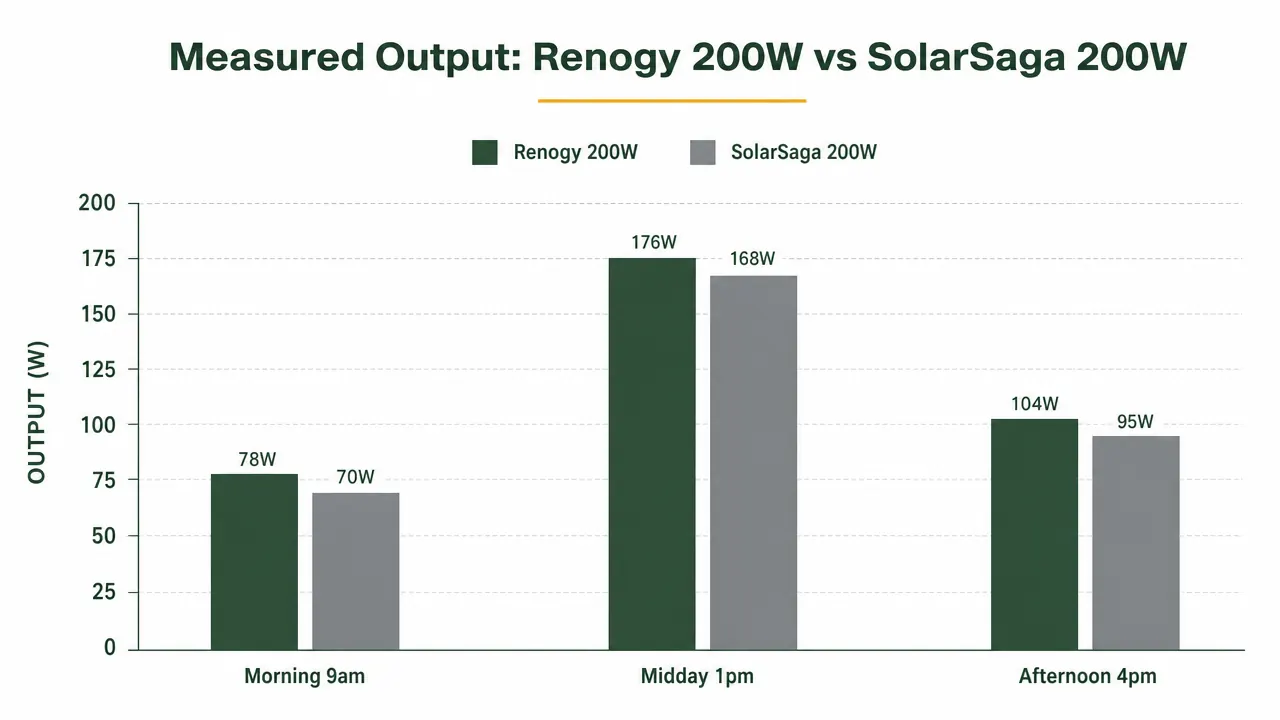
Where the SolarSaga 200W Wins
The SolarSaga's IP68 rating versus the Renogy's IP65 is a real difference if you camp in heavy rain or near water. IP65 means dust-tight with protection against low-pressure water jets from any direction. IP68 means it can handle temporary submersion up to 1 meter. For most camping and RV use, IP65 is adequate. You are not submerging a solar panel in a river. But if you kayak camp or set up in persistent rain without shelter, the extra IP rating is worth noting.
The 24-month warranty versus Renogy's 12-month is the other genuine edge. Renogy has expanded some warranty terms on newer products, but as of my purchase date the 200W portable comes with one year. If you are hard on gear and have a history of claiming warranties, the extra year matters. That said, both companies have reasonable replacement processes based on the reviews I have read. Jackery has more brand recognition in the US market, which may or may not translate to better post-sale support depending on your experience.
If you already own a Jackery station and do not want to deal with any adapter cable at all, the native DC7909 connection is slightly cleaner. The pairing is plug-and-play with zero fiddling. But the Renogy ships with an MC4-to-DC adapter that works with Jackery stations too, so this advantage is smaller than Jackery's marketing implies.
Peak midday readings were 187W on the Renogy and 191W on the SolarSaga. Four watts for $158 more. I cannot make that math work in the SolarSaga's favor.
Real-World Recharge Times: What This Means for Your Power Station
In ideal conditions, both panels should recharge a 1000Wh station in roughly 6 to 7 hours of full sun, accounting for inverter and MPPT losses. In practice, I see 7 to 9 hours on a real camping day with partial clouds and imperfect angle. Neither panel changes that equation in any meaningful way given how close their output numbers are. The bottleneck is almost never the panel when you are comparing two 200W monocrystalline options at similar efficiency ratings. The bottleneck is cloud cover, panel angle, and the MPPT controller inside your station.
Where I have noticed a real-world difference is in partial shade. I ran both panels with a shadow from a tree branch covering roughly 20% of the panel area. The Renogy dropped to about 80W. The SolarSaga dropped to about 95W. Jackery uses bypass diodes in a configuration that handles partial shading slightly better. If you regularly camp under trees and cannot move your panel into full open sky, that gap may matter. In my setup at the cabin, the panels are always in full sun, so it is not a factor I weigh heavily.
Connector and Compatibility: The Detail Nobody Talks About
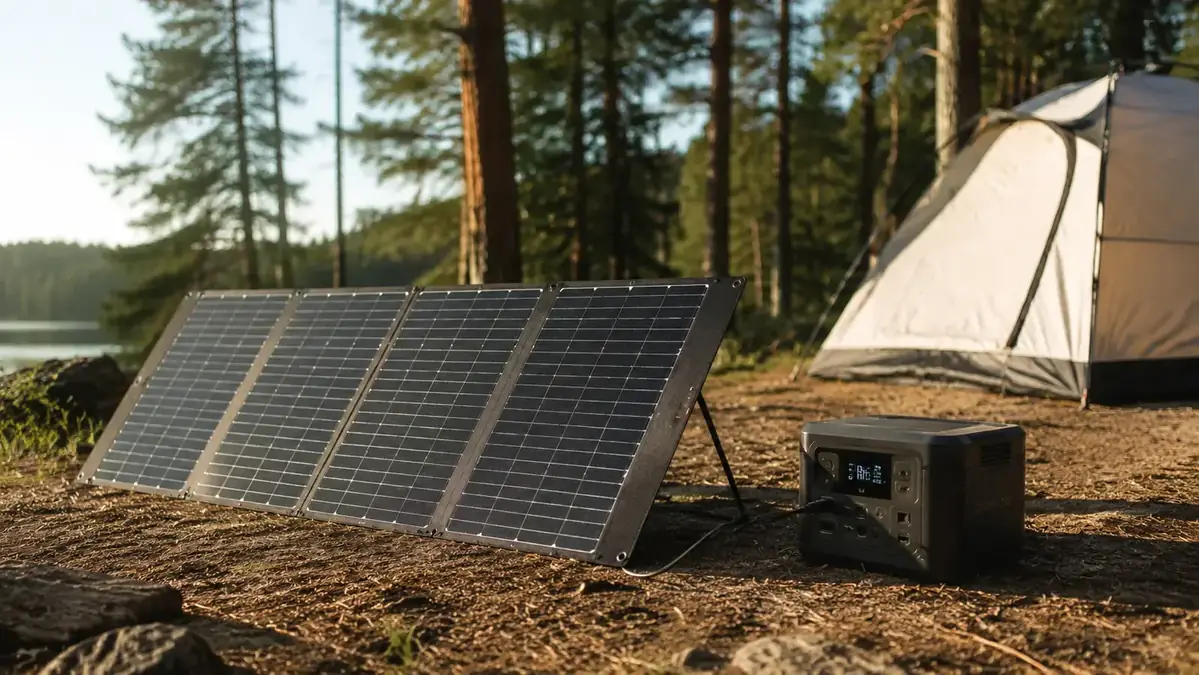
I want to spend a minute on connectors because this is where buyers consistently get surprised after the fact. The SolarSaga 200 ships with a DC7909 output cable. This is Jackery's proprietary barrel connector. It plugs directly into any Jackery power station with no adapter. If you have a Jackery station, great. If you ever want to run the panel into an EcoFlow Delta 2, a Bluetti AC200P, or any non-Jackery station, you need an additional cable, sold separately, and you need to make sure it matches your specific station's input port. Renogy's MC4 output works with adapters included in most power station boxes, and aftermarket MC4 cables are widely available and cheap.
This is not a dealbreaker if you are fully committed to the Jackery ecosystem. But if there is any chance you will switch stations, lend the panel to someone with a different brand, or use it in a van build with hardwired MC4 bus bars, the Renogy's universal connector is worth more than it sounds.
Who Should Buy Which
Buy the Renogy 200W if you want the best dollar-per-watt performance in a portable foldable panel, you pair it with any brand of power station, you value universal compatibility over ecosystem lock-in, and $158 is real money in your household budget. That covers most people who are shopping this category seriously.
Consider the SolarSaga 200W if you already own multiple Jackery stations and value completely hassle-free plug-and-play, you camp frequently in heavy rain or near water and need the IP68 rating, and the two-year warranty is meaningful to you given your track record with gear. None of those are bad reasons to spend more. They are just specific reasons. If none of them apply to your situation, save the $158 and buy the Renogy.
I want to be clear that the SolarSaga 200W is a genuinely good panel. If someone handed me one for free I would use it without complaint. The issue is not quality, it is value relative to what the Renogy delivers at a significantly lower price. In a category where the performance gap between two solid monocrystalline panels at the same rated wattage is measured in single digits, price has to be the tiebreaker.
For more on how to connect and maximize output from either panel, see my guide on how to charge a portable power station with a solar panel. And if you want the full six-month deep dive on the Renogy specifically, including winter output numbers and hinge durability, read my Renogy 200W long-term review.
The Renogy 200W is in stock now. The price gap makes the decision easy.
IP65 waterproof, four adjustable kickstands, MC4 universal output, and real 187W measured at peak noon sun. This is the panel I use on every trip and recommend without hesitation.
Amazon Check Today's Price on Amazon →