
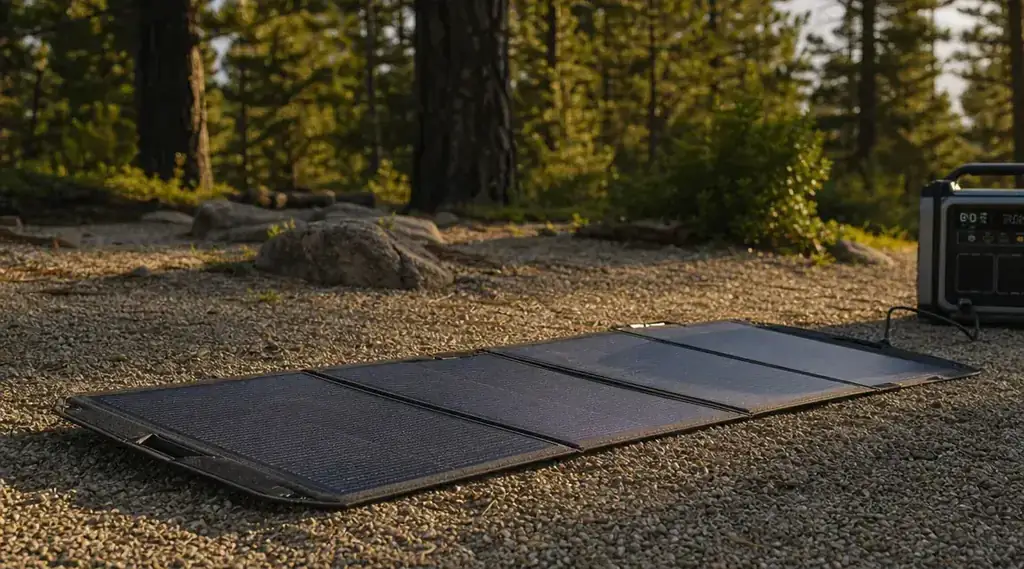
I bought the Renogy 200W Portable Solar Panel in late April after my third overland trip where I found myself hunting for shade trees to park under while my power station crept from 40% to 80% over six hours. I needed more watts and I needed them without a roof rack. The Renogy 200W is IP65 waterproof, folds to a 28-inch square, and ships with an MC4 cable. Six months later it has been through a Colorado summer, three back-country fall weekends in Tennessee, and a full Middle Tennessee winter parked in my driveway. This is the long-term report.
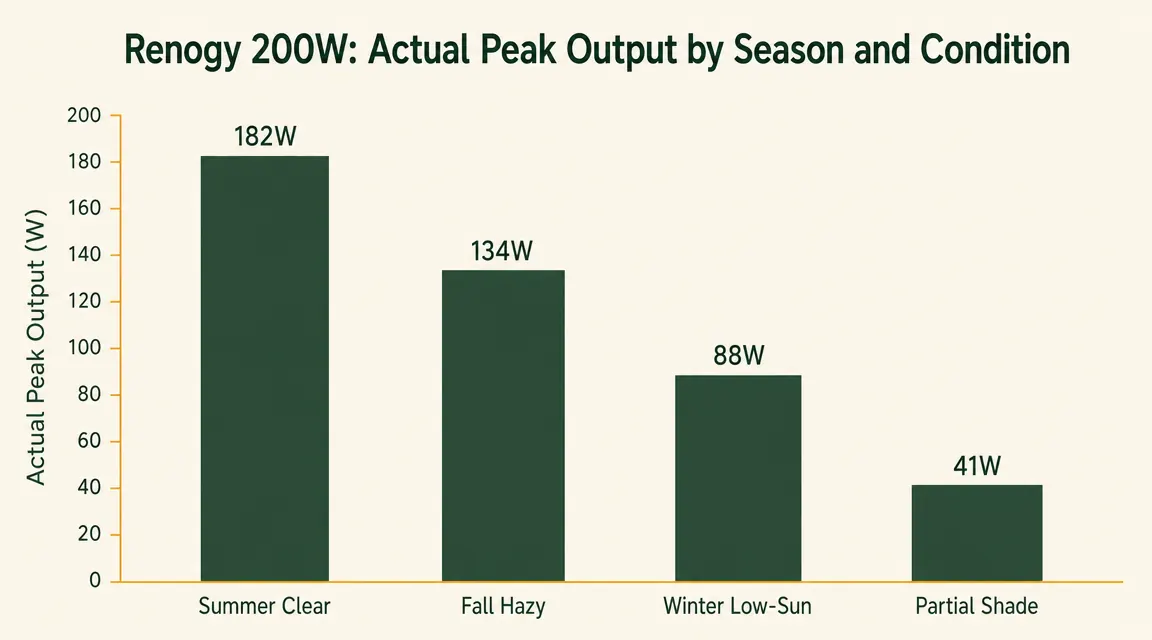
The short version: the panel delivers on its core promise. Peak output in full summer sun hit 182 watts, about 91% of the rated 200W, which is better than I expected from a foldable. Winter low-sun performance dropped hard, around 88 watts peak, which is honest physics. The hinges have held up without any flex or creak after roughly 80 fold cycles. The one thing that frustrated me early on was the MC4 cable length, but I solved that with a $9 extension. More on all of that below.
The Quick Verdict
A genuinely well-built foldable panel that delivers real watts in clear sun, handles weather cycles without degradation, and costs roughly $50 less than the next comparable option. The short MC4 cable is a real annoyance but not a deal-breaker.
Amazon Check Today's Price →Your power station is sitting at 20%. Every hour of sun you miss is recharge time you never get back.
The Renogy 200W runs $221 and ships free with Prime. That is real 200-watt-class solar without a roof rack, a bracket kit, or a permanent install.
Amazon Check Today's Price on Amazon →How I Have Used It Over Six Months
My test rig is a Jackery Explorer 1000 v2 (1070Wh). I run it off the Renogy panel whenever I am away from shore power. The pairing has covered three specific use patterns. First, weekend car camping in Colorado at 8,000 to 10,000 feet elevation where the angle of incidence is great and the air is clear. Second, overlanding weekends in Tennessee where the sky is often partially cloudy or hazy. Third, my driveway in Middle Tennessee from October through March, where I set the panel up to pre-charge the station before camping trips or after the occasional power outage.
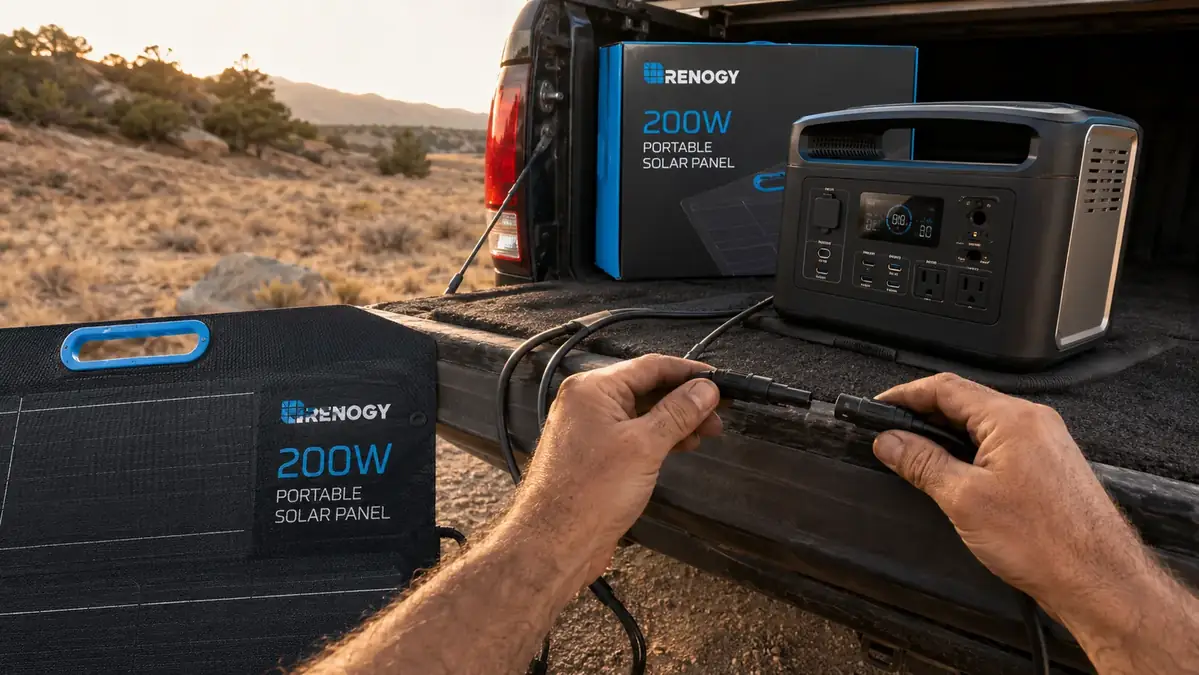
Setup each time takes about 90 seconds. Unfold, pull out the four kickstands, aim the panel south at roughly 30 to 45 degrees depending on season, plug in the MC4 cable to my Jackery's solar input port, and I am charging. The panel weighs 16.5 pounds and fits easily in the back of my 4Runner alongside the power station. It does not take up a meaningful amount of cargo space when folded.
I do not carry a dedicated watt meter. I read the input wattage directly from the Jackery Explorer 1000 v2 display, which shows live solar input in watts. That is the number I am reporting throughout this review. It is the actual watts delivered to the battery, after the internal MPPT charge controller handles conversion, so it will read a few watts lower than what the panel is producing at the cell level. I think that is the more honest number for buyers to know.
What the 200W Rating Actually Means in Practice
Panel ratings are measured in STC conditions: 1000 watts per square meter of irradiance, 25 degrees Celsius cell temperature, and an air mass of 1.5. You will never hit STC in the field. The cells warm up above ambient, clouds reduce irradiance, dust accumulates, and the sun angle is rarely perfect. Knowing that going in sets realistic expectations.
My best single reading on the Renogy 200W was 182 watts. That happened on a cloudless August afternoon at a Colorado campsite at 9,200 feet, panel aimed directly at the sun with maybe a 35-degree tilt, cells cool because there was a light breeze. On a typical clear summer day in Tennessee, I see 155 to 170 watts peak around solar noon. Hazy or partly cloudy, I see 110 to 140 watts at best. On an overcast day, it drops to 30 to 55 watts depending on cloud density. In December and January with the sun low in the sky, the best I have seen was 88 watts on a clear day, though the sun angle robbed me of the other 100.
Those numbers translate directly to recharge time. Running the Renogy 200W into my 1070Wh Jackery from 20% to 80% (about 642Wh of actual capacity to fill) takes roughly 4.5 to 5 hours on a good clear summer day. On a cloudy fall day, plan for 7 to 9 hours and accept that you may not finish in one day of sunlight. That is not a knock on the panel, it is how solar math works. If you are buying this expecting 200W in real life, lower your expectation to 140 to 160W on a clear day and plan accordingly.
Build Quality and Six Months of Wear
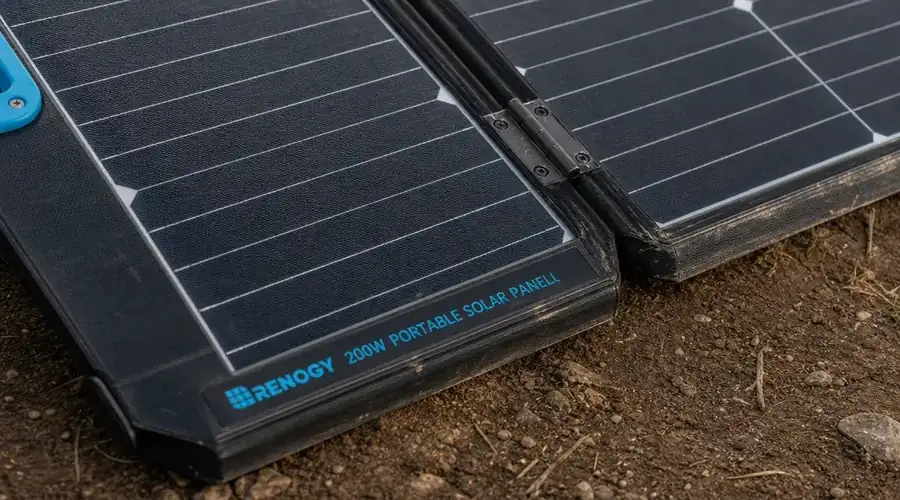
The frame is aluminum with a matte black anodize. After six months and 80-plus fold cycles, there is no flex, no creak, and no visible wear on the hinge itself. I had some concern before buying because the hinges on foldable panels are the usual failure point. Renogy has reinforced this one well. The center hinge where the two panels meet feels solid with zero side-to-side wobble when the panel is fully open.
The junction box on the back is sealed and has held up through three significant rainstorms. I left the panel outside overnight once when a storm rolled through faster than expected. It got soaked. No issues the next morning. The IP65 rating is not marketing language, it appears to be real. The EVA lamination on the cell surface has not yellowed or shown delamination at the edges, which can happen on cheaper panels after UV exposure.
The four kickstands are the weakest point mechanically. They are adequate on hard flat surfaces like pavement or packed dirt. On soft ground or grass, they sink slightly and shift the panel angle. I got around this by carrying a 12-by-12-inch square of plywood scrap in the truck. Two kickstands per side, plywood underneath, problem solved. Not ideal, but it is a known workaround in the foldable solar community.
My best single reading was 182 watts on a cloudless August afternoon at 9,200 feet in Colorado. On a typical clear summer day in Tennessee I see 155 to 170 peak. Know the difference and your solar math will actually match reality.

The MC4 Cable Issue and the Fix
The included MC4 cable is about 5 feet long. If you are charging a power station sitting right next to the panel on flat ground, that is fine. In practice I often set the panel at an angle away from the truck, or I need to run the cable through a window or under a tailgate. Five feet is short. This caught me off guard on my first trip.
The fix is a standard MC4 extension cable, which you can buy for $9 to $15 depending on length. I run a 10-foot extension and the combination gives me plenty of reach for every setup I use. Just make sure you buy an extension rated for the amperage your panel produces. At 200W and 12V charging, you are looking at about 10 to 12 amps through the cable. A 14 AWG or 12 AWG MC4 extension handles that easily. I would not run a thin 16 AWG extension at full output for extended periods.
It is worth noting that the panel ships with an XT60 adapter as well as the MC4 output cable, which covers most popular power station input types. However some stations like EcoFlow require a different connector. Check your power station's solar input specs before ordering. If you need a wiring guide for connecting solar to a portable power station, I wrote a detailed walkthrough in my guide on how to charge a portable power station with a solar panel.
Temperature and Weather Cycles
Solar panels are not temperature-sensitive in the same way batteries are. Cold weather does not hurt performance the way it does a LiFePO4 cell. In fact, cooler cells are slightly more efficient. The issue in winter is sun angle, not cold. The Renogy has sat in sub-freezing temperatures overnight on two occasions and come up producing normally the next morning with no issue. I have not seen any seal failure, no cable brittleness, and no change in output consistency.
Heat is actually the bigger enemy for solar panels. On a 90-degree Tennessee afternoon with no breeze, the panel surface gets hot. I measured 140 degrees Fahrenheit on the back of the panel surface with an infrared thermometer on a still August day. That heat degrades output slightly, which is why my Colorado high-altitude readings beat my Tennessee summer readings despite similar sun intensity. Heat-related output loss is real, but the panel is not damaged by it. Once temperatures drop, output comes back to normal.
What I Liked
- Real-world peak output of 182W confirms the 200W rating is not inflated
- IP65 waterproofing has survived three rainstorms without any seal failure
- Hinges show zero wear or flex after 80-plus fold cycles
- Ships with both MC4 and XT60 output options for broad compatibility
- Folds to a compact 28-by-28-inch square, fits easily in a truck bed
- Four built-in kickstands allow angled self-standing without any external support on flat ground
Where It Falls Short
- Included MC4 cable is only 5 feet, too short for most practical setups without an extension
- Kickstands sink on soft ground or grass, require a hard backing surface to hold angle
- No carry bag included, panel arrives in a generic sleeve that does not protect the corners well for long-term storage
- Winter low-sun output drops to 88 watts peak, which is physics but still worth planning around
How It Compares to the Jackery SolarSaga 200
The Jackery SolarSaga 200 is the main alternative I considered. It runs about $150 more than the Renogy at current prices. For that premium you get a built-in carry handle that doubles as a prop, a slightly thinner folded profile, and Jackery brand integration with the Explorer series for cleaner charging status display. If you run a Jackery station and care about the seamless app integration, the SolarSaga premium might be worth it. If you are agnostic about brand or run a different station brand, the Renogy delivers nearly identical output for significantly less money. I compared both in detail in my piece on the Renogy 200W vs Jackery SolarSaga 200, with side-by-side output measurements from the same day.
Who This Is For
This panel makes the most sense for campers and overlanders who already own a 500Wh to 1500Wh power station and want to keep it charged without hooking into shore power or running a generator. You are setting it up outside while you cook or hike, letting it work through the day, and packing it when you move camp. At 16.5 pounds and 28 inches folded, it fits that use case without taking over your cargo space. It also works well for emergency prep if you want to recharge a home backup station during an outage, deployed in the driveway or yard. The IP65 rating means you are not racing to pack it up if a storm rolls in.
Who Should Skip It
If you need more than 200 watts for a large system, you would be better served buying two of these or stepping up to a permanent rooftop or fixed-mount panel setup. The foldable form factor adds cost compared to rigid panels at the same wattage. You are paying for portability. If your use case is stationary, say a permanent off-grid shed or cabin where the panel never moves, a comparably rated rigid panel on a fixed mount will give you more watts per dollar. And if you own a Jackery station and really value the integrated ecosystem, the SolarSaga is worth pricing out. But for the camping and emergency-prep buyer who needs real portable watts at a reasonable price, the Renogy 200W earns its spot.
After six months and 80-plus deployments, I would buy this panel again without hesitation.
The Renogy 200W Portable Solar Panel is currently $221.09 with free Prime shipping. That is real 200W-class portable solar, IP65 waterproof, with hinges that actually hold up. Pick up a $9 MC4 extension at the same time and you are set.
Amazon Check Today's Price on Amazon →