
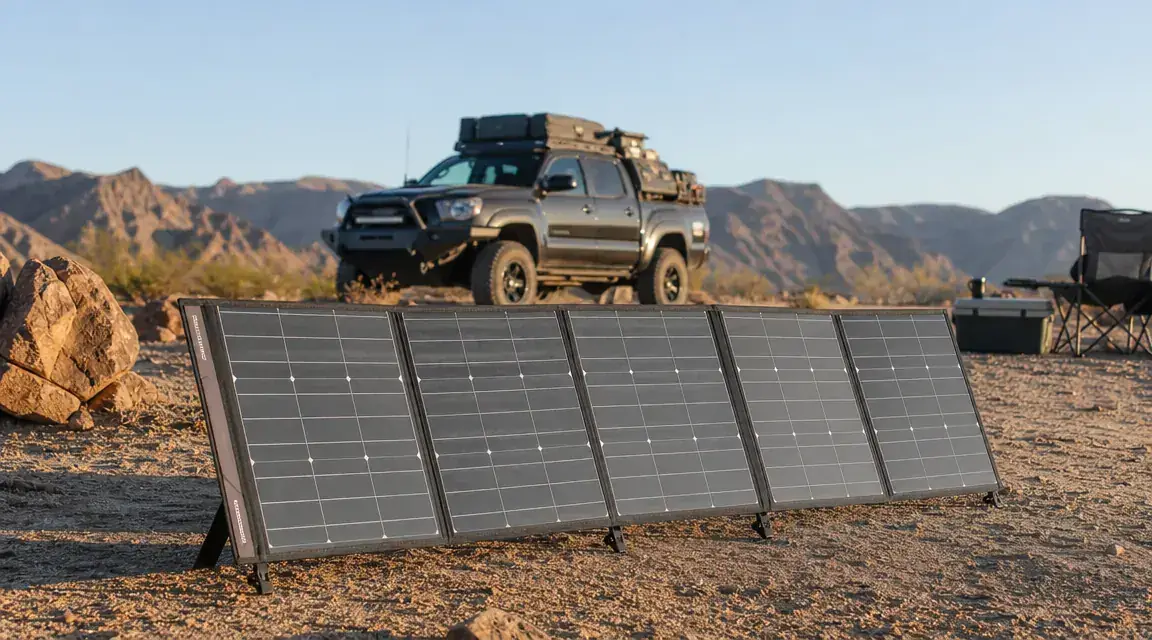
I got the Renogy 200W foldable panel about eight months ago, mostly on the recommendation of a guy in my overland group who swore by it for desert camping. I had been running a pair of 100W panels daisy-chained together and dealing with two sets of cables, two sets of connectors, and a lot of extra setup time after a 12-hour shift. The Renogy 200W was supposed to simplify things. It did, but it also performed better than I expected in a few ways I want to be specific about, because solar panel marketing is full of claims that evaporate the first time a cloud shows up.
This is not a full long-term review. For that, see my six-month field report. This is a focused list of the ten reasons this panel actually earns its place in the truck, based on real numbers from real trips.
Your power station charges faster when the panel is rated honestly. The Renogy 200W is.
Rated 4.6 stars across 650 reviews. MC4 output, IP65 waterproofing, four-kickstand stand system. Ships with the cable you actually need.
Amazon Check Today's Price on Amazon →The 200W Rating Is Close to Accurate at Solar Noon
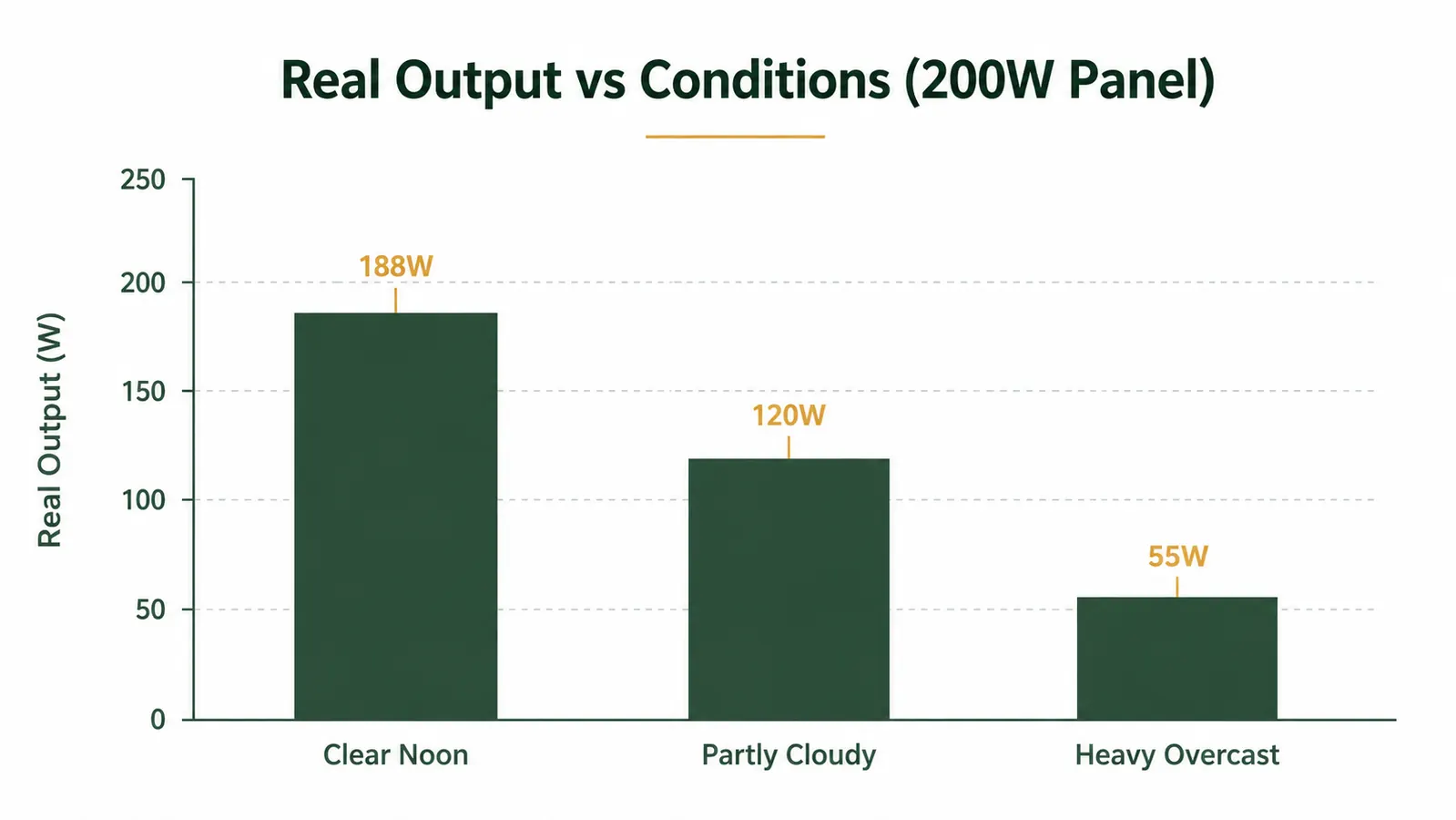
Most foldable panels are rated at Standard Test Conditions, which is a lab approximation that rarely matches the field. The Renogy 200W has pulled between 178W and 193W on clear days between 11 a.m. and 1 p.m. according to the wattage readout on my Jackery 1000 v2. That is 89 to 96 percent of nameplate rating, which is better than any panel I have owned at this price point. The gap between the label and real output is the single biggest source of disappointment in solar, and this panel keeps that gap narrow.
Four Kickstands Mean You Can Dial In the Angle Without a Stick or a Rock
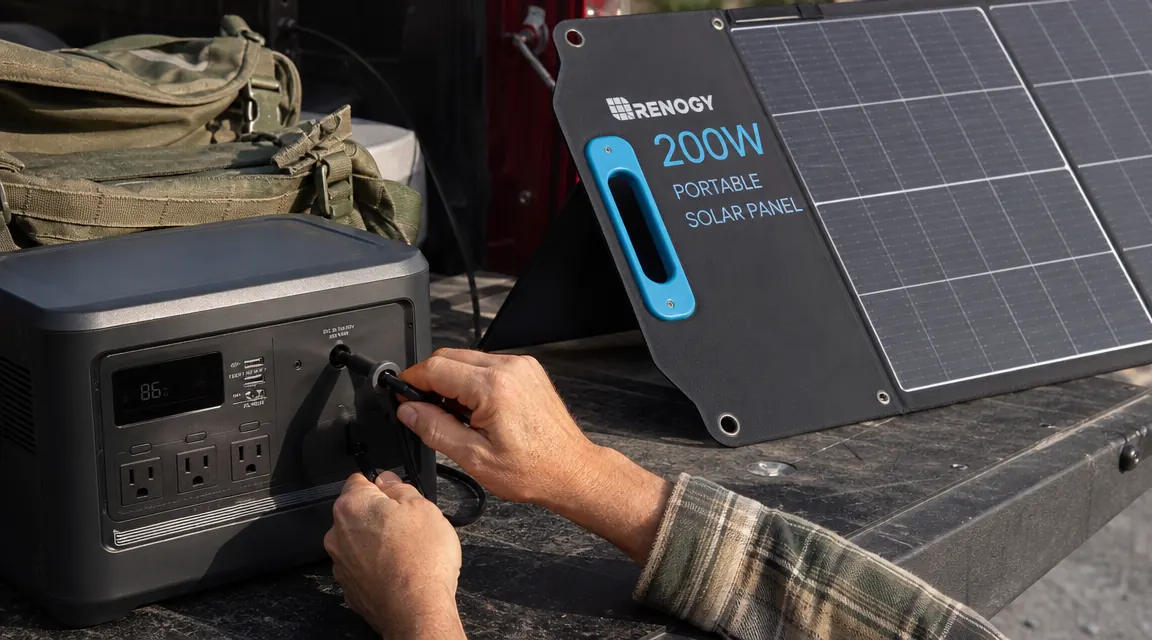
This sounds like a minor convenience and then it becomes the thing you notice every time. Most panels ship with two kickstands, and if one bends or catches the ground unevenly you end up propping the whole thing against the truck door. The Renogy 200W has four independent kickstands, one at each corner of the folded panel body. You can tilt it to 25, 35, or 45 degrees cleanly, and it stays there. I have set it on gravel, sand, and uneven dirt without it tipping over. In summer at 35 north latitude, getting the panel to roughly 30 degrees is worth about 12 to 15 extra watts compared to flat on the ground.
IP65 Waterproofing Covers Real Rain, Not Just a Sprinkle
IP65 means dust-tight and protected against water jets from any direction. That is not the same as submersible, but it is enough to leave the panel set up when a quick storm rolls through without sprinting to fold it up. I left mine out through a 40-minute afternoon thunderstorm in Arkansas last September. Zero issues. The junction box on the back has a rubber gasket around the MC4 ports that keeps the connection dry. If you camp or overland in the Pacific Northwest or the Southeast, this matters more than any wattage spec.
MC4 Output Connects to Almost Every Power Station Without an Adapter
Proprietary connectors are a tax on convenience. The Renogy 200W outputs via MC4, which is the industry-standard connector used on rooftop residential solar and the DC input on most portable power stations. The included cable is MC4 to Anderson DC5525, which fits the Jackery 1000 v2, both EcoFlow Delta models, and the Bluetti EB70. If you run a Goal Zero Yeti, you need a Yeti MC4 adapter, which is a $15 fix. For about 90 percent of portable power station owners, the cable in the box is the cable you use.
Monocrystalline Cells Hold Output Better in Partial Shade Than Budget Poly Panels
The Renogy 200W uses monocrystalline silicon cells, which have two practical advantages over polycrystalline panels at the same stated wattage. First, higher efficiency per square inch, so the folded footprint is smaller. Second, better performance under low-light and partial-shade conditions. On overcast mornings I get 55 to 75W out of this panel. A poly panel at the same price will typically give 30 to 50W in the same light. That is the difference between a trickle charge that offsets overnight drain and one that actually adds usable capacity before you break camp.
On overcast mornings I get 55 to 75 watts. That is the difference between a trickle charge and one that adds usable capacity before you break camp.
The Carry Case Has Handles That Hold Up
Small thing, but the handles on budget solar panel bags tear off after a season or two because they are sewn into the bag shell rather than looping through a reinforced grommet. The Renogy carry case uses webbing handles attached to the inner frame, not just the fabric skin. I have carried this panel from the truck to a campsite and back probably 40 times and the handles show no fraying. The bag also has a mesh pocket that fits the included cable neatly, so you do not have to stuff loose cable into the main compartment and then fight to zip it.
You Can Daisy-Chain Two Panels for 400W Input on a Single Power Station
If your power station supports more than 200W of solar input, two Renogy 200W panels in series will push up to 400W through one MC4 connection. The Jackery 1000 v2 caps at 200W solar input, so you will not use this feature with that station. But the EcoFlow Delta 2 accepts 500W, the Delta Pro accepts 1600W, and the Bluetti AC200P accepts 700W. If you are running a larger station, buying a second Renogy 200W panel and a parallel combiner cable gives you a simple 400W rig at under $500 total. That will fully recharge a 1000Wh station in about three hours on a clear day.
The ETFE Surface Layer Resists Scratching and UV Degradation
Cheaper foldable panels use PET laminate on the cell surface. ETFE (ethylene tetrafluoroethylene) is a fluoropolymer that is harder, more UV-stable, and transmits slightly more light. The Renogy 200W uses ETFE. This matters for longevity. PET panels that live in a truck bed and get unfolded and folded 50 times a year will show surface haze and micro-scratches within two to three seasons. ETFE holds up considerably longer. I cannot give you a five-year outcome because I have only owned mine eight months, but the surface looks identical to day one and Renogy backs it with a 5-year material warranty on the panel itself.
The Folded Size Fits Upright in the Bed of a Mid-Size Truck Without Sliding
Folded, the Renogy 200W is 21.9 by 20.5 by 2.4 inches. That is compact enough to slide vertically between a Pelican case and the side of a truck bed without blocking the tailgate. I have also carried it in the cargo area of a 4Runner with the rear seat folded flat. It does not take up meaningful space. The competing 200W panels from Jackery SolarSaga and Bluetti fold to similar footprints, but the Renogy is notably lighter at 13 pounds, which matters if you are hiking the panel out to a site.
The Price Is About $150 Less Than Comparable Panels From Jackery and Bluetti
The Jackery SolarSaga 200W is currently around $370. The Bluetti PV200 is around $320. The Renogy 200W comes in well below both. I ran both the Renogy and the SolarSaga side by side on the same clear afternoon last summer and got within 8W of each other at peak output. For the use cases this panel is built for, camping, overland trips, emergency backup, the Renogy puts that extra money back in your pocket without giving up measurable performance. If you want the full side-by-side breakdown, I covered it in my <a href="how-to-charge-power-station-with-solar-panel">solar charging setup guide</a>.
What I Would Skip
The Renogy 200W is not the panel for permanent roof mounting on an RV. For that, you want rigid aluminum-framed panels with a through-bolt mounting system, not a foldable carry case. The kickstands are also not designed for high-wind environments. If you are in a coastal or desert region where afternoon gusts hit 25 mph or more, you will want to weight the legs or guy it to the truck hitch. And if your power station only accepts its own proprietary solar connector, budget $15 to $30 for an MC4 adapter before your first trip.
I ran the Renogy and the SolarSaga side by side on the same clear afternoon and got within 8 watts of each other at peak. The Renogy costs about $150 less.
If your power station is sitting at 40% at the end of a camp day, the panel is the problem. This one fixes it.
Renogy 200W foldable panel. IP65, ETFE cells, four kickstands, MC4 output. 4.6 stars from 650 owners. Ships with the cable you need for most power stations.
Amazon Check Today's Price on Amazon →