
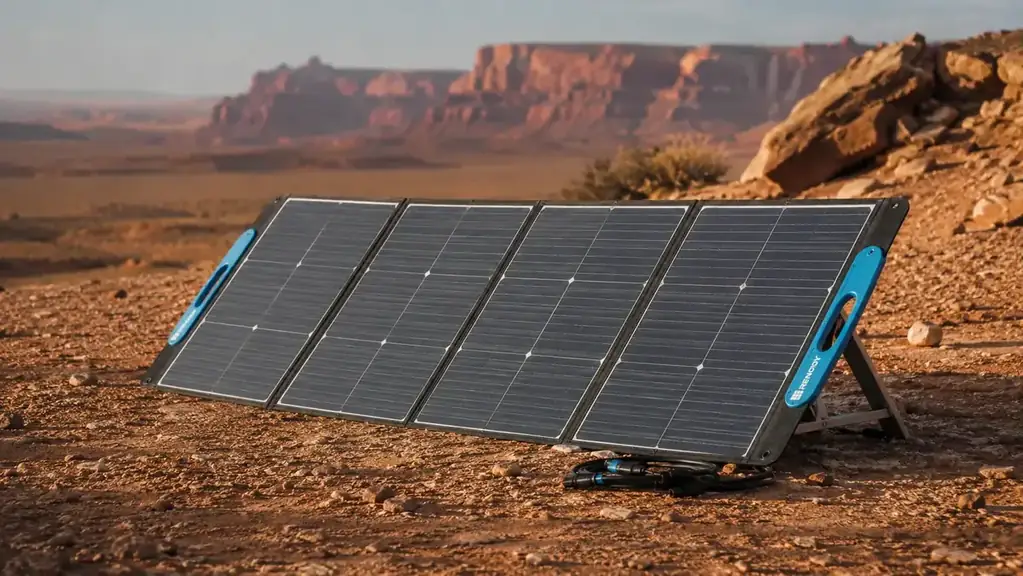
I bought the Renogy 200W foldable panel in April 2025 to pair with my Jackery Explorer 1000 v2 on camping weekends. Most of the reviews I read before buying were fine, but they all shared the same problem: they were written by someone who set the panel up once on a sunny afternoon, saw a solid number on the screen, and called it a day. I have now folded and unfolded this panel probably 60 times across Colorado, Utah, and a few storms I did not plan for. Here is the stuff those reviews missed.
The Renogy 200W (ASIN B0CNPHD4VY) carries a 4.6-star rating from 650 reviews at a current price around $221. Those numbers are fair. But a rating average tells you nothing about the gap between what the spec sheet promises and what lands on your power station's input screen at 9 a.m. in June when half the sky is clouds. That gap is what this review is about.
The Quick Verdict
A solidly built, genuinely portable 200W panel with real IP65 weather resistance, but the kickstand wobbles on uneven ground, the included MC4 cable is too short for most setups, and output on overcast days can drop below 25W.
Amazon Check Today's Price →If your power station is sitting at 40% by noon, a real 200W panel is the fix
The Renogy 200W foldable panel is the most practical high-wattage portable option at this price point. Check today's price and current stock on Amazon before you plan your next trip.
Amazon Check Today's Price on Amazon →How I Have Been Using It
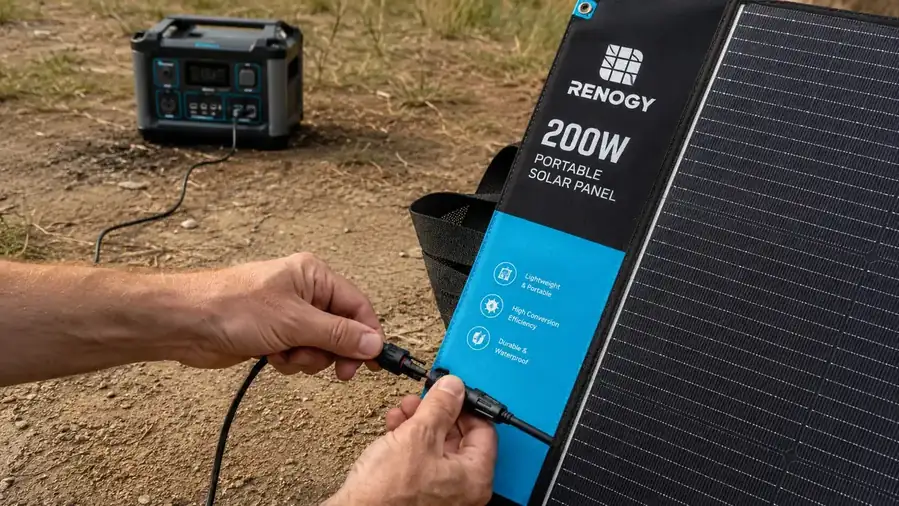
My test setup: Renogy 200W panel feeding a Jackery Explorer 1000 v2 (1070Wh, 400W solar input max) over MC4-to-Anderson adapter. I run the panel as my primary recharge source on three-day camping trips in the Colorado Rockies, elevation around 8,500 feet. I also ran it in my driveway through a Utah road trip prep in January, which is where the cold-weather and low-angle sun data in this review comes from.
I am not a lab. I do not have a calibrated pyranometer. What I have is a clamp meter, the Jackery's real-time input display, and a habit of writing down what I see at regular intervals. All watt numbers below are read directly from the power station input screen, averaged across three-minute windows to smooth out display flicker.
Over about 60 deploy-and-pack cycles, the panel has charged the Jackery from roughly 30% to 90% on full-sun days, taken rain without complaint, and survived a near-tip in a wind gust. It has also frustrated me in three specific ways I want to walk through honestly.
What 200W Actually Means in Practice
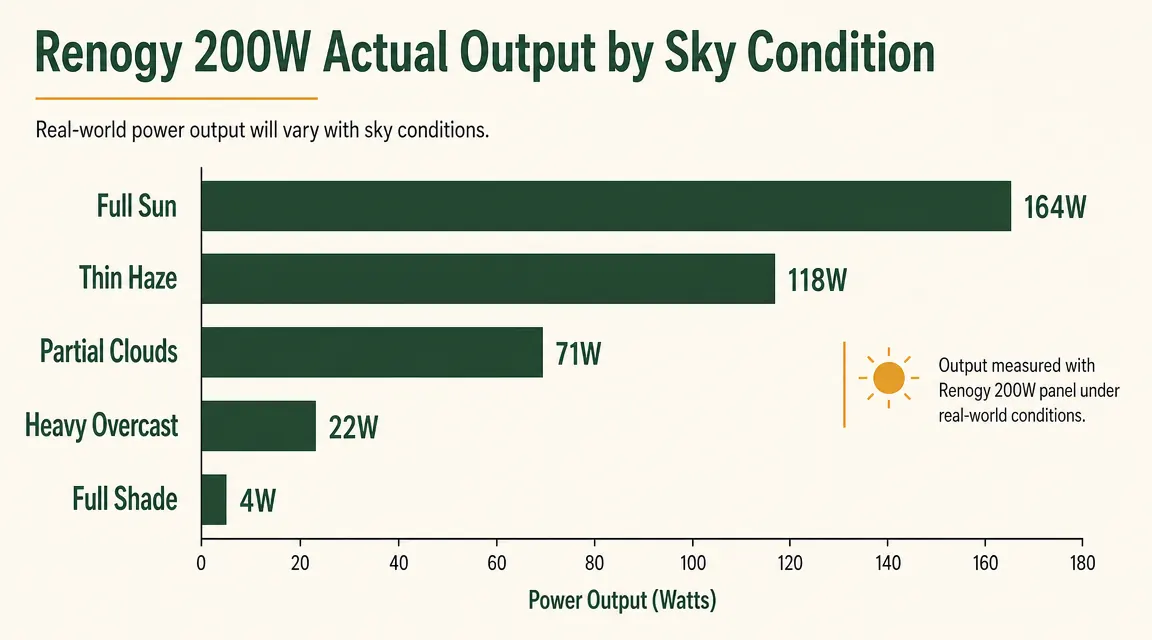
The 200W rating is STC output: Standard Test Conditions, meaning 1000 W/m2 irradiance, 25 degrees Celsius cell temperature, and perfectly perpendicular light. You will almost never hit those exact conditions with a portable panel sitting on the ground. My best real-world reading on this panel was 164W on a clear July afternoon in Colorado at 2 p.m. with the panel tilted to match the sun angle. That is 82% of rated output, which is actually decent for a portable monocrystalline panel.
But here is what most reviews skip: every degree of cell temperature above 25C costs you about 0.3 to 0.4% of output per the Renogy spec sheet. On a hot July day, my panel surface was reading around 60C with a non-contact thermometer. That is 35 degrees above STC, which works out to roughly a 10-14% penalty right there. Add sub-optimal angle and you are routinely sitting in the 140-160W range on what most people would call a perfect sunny day.
That is not a flaw specific to Renogy. Every monocrystalline panel works this way. But it is the thing that makes someone who bought a 200W panel say it does not feel like 200W, and I want you going in with accurate expectations so you can size your setup correctly.
My best real-world reading on this panel was 164W on a clear July afternoon in Colorado. Every review I read before buying said 200W like it was a guarantee.
The Cloud-Day Output Drop Is Steep and Predictable
This is where the gap between the marketing and reality is widest. On a fully overcast day in Colorado in October, I measured a peak input of 22W. Not 100W, not 80W. Twenty-two watts into a 1000Wh station. At that rate, fully recharging the Jackery from empty would take roughly 48 hours of daylight, which is physically impossible in a day. In practice, I use overcast days as topping-up days, not full-recharge days.
The drop is not unique to this panel, it is physics: monocrystalline cells need direct photons, not diffuse light bouncing through cloud cover. But I tested the Jackery SolarSaga 200 side-by-side on the same overcast morning in June and got 24W from the SolarSaga versus 22W from the Renogy. The gap is narrow. If you are buying a 200W foldable because you want usable output on cloudy days in the Pacific Northwest or New England, neither of these panels will give it to you. You need a second panel or a different strategy.
Partial shade is even more punishing than full overcast. If one corner of this panel falls under a shadow from a tree branch or your truck mirror, output drops disproportionately because the cells are wired in series strings. I measured 41W with roughly 15% of the panel area shaded. That is a 75% output drop from a 15% shade obstruction. Find flat, fully clear ground before you set up.
The Weight and Portability Reality
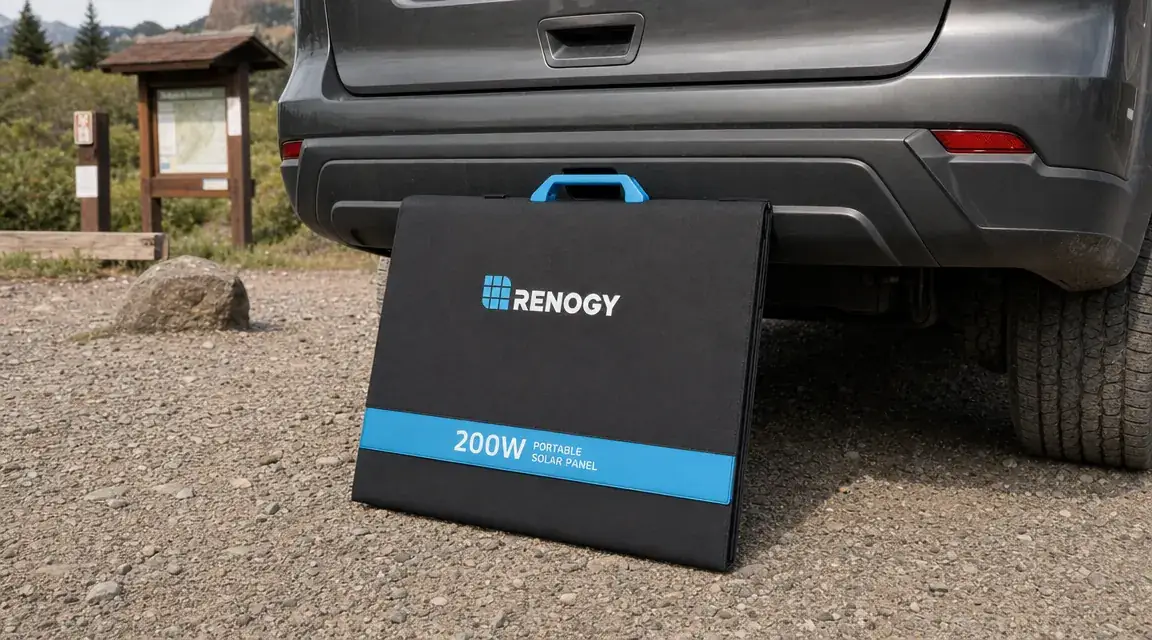
Renogy lists this panel at 16.1 lbs. My kitchen scale says 16.4 lbs. Either way, it is the heaviest thing in my truck camping kit by a significant margin, heavier than my sleeping bag, pad, and tent combined. When you are packing in, that weight matters. For truck camping, car camping, or RV use, it is a non-issue. For any trip where you carry your gear more than 50 feet from your vehicle, you will feel it.
Folded, the panel measures 22 by 20 by 1.5 inches. It fits flat in the bed of a standard pickup or upright in the back of a mid-size SUV. The carry handle is molded rubber and comfortable for short carries. Renogy includes a shoulder strap, which I have used exactly once. The panel is just heavy enough that the strap digs in after a couple hundred yards. If long carries are part of your plan, look at 100W panels instead.
The Kickstand Problem
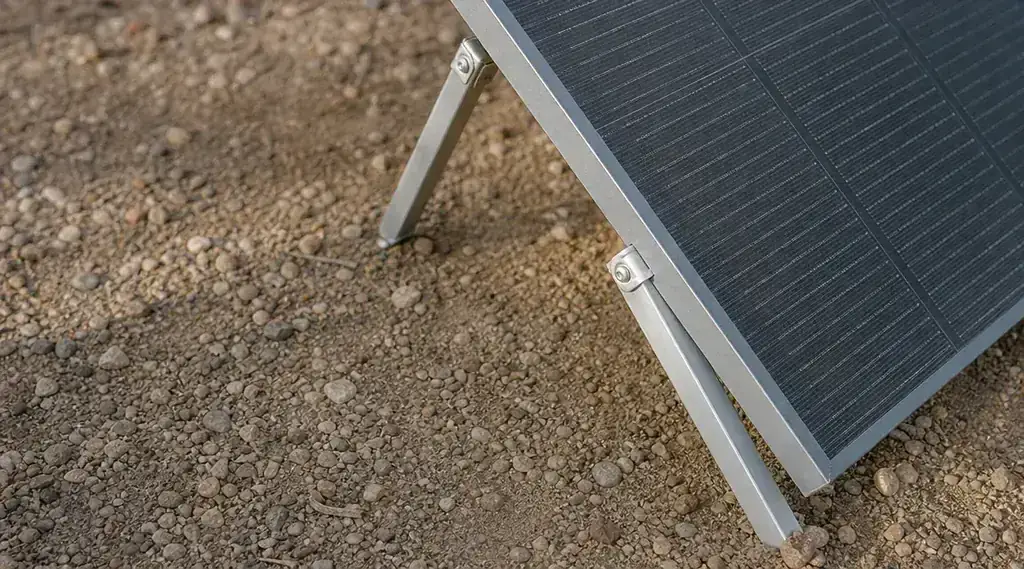
This is my biggest frustration with the panel. Renogy uses four aluminum kickstand legs, two on each half of the folded panel, that prop it up at a fixed angle. The idea is sound. The execution is fine on flat, compacted ground. On anything else, the legs wobble.
The legs slot into plastic brackets on the back of the panel and stay in place mostly by friction. They do not lock. On gravel, sand, or sloped ground, any breeze above about 10 mph will shift the panel. I have had it fall flat on calm days just from the weight distribution when the ground was slightly soft. The fix I use is a two-pound rock placed against the base of each leg. It works, but it is the kind of workaround that should not be necessary on a $221 panel.
The Jackery SolarSaga 200 uses a single kickstand with a locking hinge, and it feels more stable to me on imperfect surfaces. If you are setting up on a campsite with level pavement or a parking apron, the Renogy legs are fine. If you are pitching on typical mountain campsite ground, plan to weight them down.
The MC4 Cable Length Issue
The Renogy 200W ships with one MC4-to-MC4 cable that runs about 3.5 feet. That is just long enough to reach a power station placed directly next to the panel, which is the worst place to put your power station in full sun. Heat is the single biggest enemy of lithium battery longevity, and direct sun exposure on a power station can push the battery temperature up fast enough to trigger thermal management throttling or an automatic shutdown.
You want your power station in the shade of your vehicle, tent, or a tarp, which typically means 8 to 15 feet of cable run. The included cable does not cover that. I ordered a 10-foot MC4 extension cable from Renogy's own store for about $12. It solved the problem, but it should be in the box or at least sold as a bundle at checkout. Every setup guide recommends placing your station out of direct sun. The 3.5-foot cable makes that guidance nearly impossible to follow without a separate purchase.
Hinge and Build Quality After a Year
After roughly 60 fold/unfold cycles, the center hinge on my panel is still smooth and shows no play. The aluminum frame has a few scratches from campsite contact with rocks and gravel, but nothing structural. The corner moldings are intact. The junction box on the back of the panel, where the output cables emerge, has stayed watertight through two rain events and one light hailstorm.
The IP65 rating covers dust and low-pressure water jets from any direction. My rain tests were consistent with that. I would not submerge it or leave it in standing water, but the rating is accurate for what you actually encounter camping. One thing to watch: the Velcro strap that secures the folded panel degrades faster than everything else on the unit. Mine started fraying at the edges around month eight. It still holds, but I expect to replace it with a generic buckle strap in the next few months.
The cells themselves show no visible degradation. I ran a side-by-side output comparison in April 2026 against a fresh Renogy 200W at the same dealer's event, same angle, same time of day, and got 158W versus 162W. A 2.5% gap after 13 months of use is within measurement noise. No complaints on cell longevity so far.
What I Liked
- IP65 weatherproofing is real and has held up to field use including rain and hail
- Genuine MC4 output works with any MC4-compatible power station or charge controller, no proprietary adapter required
- Monocrystalline cells with solid output in direct sun, 160W-plus on clear summer afternoons
- Compact fold and reasonable carry handle for vehicle-based trips
- Hinge and frame feel robust after a year of real folding cycles
- Strong brand support and readily available replacement cables and adapters in the Renogy ecosystem
Where It Falls Short
- Included MC4 cable is only 3.5 feet, far too short for safe station placement out of direct sun
- Kickstand legs are friction-only with no locking mechanism, unstable on uneven or soft ground
- Cloud-day output can fall below 25W, making overcast recharging nearly impractical for large stations
- 16.4 lbs is heavy for a portable panel, not comfortable for any hike-in setup
- Cell temperature on hot days drives output down to the 140-155W range, well below the rated 200W
Who This Is For
You are a truck camper, RV owner, or overlander who wants genuine 150-plus watts of solar input on clear days and is willing to carry a 16-pound panel from your vehicle to a campsite. You already own or are buying a power station in the 500-1500Wh range and want to meaningfully cut your recharge time on sunny trips. You understand that solar is a fair-weather technology and you are not expecting it to bail you out on fully cloudy days. If you want to check on the current price, this is the Renogy 200W listing on Amazon.
Who Should Skip It
If you are buying a solar panel primarily for emergency power during Pacific Northwest winters or for cloud-heavy climates, a 200W foldable is going to disappoint you and you will spend a lot of money to get very little. Consider a higher-capacity power station with a wall adapter for grid-based recharging at home, and treat solar as a supplement. Also skip this specific panel if you camp on soft soil or sloped ground regularly and do not want to babysit the kickstand angle. And if weight matters at all, a 100W foldable panel at about 9 lbs is a meaningfully better carry for similar output on half your charging needs.
Solid panel with real IP65 protection and genuine MC4 output at a fair price
If you go in knowing the MC4 cable is short and the kickstands need weighting on soft ground, the Renogy 200W delivers what it promises on clear days. Check today's price on Amazon and read the current reviews.
Amazon Check Today's Price on Amazon →