
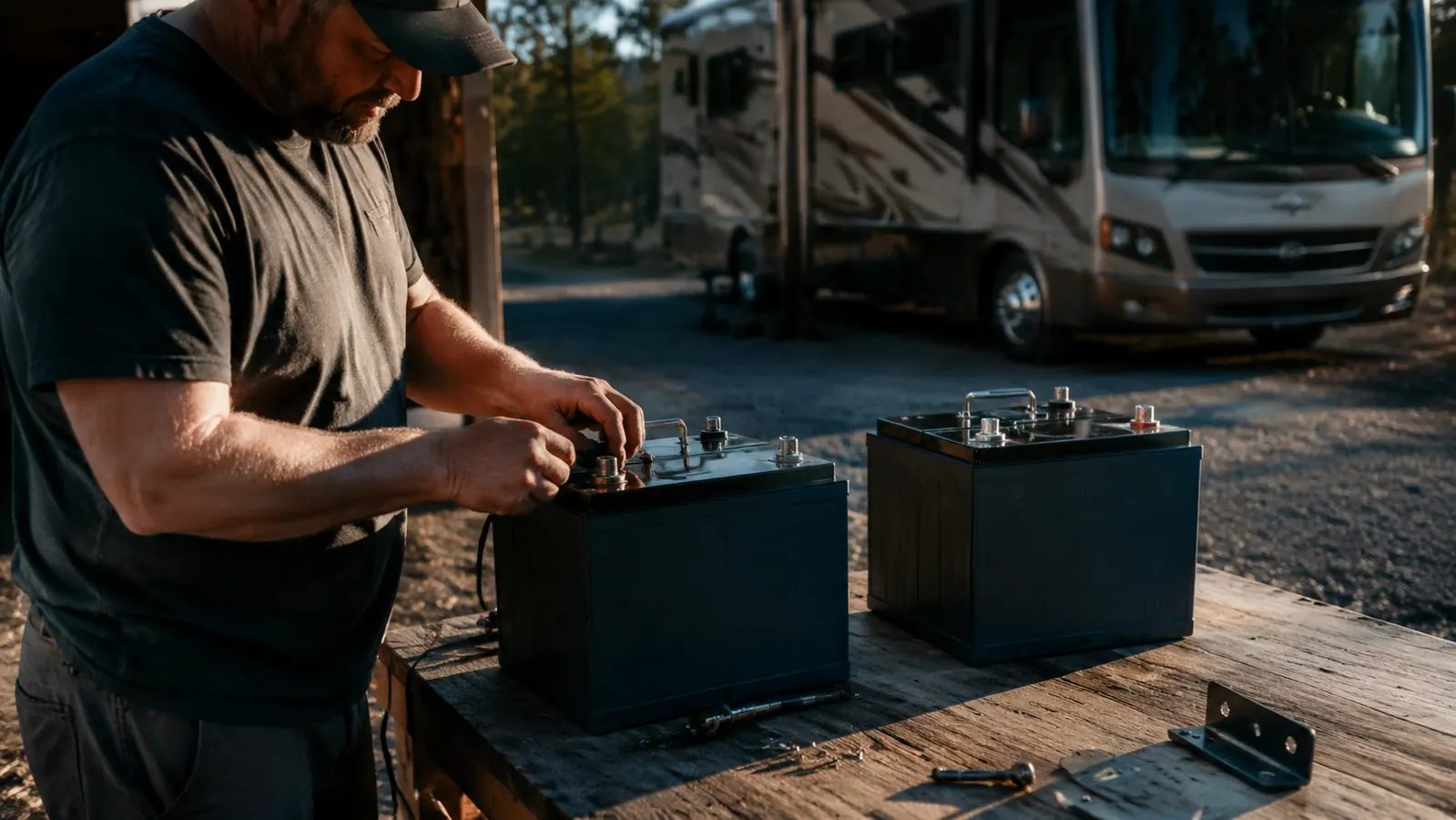
If you have been shopping for a 12V 100Ah LiFePO4 battery for your RV, cabin, or solar setup, you have almost certainly seen these two names at opposite ends of the price spectrum. The LiTime 12V 100Ah sits around $310. The Battle Born 100Ah runs roughly $900 depending on where you find it. That is nearly a $600 gap for what is, on paper, the same capacity and the same lithium iron phosphate chemistry. The question I kept asking myself before I pulled the trigger on LiTime two years ago: what exactly does the extra money buy you?
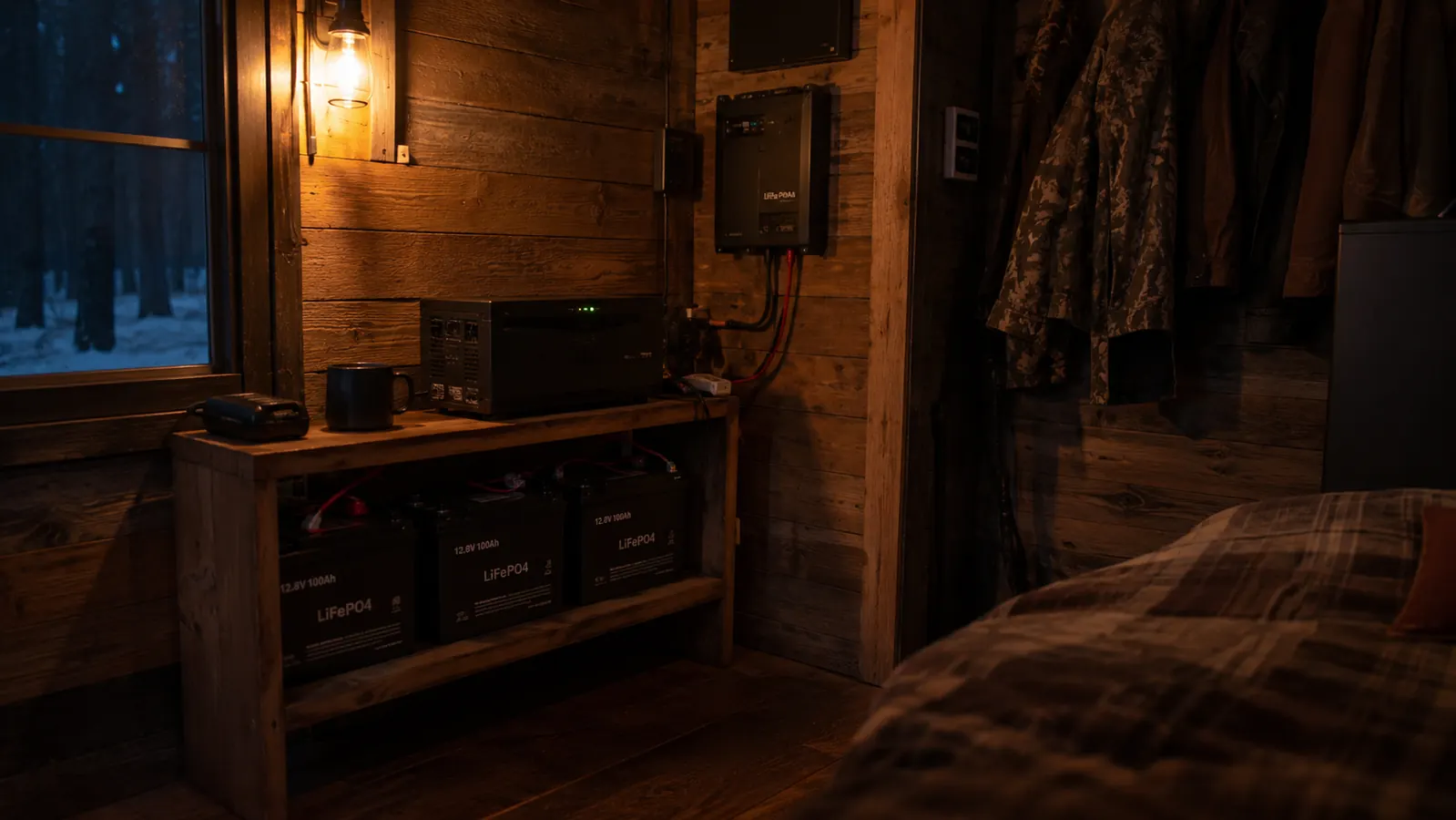
I am an ER nurse who runs solar setups on a 26-foot travel trailer and a small off-grid hunting cabin in central Florida. I put two LiTime 100Ah batteries to work in late 2024. One lives in the RV battery compartment paired with 200W of Renogy solar. The other is in a 400Ah bank at the cabin running lights, a fan, and occasional power tool charging. I have never owned a Battle Born personally, but I have read the spec sheets carefully, talked to RV park neighbors who run them, and tracked the community feedback on both products long enough to give you a grounded comparison. Here is what the numbers actually show.
| Price (approx.) | $309.99 | ~$899.00 |
| Capacity | 100Ah / 1280Wh | 100Ah / 1280Wh |
| Usable Capacity (at 100% DoD) | 100Ah | 100Ah |
| Chemistry | LiFePO4 | LiFePO4 |
| Cycle Life Claim | 15,000 cycles (100% DoD) | 3,000–5,000 cycles (80% DoD) |
| BMS | Built-in, 100A continuous | Built-in, 100A continuous |
| Cold-Charge Cutoff (BMS) | ~32°F / 0°C | ~25°F / -4°C |
| Weight | 26.5 lbs | 29 lbs |
| Dimensions (L×W×H in.) | 13 × 6.8 × 8.7 | 12.75 × 6.88 × 9 |
| Group Size | Group 31 | Group 27 |
| Bluetooth App | Yes (LiTime app) | No |
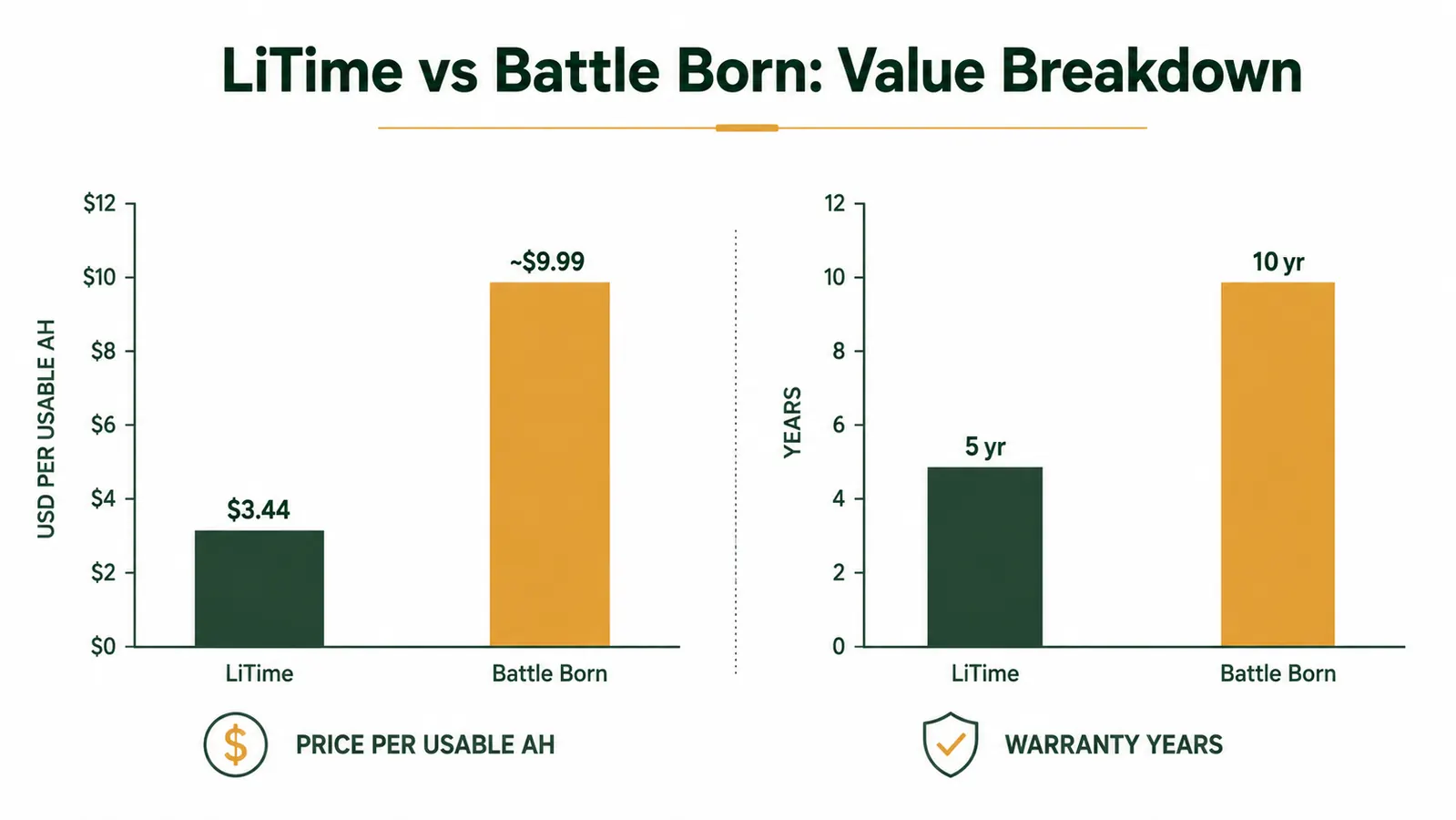
| Warranty | 5 years | 10 years |
| Made In | China | USA (assembled) |
| Amazon Rating | 4.5 / 5 (1,755 reviews) | Not sold on Amazon |
Where LiTime Wins
The most obvious win is price-per-usable-watt-hour. At $309.99 for 1,280Wh of usable capacity, you are paying roughly $0.24 per Wh. The Battle Born at $899 puts you at about $0.70 per Wh. That math matters a lot when you are building a bank. Two LiTimes gives you 200Ah for around $620. Two Battle Borns for the same capacity costs you roughly $1,800. If your goal is a 400Ah bank for a cabin or a full-time RV, the LiTime path saves you well over $2,000 for the same total capacity and the same chemistry.
The cycle-life spec is also worth reading carefully. LiTime claims 15,000 cycles at 100% depth of discharge down to around 80% capacity retention. Battle Born publishes 3,000 to 5,000 cycles at 80% DoD. Even accounting for the fact that real-world numbers rarely match spec-sheet claims, the LiTime number is significantly higher. For a typical RV user doing one full cycle per day, 15,000 cycles would last over 40 years. You will replace the RV before you replace the battery. Battle Born's 3,000 to 5,000 cycle claim is still very good compared to AGM, but it is not in the same league as what LiTime is publishing.
The built-in Bluetooth app is a genuine practical advantage for RV and cabin installs. I open the LiTime app on my phone and can see state of charge, voltage, current draw, and temperature without crawling into the battery bay. It is not the most polished app I have used, but it works reliably over about 20 feet and has saved me from running the bank too low on two separate camping trips when overcast weather cut into my solar production. Battle Born has no native app on their standard 100Ah model.
Same capacity, $590 less: check today's price on the LiTime 100Ah
The LiTime 12V 100Ah LiFePO4 (Group 31) has 4.5 stars across 1,755 reviews. It is the battery I installed in my RV and off-grid cabin. Current price and availability are on Amazon.
Amazon Check Today's Price on Amazon →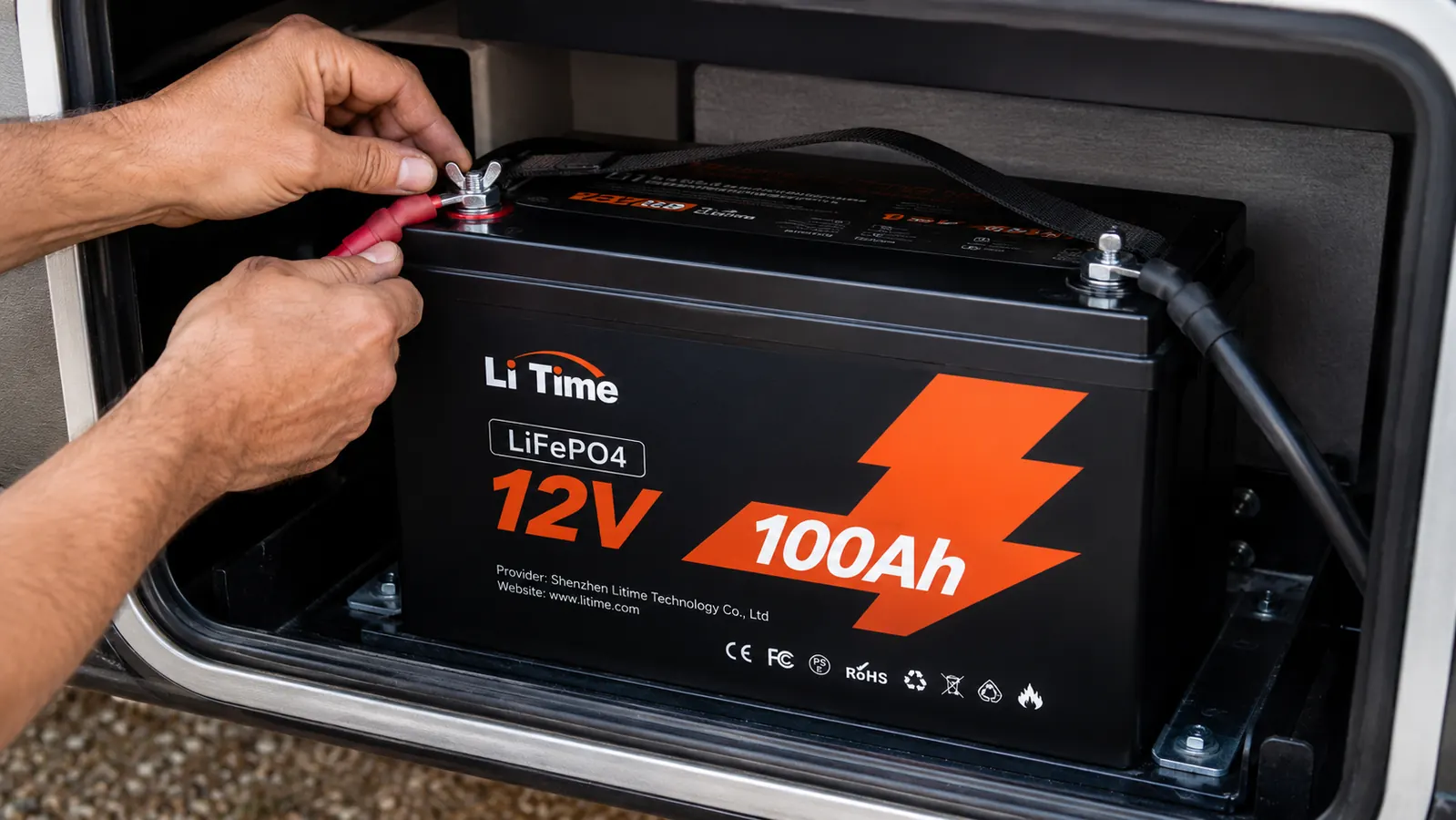
Where Battle Born Wins
The 10-year warranty is the clearest advantage Battle Born has over LiTime. LiTime covers the battery for five years. Battle Born doubles that. If you are a full-time RV liveaboard putting serious cycles on your bank every single day, that extended coverage is real insurance. Battery failures are uncommon with either brand, but when a failure does happen at year seven or eight, Battle Born owners have recourse. LiTime owners are on their own at that point.
Cold-charge cutoff is the other area where Battle Born has a marginal edge. The LiTime BMS locks out charging at approximately 32 degrees Fahrenheit, meaning if your battery bay drops to freezing overnight, your solar or shore power charger will not be able to push current into the cells until things warm up. Battle Born's BMS allows charging down to around 25 degrees. In practice this is a narrow edge, four or five degrees of margin in truly cold climates. But if you are camping in the Rockies in October and your battery bay is not insulated, those few degrees can be the difference between your panel being able to top you off in the morning or not.
Battle Born's US assembly is meaningful to some buyers from a supply-chain and customer-service standpoint. Their support team is US-based and has a strong reputation in the van-life and RV community for actually picking up the phone. LiTime's support is responsive over email but the experience is not identical. If long-term relationship with a domestic company matters to you, that is a real factor.
Two LiTime 100Ah batteries have given me 25 months of trouble-free cycling in conditions ranging from 95-degree Florida summers to 28-degree hunting weekends in north Georgia. I have not touched either battery since installation.
BMS Behavior: What the Spec Sheet Does Not Fully Explain
Both batteries have a built-in BMS rated at 100A continuous current. What the spec sheets do not spell out clearly is how each BMS handles short-duration high-current events, like starting an inverter with a large capacitive load. My LiTime cells have handled 600W inverter startup loads without tripping, which tells me the BMS has some headroom above its continuous rating. Several Battle Born owners have reported the same experience with brief surge draws. For typical RV and cabin loads, such as a compressor fridge, LED lights, a laptop, and a fan, neither battery is going to trip its BMS under normal conditions.
One area where I have heard occasional complaints about LiTime is the balancing behavior at the top of charge. A small number of users have reported cell imbalance developing after a year or two of cycling, showing up as the BMS cutting off charge early. In my two batteries I have not seen this, but I do run a proper 14.6V absorption stage on my charger rather than a flat 14.4V float, which may help keep the cells balanced. If you are running a generic charger with a fixed voltage profile, check that it is actually hitting the LiFePO4 absorption voltage.
Physical Fit: Group 31 vs Group 27
This is worth checking before you order. The LiTime 12V 100Ah is a Group 31 form factor at 13 inches long, 6.8 inches wide, and 8.7 inches tall. Battle Born's 100Ah is a Group 27 at 12.75 by 6.88 by 9 inches. The dimensional differences are small but real. If you are dropping a battery into a dedicated RV battery tray that was built for a Group 24 or Group 27, the LiTime may not fit without modification. Measure your bay before ordering. Both batteries use standard SAE terminals, so connections are not an issue.
Who Should Buy Which
Buy the LiTime 100Ah if you are building a new bank for an RV, cabin, solar shed, or trolling motor setup and your primary goal is the most amp-hours per dollar. The five-year warranty is sufficient for most users, the Bluetooth app adds genuine day-to-day utility, and the cycle-life spec gives you confidence the battery will outlast your system. At $309.99 with over 1,700 Amazon reviews backing it up, it is the straightforward pick for 90% of buyers in this category.
Consider Battle Born if you are a full-time RV liveaboard putting 300 to 365 cycles per year on your bank and you want the 10-year warranty as a backstop. Or if you are camping in consistently cold conditions where a few extra degrees of cold-charge margin matter. Or if you simply want the peace of mind that comes with a US-based company with a strong support reputation and you are willing to pay roughly three times the price for it. Those are legitimate reasons. They are just not the right reasons for most people who are shopping this category.
For off-grid cabins and seasonal RV users, the LiTime math is hard to argue with. The money you save on the battery bank can go toward a better MPPT charge controller, a second solar panel, or a proper inverter-charger, all of which will have a bigger impact on your system's daily performance than the brand name on the battery.
The LiTime 100Ah is what I run. Here is where to check current price.
LiTime 12V 100Ah Group 31 LiFePO4 with built-in BMS and Bluetooth app. Ships Prime. Check Amazon for today's price and any available coupons.
Amazon Check Today's Price on Amazon →