

I made the switch from AGM to LiFePO4 in my RV about two years ago. I had been running two Group 31 AGMs in parallel, 200Ah nominal, and I was genuinely annoyed at how little of that capacity I could actually use without killing the batteries. A buddy on a camping trip pulled out a single LiTime 12V 100Ah LiFePO4, ran his fridge, fan, and lights all night, and woke up with 45 percent left. I went home and did the math. The batteries were replaced the following month.
If you are still on AGM and you run any kind of regular 12V load, the ten points below are the practical reasons the chemistry switch matters. I am not selling you on the most expensive option. The LiTime 12V 100Ah has 4.5 stars across 1,755 Amazon reviews and sits at a price point that is actually competitive with quality AGM. That is the battery I use and the one I reference throughout.
Still draining your AGM down to 50 percent and calling it full? There is a better way.
The LiTime 12V 100Ah LiFePO4 gives you 80Ah of usable capacity from a 100Ah pack, weighs 26 lbs, and is rated for up to 15,000 cycles. Over 1,755 verified Amazon reviews.
Amazon Check Today's Price on Amazon -> →You Get 80 Percent Usable Capacity Instead of 50 Percent
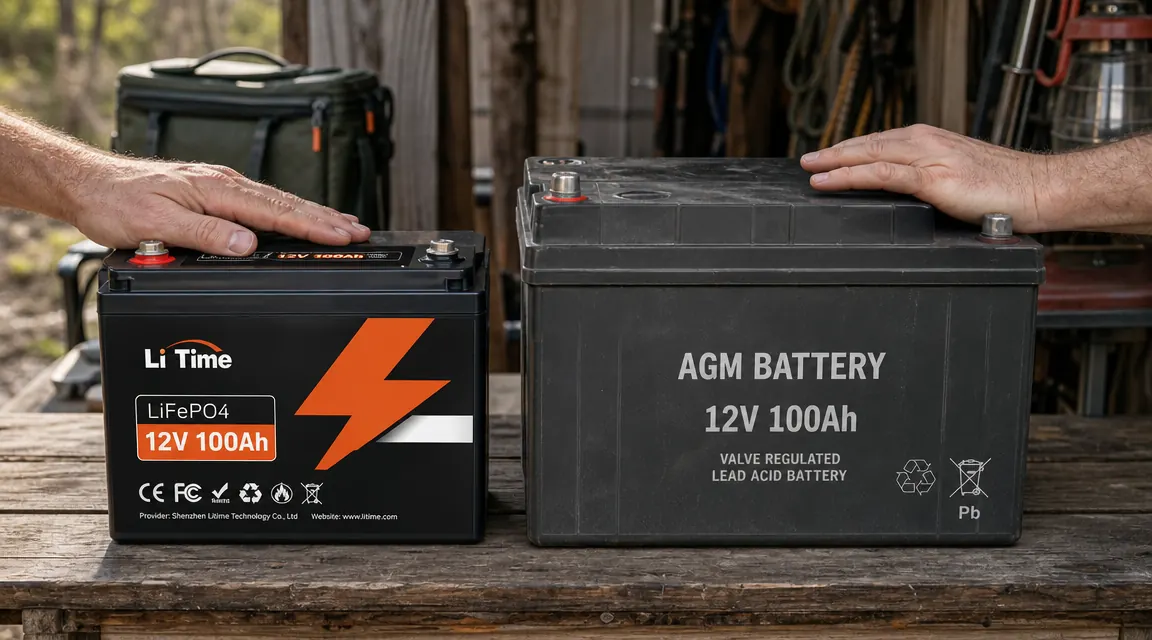
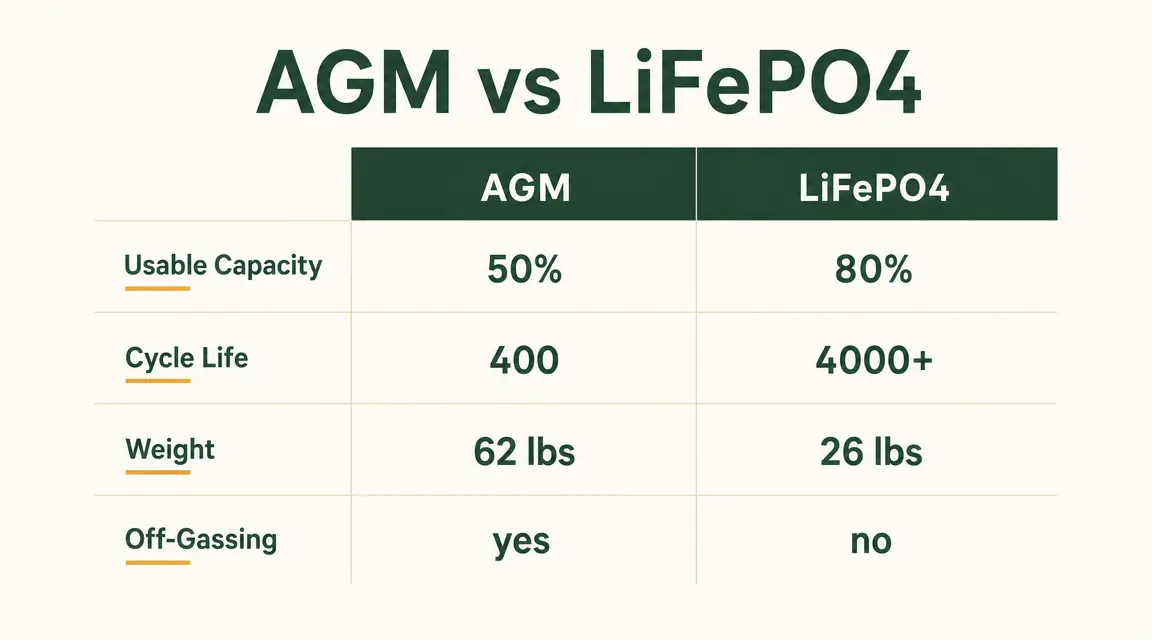
A 100Ah AGM has a practical usable depth of 50Ah before you risk shortening its life. The same nominal capacity in LiFePO4 gives you 80Ah safely. On the LiTime 100Ah that means 80 real amp-hours versus 50. If you are running a 12V compressor fridge at 4A average, that is an extra five hours of runtime per charge cycle from the same battery size. For an RV or cabin, that gap adds up fast.
Cycle Life Is Not Even Close
A decent AGM gives you 400 to 600 cycles at 50 percent depth of discharge before capacity drops below 80 percent of rated. LiTime rates their 100Ah LiFePO4 at up to 15,000 cycles at 80 percent DoD. Even discounting that figure to 4,000 real-world cycles, you are looking at ten times the longevity. If you cycle your battery bank once a day on a long trip, the math on total cost per cycle swings decisively toward lithium.
The Weight Difference Is Significant in an RV
A Group 31 AGM weighs around 60 to 65 lbs. The LiTime 12V 100Ah LiFePO4 weighs 26 lbs. If you run two batteries in parallel for a 200Ah bank, that is roughly 120 lbs of AGM versus 52 lbs of LiFePO4. In a Class B or C RV where every pound affects handling and fuel economy, cutting 68 lbs from one compartment is a real number. In a portable cabin setup, carrying one battery to a remote site becomes an actual option.
Charge Acceptance Rate Is Much Higher
AGM batteries taper their charge acceptance as they fill, so a standard 40A charger is not delivering 40A for most of the charge cycle. LiFePO4 accepts a full charge current through most of the cycle and only tapers near the top. With the LiTime 100Ah, a 40A charger can bring you from 20 percent to 95 percent in about two hours. Paired with solar panels or a shore power hookup, you refill the bank faster and spend less time waiting before you can run loads again.
No Off-Gassing Means You Can Install It Anywhere
Charging AGM in an enclosed space produces hydrogen gas. RV manufacturers account for this with ventilation requirements for battery compartments. LiFePO4 does not off-gas during normal charging. That means you can mount the LiTime 100Ah inside a cabin, under a bench seat, or in a locker without building in ventilation. It also removes one safety concern in a small living space.
I went from pulling 50Ah out of a 100Ah AGM and feeling guilty about it, to pulling 80Ah from the LiTime and having charge capacity to spare at the end of a full day of camping loads. That is not a marginal upgrade.
Flat Voltage Discharge Curve Means Consistent Performance
AGM voltage sags as the battery discharges, which means your inverter, charge controller, or load device sees a variable input voltage from 12.7V fully charged down to 11.8V before low-voltage cutoff. LiFePO4 holds near 13.2V through most of the discharge cycle and only drops sharply at the very end. Inverters run more efficiently, DC loads get cleaner power, and you get a more reliable state-of-charge reading from a basic voltmeter.
The Built-In BMS Handles What AGM Relies on You to Prevent
AGM has no internal protection. Overdischarge it past 11.7V repeatedly and you have shortened its life significantly, sometimes permanently. The LiTime 100Ah includes a battery management system that monitors cell voltage, temperature, and current, and cuts off before damage occurs. Overdischarge protection, overcharge protection, short circuit protection, and thermal cutoff are all handled internally. One less thing to configure in a system.
Cold Storage Performance Is Better
AGM loses significant capacity in cold temperatures. At 32F a typical AGM delivers 70 to 80 percent of rated capacity. LiFePO4 is not immune to cold discharge losses, but the drop is smaller and more predictable. The LiTime 100Ah specifies a discharge temperature range down to negative four degrees Fahrenheit. For winter camping or an unheated cabin in the Pacific Northwest, that operating range is wider than most AGM alternatives at the same price point.
It Fits the Same Group 31 Battery Box You Already Have
The LiTime 12V 100Ah is a Group 31 form factor: 13.0 x 6.8 x 8.7 inches. If your RV or cabin system was already running Group 31 AGM batteries, the LiTime drops into the same tray, uses the same cable terminals, and connects to your existing charger (provided your charger has a lithium or LiFePO4 charge profile, which most units made after 2018 do). There is no rewiring, no new battery box, no fabrication.
The Per-Cycle Cost Math Favors LiFePO4 Over Any Multi-Year Horizon
A quality Group 31 AGM runs about $200 to $240. At 500 real cycles, that is $0.40 to $0.48 per cycle. The LiTime 12V 100Ah currently sits around $310. At a conservative 4,000 cycles, that is $0.078 per cycle, five to six times cheaper per cycle. If you cycle the battery pack 150 times a year between camping trips and emergency use, the AGM needs replacing in roughly three years. The LiTime is still in its first quarter of rated life at that point.
What I Would Skip
If you use a battery a few times a year for car camping and leave it in storage most of the time, the case for switching is weaker. LiFePO4 cells do not like sitting fully charged or fully discharged for long periods without cycling, and the upfront cost is harder to justify for a battery that sees 20 cycles a year. For that use case, a good deep-cycle AGM like an Optima Blue Top or Interstate DCM0100 still makes sense. But if you are running a camp fridge, a CPAP, or any regular 12V draw more than 50 nights a year, the AGM is costing you money and capacity every season.
The per-cycle math is the argument nobody makes in the battery aisle, but it is the one that matters most once you are buying your second or third AGM in six years.
Ready to stop replacing AGM banks every three years? The LiTime 100Ah is where most RV and cabin builders start.
Group 31 form factor. 26 lbs. Built-in BMS. Rated for up to 15,000 cycles. Compatible with any charger that has a LiFePO4 profile. Check current pricing and availability on Amazon before you commit to another AGM.
Amazon Check Today's Price on Amazon -> →