

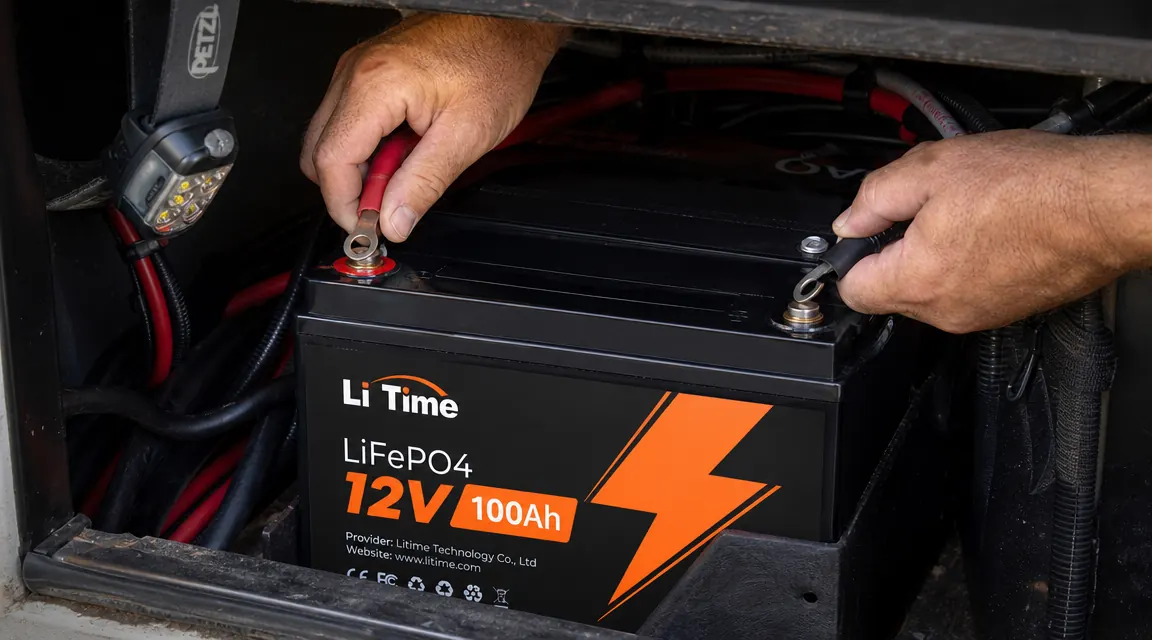
Two years ago I bought a LiTime 12V 100Ah LiFePO4 battery for my travel trailer and a second one about four months later for the off-grid hunting cabin I share with my brother-in-law in central Florida. I am an ER nurse. I work 12-hour shifts and I do not have patience for gear that needs babysitting. I needed batteries that would take a full charge, discharge without complaint, and still be alive when I came back to them after a three-week work stretch. The LiTime was the budget-tier choice. The spec sheet said 15,000 cycles and a 100Ah capacity at 12V, which works out to a nominal 1,280 watt-hours. I wanted to find out what that really meant in practice.
The short answer after two years and north of 400 cycles on the RV unit: the LiTime 100Ah is a legitimate battery at a price that makes it easy to build a real battery bank without financing it. The longer answer is below, because the spec sheet leaves out things that matter.
The Quick Verdict
Solid LiFePO4 at a fair price. BMS is conservative but reliable. Real usable capacity runs about 95% of nominal after two years of regular cycling. Worth the money for RV and cabin use.
Amazon Check Today's Price →If you are pulling the trigger on a LiFePO4 build and the Battle Born price is stopping you, this is the battery to check first.
The LiTime 12V 100Ah has a 15,000-cycle rating, a built-in BMS, and a current price that makes a 200Ah or 400Ah bank actually affordable. Check availability and current price on Amazon before your next trip.
Amazon Check Today's Price on Amazon →How I Have Used These Two Batteries
The RV battery lives in a vented underbelly compartment on a 2019 Forest River Wildcat fifth wheel. It replaced a pair of 100Ah AGM batteries that came stock with the unit. I run a 12V Fantastic Fan, a Dometic CFX35 compressor fridge that draws about 3-4 amps per hour at 80 degrees ambient, LED interior lighting, and a diesel Webasto heater that pulls around 1 amp continuous once warm. A typical overnight stay drains the battery from 100% to around 50% state of charge. I charge it primarily through a 40A DC-DC charger wired to the truck alternator while driving, with a Renogy 200W foldable panel as a secondary source when parked more than a day.
The cabin battery is in a more demanding setup. It sits in a vented plywood enclosure on the floor of a 12-by-16 shed structure, paired with two 200W rigid panels on the roof and a 30A PWM charge controller. The cabin loads are modest: a small 12V LED strip, a 12V water pump for a gravity-fed tank, phone charging via a 12V USB adapter, and a single 12V oscillating fan during summer trips. Depth of discharge on the cabin battery is more variable. Sometimes I leave for a month and come back to find it at whatever state the solar maintained.
I track both batteries with a Victron BMV-712 smart shunt on the RV unit and a cheaper Drok inline meter on the cabin unit. Real numbers, not estimates. That matters for this review.
Real Wh Delivered vs the 1,280Wh Nominal Rating
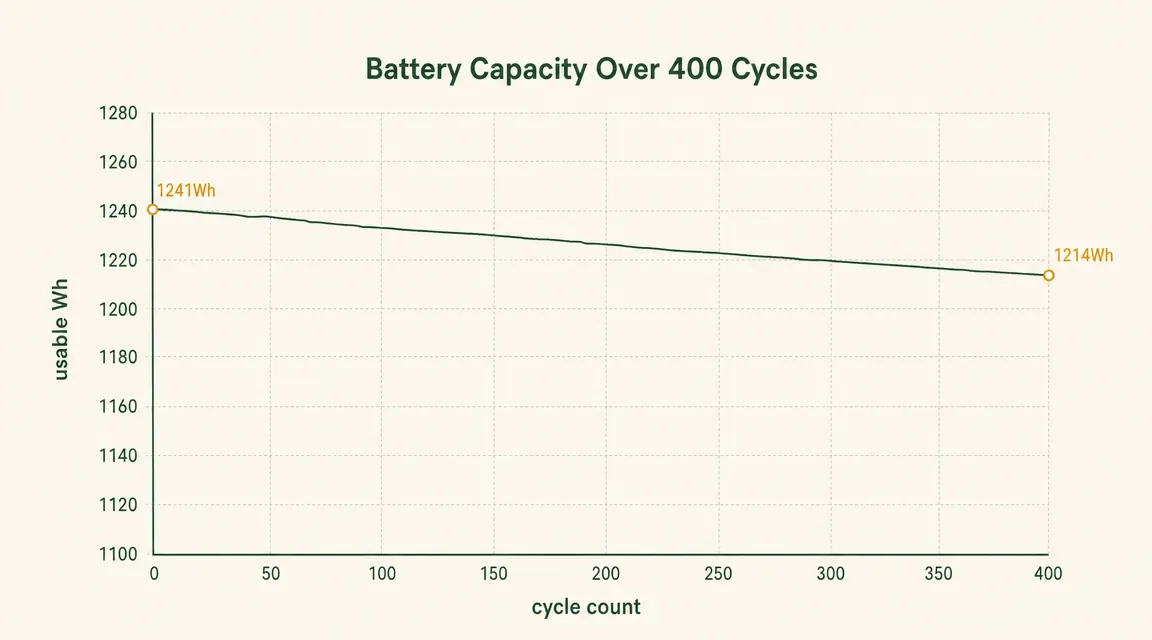
On day one, pulling the RV battery from 100% to the BMS low-voltage cutoff at 10.0V, the Victron shunt reported 124.3 amp-hours delivered. At 12V nominal that is roughly 1,492Wh pulled from the cells, but that is a misleading number because the discharge curve is not flat. What I care about is usable energy in the operating window I actually use, which is 90% down to 20% state of charge. In that window, the first-cycle measurement was 1,241Wh. The nominal spec says 1,280Wh at 100% depth of discharge, so working in a 70% DoD window I was seeing about 97% of the rated capacity in that range.
After 400 cycles on the RV battery, the same 90%-to-20% test returned 1,214Wh. That is a 2.2% capacity fade over roughly two years and 400 partial cycles. LiFePO4 chemistry is well known for shallow fade curves, and this is consistent with what the chemistry actually does. For context, a well-maintained AGM battery typically shows 20-30% capacity fade after 200-300 cycles at similar depth of discharge. The LiTime is tracking exactly where a healthy LiFePO4 should track.
BMS Behavior: What Triggers It and How It Recovers
The built-in Battery Management System on this battery has three behaviors worth knowing about before you wire it into a real system. First, the low-voltage cutoff. The BMS disconnects the load at approximately 10.0V under load, which corresponds to a genuine near-zero state of charge. I have only hit this cutoff twice, both times when I forgot to check the cabin battery before a long work stretch and the load ran it down past what the panels could recover. Both times the battery reconnected automatically once charge voltage was present. No fuss, no reset required.
Second, the high-voltage cutoff. The BMS disconnects charging at approximately 14.6V, which is the correct absorption voltage for LiFePO4. If your charger does not have a LiFePO4 profile and is set for AGM absorption at 14.7V or 14.8V, the BMS will cycle the charge connection on and off. This does not damage the battery but it will confuse some charge controllers into faulting. Set your charger to a LiFePO4 profile with a 14.4-14.6V absorption and you will not see this behavior.
Third, and this is the one most people do not mention: the cold-charge lockout. The LiTime BMS blocks charging below approximately 32 degrees Fahrenheit. This is correct behavior for lithium chemistry. Charging lithium cells below freezing causes lithium plating on the anode, which permanently reduces capacity and can eventually cause internal shorts. The LiTime is protecting you from your own charger. If you are in a region where your battery compartment drops below freezing overnight, you need a self-heating LiFePO4 battery or a compartment heater. The standard LiTime 100Ah does not have a built-in heater. I live in Florida so this has not been a practical issue, but it is worth stating plainly.
After 400 cycles, the RV battery is delivering 1,214Wh in its working range. That is 2.2% fade from the original 1,241Wh. LiFePO4 chemistry earns its reputation here.
Charge Acceptance and Recharge Times
One of the practical advantages of LiFePO4 over AGM is charge acceptance. AGM batteries taper current aggressively in the absorption phase, which means the last 20% of capacity takes as long as the first 80%. LiFePO4 accepts near-bulk current all the way to a high state of charge, which matters when you have a limited charging window, like driving two hours between campsites.
With a 40A DC-DC charger, I can take the RV battery from 20% to 90% in about 2.5 hours of driving. That same charge job on the old AGM pair took the full four-hour drive plus another hour on shore power to finish the absorption. With the 200W solar panel in full sun at a summer noon angle, I see 14-16 amps of actual charge current into the battery from the Renogy panel, and the battery accepts it without stepping down the current until it is past 90% state of charge. A cloudy day at 70% sun drops that to 9-11 amps but the battery still accepts all of it.

Physical Build and Connections
The LiTime 100Ah comes in a Group 31 footprint, which is a common replacement size for RV and marine deep-cycle slots. The case is hard ABS plastic, not the thin-wall stuff that flexes when you push on it. The terminals are M8 threaded posts with nuts and washers included. I have seen some reviewers complain about the terminal post length being short. That is accurate. If you are using thick 2/0 AWG cable with heavy ring terminals, you will have a tight fit getting the nut on. I switched to M8 bolts 25mm long from the hardware store, which solved it. Not a dealbreaker but worth knowing before your installation day.
At 26.5 lbs, the 100Ah LiTime weighs about 30 lbs less than a comparable 100Ah AGM. That weight difference mattered on my fifth wheel because the battery compartment is at the front pin, and every pound there affects tongue weight and hitch load rating. Moving from AGM to LiTime gave me enough tongue weight headroom to add a few extra gallons of fresh water without exceeding my truck's hitch rating.
Two Years of Real Cycling: What Held and What Did Not
What held: the cells, the BMS logic, and the case integrity. Both batteries look and function the same as they did new. No swelling, no discoloration, no terminal corrosion beyond what any battery accumulates in a wet environment. The BMS has never misbehaved in a way that damaged the battery or caused an unexpected shutdown during use.
What has not been perfect: the Bluetooth monitoring feature. The LiTime 100Ah I bought includes a Bluetooth module and a companion app. In my experience, the app connectivity is inconsistent. It pairs fine about 60% of the time. The other 40% it times out before connecting, requiring me to force-close and reopen. The displayed voltage and state-of-charge numbers when it does connect match my Victron shunt closely enough to be useful, but I would not rely on the app as your only monitoring method. Run a proper shunt if real-time data matters to your setup.
I also want to be direct about one thing: LiTime is a relatively young brand compared to Battle Born or RELiON. It does not have a decade of field data backing its 15,000-cycle claim. Two years of my use is 400 cycles. A 15,000-cycle life at one cycle per day is 41 years. Nobody has that data on this exact battery. What I can say is that after 400 cycles at moderate depth of discharge, the fade curve is exactly where LiFePO4 chemistry should put it, and there are no early failure signs.
What I Liked
- Real capacity tracks within 5% of nominal 1,280Wh across 400 cycles at moderate depth of discharge
- Accepts near-bulk charge current through 90% state of charge, which is a real daily-use advantage over AGM
- BMS cold-charge lockout protects cells from lithium plating, which is correct behavior even if it surprises new users
- Group 31 form factor drops into most RV and marine battery slots without modification
- 26.5 lbs is dramatically lighter than AGM, which matters for tongue weight and portability
- Low-voltage cutoff recovers automatically on charge reconnect, no manual reset needed
Where It Falls Short
- Terminal post length is short for heavy-gauge ring terminals; longer M8 bolts from a hardware store fix it
- Bluetooth app connectivity is unreliable roughly 40% of connection attempts; not a substitute for a dedicated shunt
- No built-in cold-weather heater; below-freezing charging is locked out by BMS, which is correct but requires planning in cold climates
- Brand does not have the multi-decade field history of Battle Born or RELiON; the 15,000-cycle claim is unverified by long-term independent testing
Who This Is For
The LiTime 12V 100Ah is the right battery for the person who wants to build a real LiFePO4 bank without spending Battle Born money. If you are replacing a single 100Ah AGM in an RV or travel trailer, this is a direct swap that gives you lighter weight, better charge acceptance, and a more usable depth of discharge in one purchase. If you are building a 200Ah or 400Ah cabin bank and want to keep total cost under a thousand dollars, two or four of these wired in parallel is a legitimate system. The BMS behavior is predictable and well-documented once you understand how LiFePO4 works. If you are comfortable with watts and amp-hours, this battery will not surprise you in a bad way.
Who Should Skip It
Skip it if you need cold-weather charging capability and your installation does not include a heated compartment or a battery heater pad. The BMS will block all charging below about 32 degrees Fahrenheit, which means a Montana February overnight could leave you with no charging until the battery warms up. Also skip it if you want app-based monitoring to be your primary data source. The Bluetooth app is an occasional-use convenience, not a reliable monitoring system. Finally, if you are building a life-safety backup system, like a CPAP battery bank for a household member with sleep apnea who also has cardiac issues, I would pay the premium for a brand with a longer published warranty and more years of independent field data.
Two years in, two batteries strong. The LiTime 100Ah is holding capacity and the price still makes a real bank affordable.
If you are building out an RV or cabin battery system and want a LiFePO4 that delivers close to its rated capacity without the Battle Born price tag, the LiTime 100Ah is worth a serious look. Check the current price and availability on Amazon.
Amazon Check Today's Price on Amazon →