
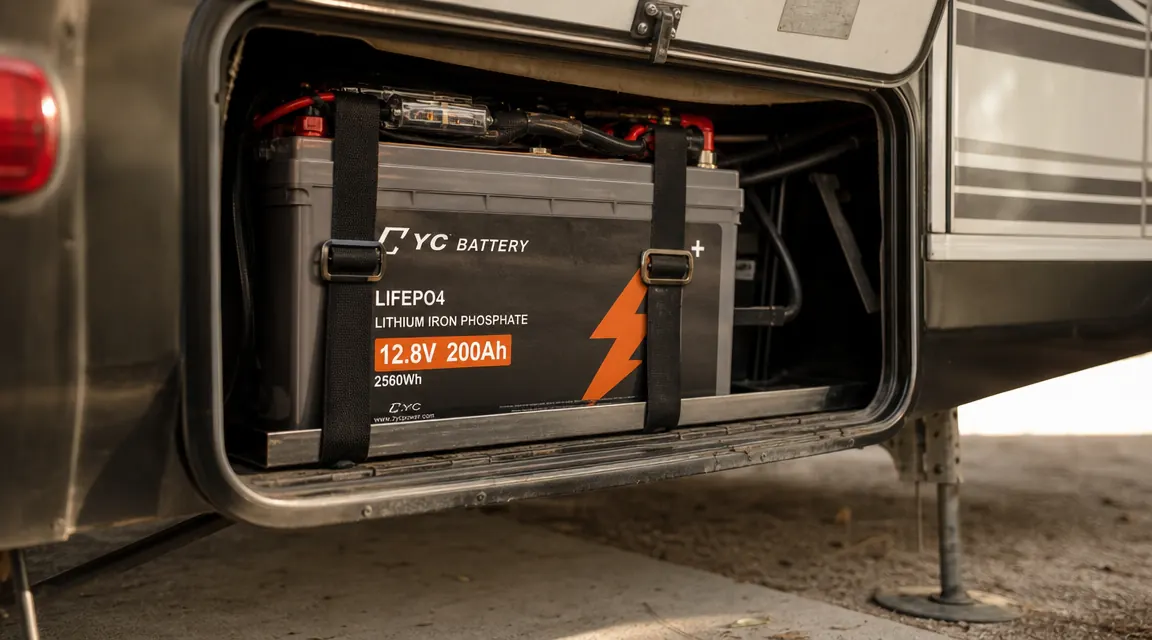
I bought my first LiTime 12V 100Ah battery in early 2024 for the battery bay of my travel trailer. I added a second one to my off-grid hunting cabin six months later. Between the two installs I have run these cells through somewhere north of 400 charge cycles, across temperatures ranging from 28 degrees Fahrenheit on a February overnight to 97 degrees sitting in a south-facing cabin on a July afternoon. I know this battery pretty well at this point. What I want to do here is cover the things the product page and the YouTube unboxing videos do not tell you, because several of those things surprised me and a couple of them almost cost me a weekend trip.
This is not the same article as my long-term use review. That one covers installation, capacity retention over two years, and why I chose LiTime over a premium brand like Battle Born. This one covers the edge cases, the BMS behavior nobody warns you about, the terminal hardware situation, and what it actually means that this specific SKU has no Bluetooth or app. If you are deciding whether to buy a LiTime 100Ah, read both. If you only have time for one, read this one.
The Quick Verdict
Solid LiFePO4 chemistry at a price that makes sense, but the BMS low-temp lockout is stricter than competitors and the lack of Bluetooth on this SKU is a real blind spot for anyone who wants to monitor state of charge remotely.
Amazon Check Today's Price →If cold mornings or remote monitoring matter to your setup, read the full review before you order.
The LiTime 100Ah is legitimately good at the right price point. But two specific quirks will frustrate you if you do not know about them going in. Current price on Amazon below.
Amazon Check Today's Price on Amazon →How I Have Actually Used This Battery
RV install: the battery sits in the standard Group 31 battery tray on my 2019 Lance 1995 travel trailer. I replaced a pair of flooded lead-acid 6V batteries wired in series. The LiTime runs a single 12V system: a 10-cubic-foot propane-electric refrigerator on 12V DC mode, a Fantastic Fan roof vent, LED lighting, a water pump, and a 300W Renogy inverter for phone and laptop charging. On a typical three-night camping trip without solar I draw the battery from roughly 100% down to about 40% state of charge across the trip. That is about 60 usable amp-hours, consistent with a healthy 100Ah LiFePO4 cell at 80% depth of discharge.
Cabin install: four LiTime 100Ah batteries wired in a 2P2S configuration for a 24V 200Ah bank. Two Renogy 200W panels feed a Renogy Wanderer 30A PWM charge controller. The cabin runs LED lighting, a small 12V water pump, and occasional power tool charging via a 1000W inverter. Hunting season runs October through December in my part of the country, which means the bank regularly sees overnight lows in the 30s and occasional dips below freezing. That is where the trouble started.

The BMS Low-Temperature Cutoff: What the Spec Sheet Buries
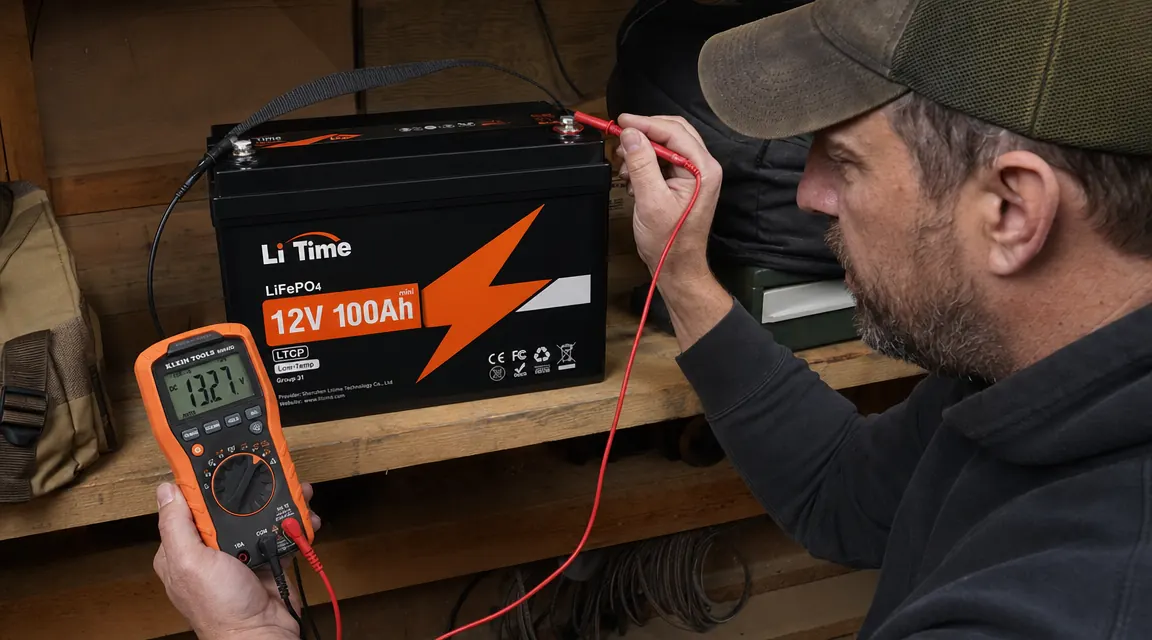
LiFePO4 batteries cannot accept a charge below freezing without risking lithium plating on the anode, which permanently damages the cell. Every LiFePO4 battery on the market includes a Battery Management System that cuts off charging when cell temperature drops too low. That part is not a defect. What surprised me with the LiTime is where that cutoff is set and how aggressively the BMS enforces it.
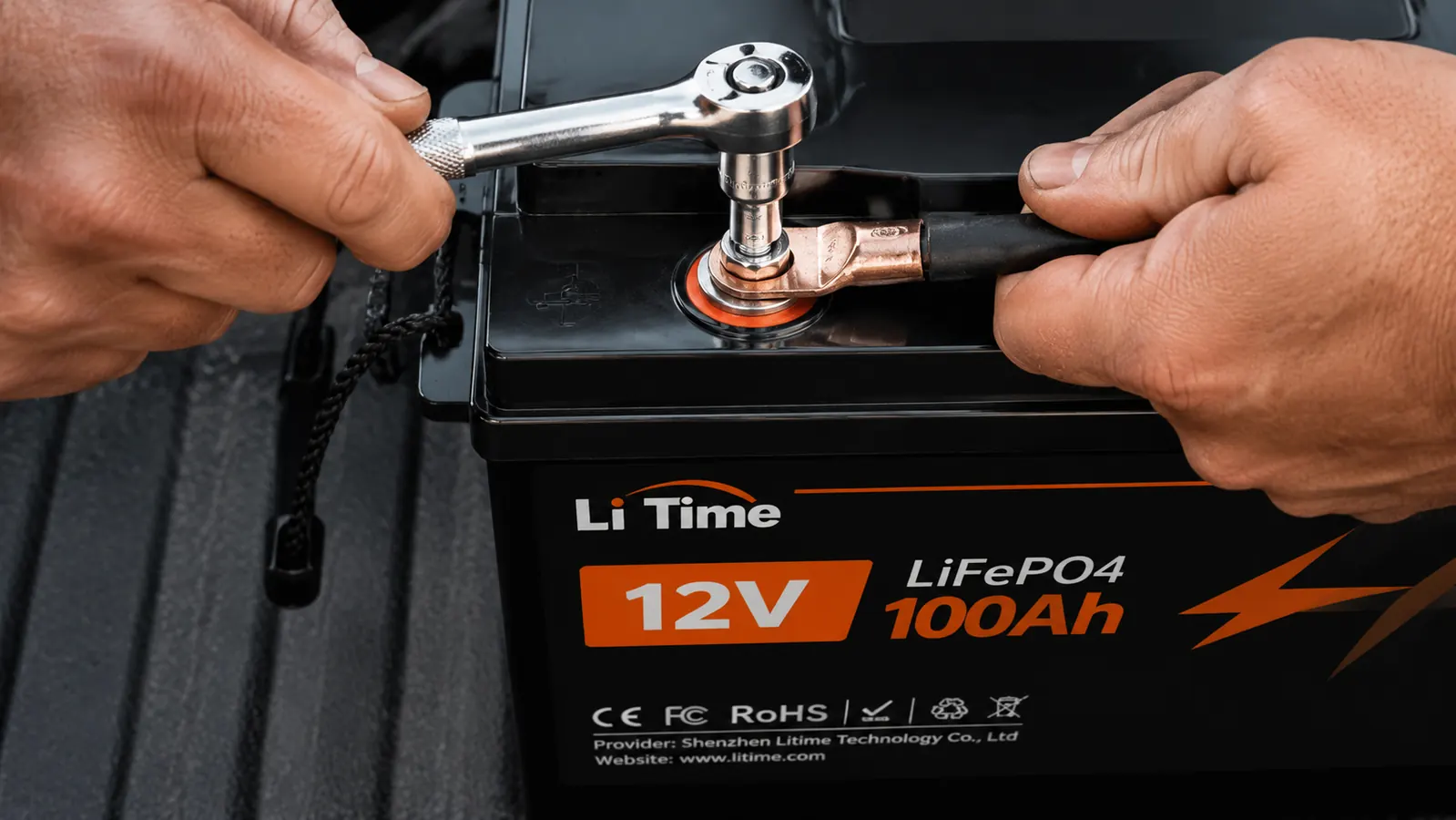
LiTime's published low-temperature charge cutoff is 32 degrees Fahrenheit (0 Celsius). In practice, I found the BMS was refusing charge inputs at measured battery case temperatures of about 34-35 degrees, which suggests the internal cell temp probe is running a few degrees cooler than the case surface. On two separate October mornings at the cabin, my solar charge controller showed a healthy 14.4V absorption voltage from the panels but the battery was not accepting any current. The controller was not faulted. The battery simply was not charging. I confirmed this with a clamp meter on the charge wire: zero amps in, despite the panel producing 8+ amps at the controller output.
The fix was simple once I understood it: I installed a cheap foam insulation wrap around the battery, and on mornings where the overnight low had been below 40 degrees, I started a small propane heater inside the battery cabinet for about 20 minutes before the sun came up. Once the battery case temperature was above 40 degrees, the BMS opened and charging proceeded normally. But if you are automating a remote cabin setup and expecting your solar to top off the battery bank every morning regardless of temperature, know that the LiTime BMS will silently block that below its threshold. There will be no alarm, no error code, and no notification. Your battery just will not charge.
Some competitors handle this better. Battle Born uses a self-heating BMS on several of their models that draws a small amount of energy from the battery itself to warm the cells before accepting a charge input. LiTime does not offer that on the standard 100Ah. If you are in a climate where overnight temps regularly drop below 35 degrees and your battery is uninsulated, budget for either a heating pad, insulation, or both.
Terminal Lugs: The Hardware Situation Nobody Covers
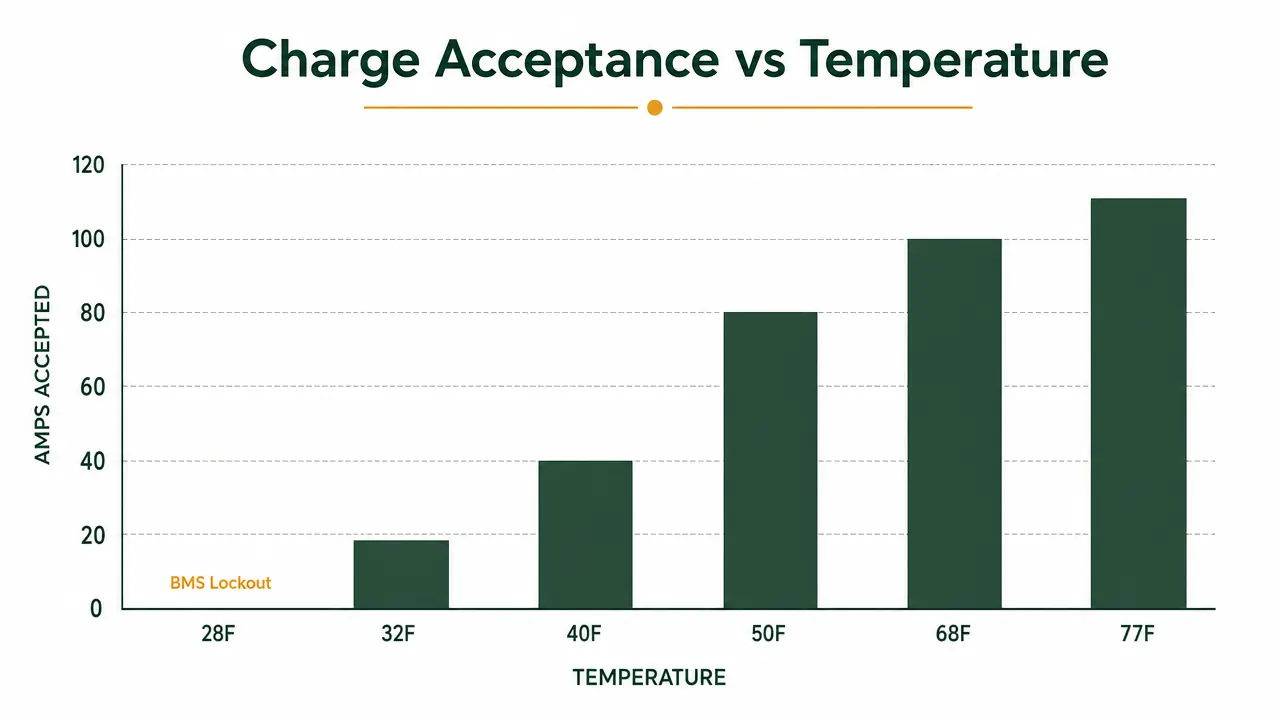
The LiTime 100Ah uses M8 threaded terminal posts. That is a good choice for a battery in this class, and it should be compatible with most battery lugs rated for 4 AWG through 2/0 AWG cable. The issue is that a significant number of ring terminal lugs sold in hardware stores and even at well-known marine and RV supply shops use a slightly smaller or non-standard bore that does not slide cleanly over the M8 post.
When I built the cabin bank, I ordered a set of tinned copper ring terminals from a popular marine supplier. The 5/16-inch bore terminals I had on hand were too tight to seat flush on the terminal post. The M8 post diameter is approximately 8mm, which converts to roughly 0.315 inches. Most 5/16-inch (0.3125 inch) lug bores are slightly undersized and require forcing. I ended up ordering 3/8-inch bore terminals (0.375 inch), which seat cleanly and torque down without binding. If you are wiring a new install, order 3/8-inch bore ring terminals from the start. It will save you a parts run.
The supplied hardware in the box is a set of M8 bolts and washers, which are fine for a basic install. For a high-current setup with heavy welding cable or 2/0 AWG, use a proper torque wrench and target 10 to 12 foot-pounds. I have seen people over-torque these terminals and crack the plastic terminal cover. The cover is cosmetic but a cracked one is also a potential short hazard if conductive debris gets in there.
Real-World Charge Acceptance vs. the Rated Numbers
LiTime rates this battery for a maximum charge current of 50A. In my RV install with a 30A MPPT controller and a 20A converter charger, I have never pushed anywhere near that ceiling, so I cannot speak to whether it actually accepts 50A cleanly. What I can tell you is charge acceptance at more typical rates and in varying conditions.
At 20A charge current from my MPPT controller, the battery accepts charge smoothly from bulk through absorption. Bulk charging from 30% to around 80% state of charge is fast and consistent, roughly 0.7 hours to cover 50 amp-hours at that rate, which is essentially what the math says it should be. The slowdown starts in the top 20%, which is normal for LiFePO4. Absorption from 80% to 95% takes noticeably longer than the first 50% of the charge curve, which is chemistry, not a defect. If you expect to charge from 30% to 100% every morning, plan for 4 to 5 hours at 20A.
One thing I did notice: charge acceptance in warm weather (above 70 degrees Fahrenheit) is visibly better than in the 40-to-50-degree range. At 45 degrees, the battery often enters a de-rated acceptance mode where the BMS appears to cap incoming current below what the controller is trying to push. This is protective behavior and it is normal, but it means your solar charging math needs a cold-weather buffer. A system sized to top off the battery in 5 hours on a warm fall day might need 7 hours at the same solar input when temps are in the low 40s.
A system sized to top off the battery in 5 hours on a warm fall day might need 7 hours at the same solar input when temps are in the low 40s. That gap matters if your cabin runs on a single day of solar harvest.
No Bluetooth, No App: What You Are Actually Missing
LiTime does make LiFePO4 batteries with Bluetooth connectivity and a companion app. This 100Ah Group 31 SKU (ASIN B084DB36KW) is not one of them. There is no Bluetooth radio in this battery. You will not find a pairing mode. If you search for the LiTime app and wonder why it shows no battery, that is why.
For my RV install, this has not been a problem. I added a Victron SmartShunt between the battery negative terminal and the ground bus. The SmartShunt tracks state of charge, voltage, current in and out, and cumulative amp-hours consumed. It communicates over Bluetooth to my phone via the Victron Connect app. I can check the battery status from inside the trailer without walking out to the battery bay. The SmartShunt cost me about $70 and it works better than any battery-integrated Bluetooth I have used because it stays calibrated over time through coulomb counting rather than relying on voltage curves.
For the cabin bank, I have a Renogy BT-2 Bluetooth module on the charge controller, which gives me panel input, battery voltage, and a rough state-of-charge estimate from the controller's perspective. It is not as accurate as a dedicated shunt, but it is enough to tell me whether the bank is charging and approximately how full it is. The point is: the absence of built-in Bluetooth on this battery is workable if you budget $50 to $100 for an external shunt or module. It is not workable if you expect to buy the battery, plug it in, and monitor it from your phone with zero additional hardware.
If remote monitoring matters to you and you do not want to wire in an external shunt, LiTime's 100Ah with Bluetooth is a different SKU and runs about $50 more. Look for the Bluetooth-specific listing. The hardware is similar but the BMS board includes the radio module.
About That 15,000-Cycle Claim
LiTime advertises up to 15,000 cycles on this battery. I want to be honest about what that number means for a typical buyer. 15,000 cycles is a laboratory figure achieved at a specific charge rate, a specific depth of discharge, and a specific temperature, typically around 0.2C charge rate, 80% depth of discharge, and 25 Celsius. Real-world use at higher charge rates, deeper discharges, or temperature extremes will land you at a lower number.
For context: if you cycle the battery once per day, 15,000 cycles is 41 years. Nobody is keeping a battery for 41 years. A more realistic benchmark is the cycle life at which the battery retains 80% of its original capacity, which LiTime puts at around 4,000 cycles for this model. At one cycle per day, that is 11 years. At three cycles per week, it is about 26 years. The point is, you will probably sell your RV before this battery fails from cycle fatigue. The more realistic failure modes are a BMS fault, a connection problem, or physical damage, not cell wear.
What I Liked
- Genuine LiFePO4 chemistry with no memory effect and minimal self-discharge
- Group 31 form factor fits standard AGM battery trays in most RVs and marine applications
- Solid capacity retention after 400-plus real cycles in my two installs
- Competitive price per usable amp-hour versus premium brands
- BMS handles overvoltage, undervoltage, short circuit, and overcurrent protection reliably
- Internal resistance stays low enough to support high-current loads without significant voltage sag
Where It Falls Short
- BMS low-temp charge cutoff engages at or slightly above 32F, which blocks solar charging on cold mornings without insulation or heating
- No Bluetooth or app on this SKU; external monitoring hardware required if you want state-of-charge data
- M8 terminal posts require 3/8-inch bore ring lugs, not the more common 5/16-inch lugs sold at most hardware stores
- No self-heating capability, so cold-weather installs need additional thermal management
- Warranty service requires shipping the battery back, which is logistically painful for a 31-pound box
One Thing That Actually Surprised Me in a Good Way
I expected the BMS to be the weak link after reading a handful of one-star Amazon reviews where buyers described sudden shutdowns and batteries that went dead and would not recover. In two years and 400-plus cycles I have had zero BMS faults. The battery has never gone into lockdown from an over-discharge event. I have taken it down to 10.8V once, which is below the typical 11.4V cutoff I use as a floor, and the BMS cut the load cleanly, the battery rested for a few hours, and it recovered to a normal voltage and accepted a full charge with no issues.
The one-star reviews I mentioned often describe scenarios where the buyer tried to charge a deeply discharged battery with a standard lead-acid charger. Most lead-acid chargers will not initiate a charge cycle if the battery voltage is below about 10V, because they assume a dead lead-acid battery at that voltage is sulfated and not worth charging. The LiTime BMS may also enter a sleep mode below a certain voltage threshold. If you end up in that situation, the fix is to apply a small constant-current charge directly to the terminals for a few minutes to wake the BMS before using a normal charger. LiTime's support team confirmed this when I asked, and it works.
Who This Battery Is For
The LiTime 100Ah makes the most sense for someone replacing AGM batteries in a travel trailer, fifth wheel, or off-grid shed setup in a mild to moderate climate, who is comfortable wiring in an external battery monitor and understands that cold-weather charging requires some planning. It is a good battery at a fair price, and it will outlast most AGM alternatives by a significant margin in normal use. The people who are happiest with it are the ones who treat it as competent budget hardware rather than set-it-and-forget-it premium hardware.
Who Should Skip It
If you are setting up an unattended off-grid system in a northern climate where the battery will regularly sit at freezing temperatures without insulation, this SKU will leave you wondering why your panels are not charging the bank. Look at batteries with integrated self-heating BMS, or budget for a heating pad and an insulated enclosure. If you want to pull up your phone and see battery percentage the way you check your phone battery, you will need either a different LiTime SKU with Bluetooth or an external shunt. And if you are buying this to replace a starting battery in a vehicle, do not. LiFePO4 cells are not designed for the high cold-cranking-amp demands of engine starting. This is a deep-cycle battery for sustained low-to-medium current draw.
Two years in, I would buy this battery again, with the same two caveats I outlined above.
Cold-weather charging requires planning, and you will need a separate monitor for state-of-charge visibility. If your setup accounts for those two things, the LiTime 100Ah delivers more usable amp-hours per dollar than anything else in its class. Check the current price on Amazon before you decide.
Amazon Check Today's Price on Amazon →