

I have made this mistake twice. Once in my RV and once in my off-grid hunting cabin. Both times I bought a battery based on a forum post, hooked everything up, and watched the state-of-charge drop well before I expected. The RV battery ran out at 2 a.m. when my CPAP shut off. The cabin bank died on day two of a three-day trip. The fix was not a bigger battery. The fix was doing the math first. This guide walks through exactly how I size a LiFePO4 bank now, from a blank piece of paper to a purchase decision. The primary battery I use as my baseline is the LiTime 12V 100Ah LiFePO4, ASIN B084DB36KW, because 1200 usable watt-hours at a sensible price point makes it an easy building block. But the math applies to any lithium battery you are considering.
There are five steps. None of them require an electrical engineering degree. You need a notepad, a phone calculator, and about twenty minutes.
If your current battery is not lasting the night, the math below will tell you exactly why.
The LiTime 12V 100Ah LiFePO4 is the building block I use for most RV and cabin systems. 4.5 stars from over 1,700 buyers. Check today's price before running your numbers.
Amazon Check Today's Price on Amazon →Step 1: Run a Complete Daily Load Audit in Watt-Hours
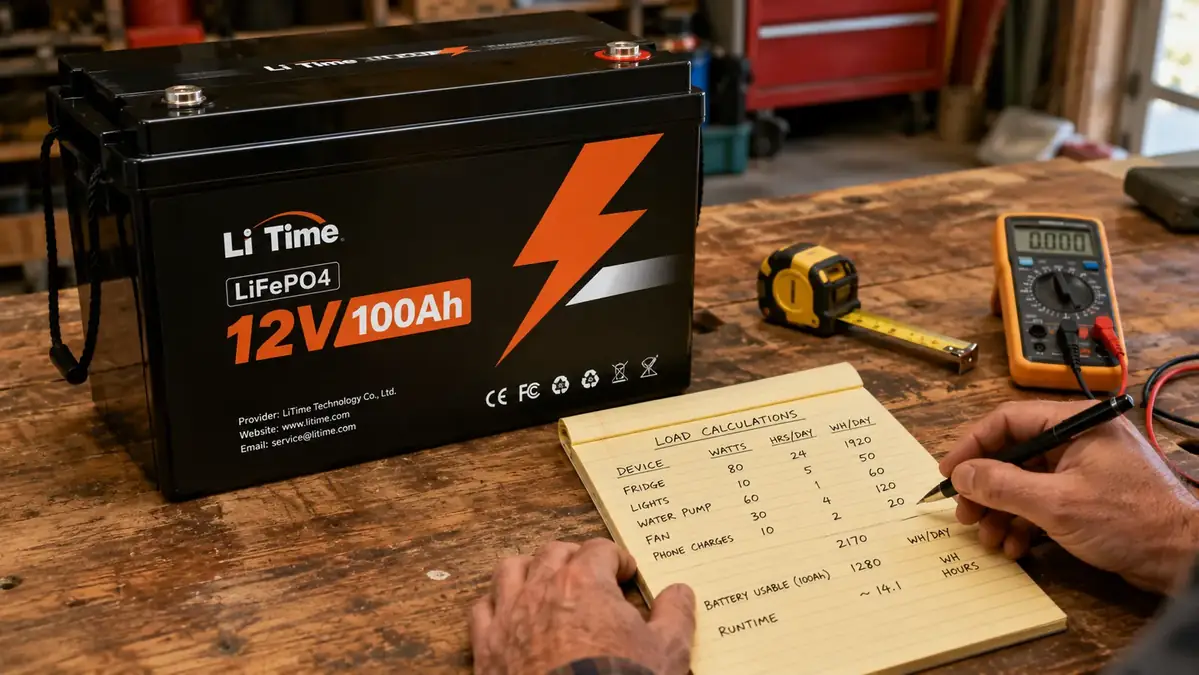
Write down every device you plan to run off battery power. For each device, find two numbers: watts (how hard it draws) and hours per day (how long it runs). Multiply those together to get watt-hours per day for that device. Add every device's watt-hours together for your daily total.
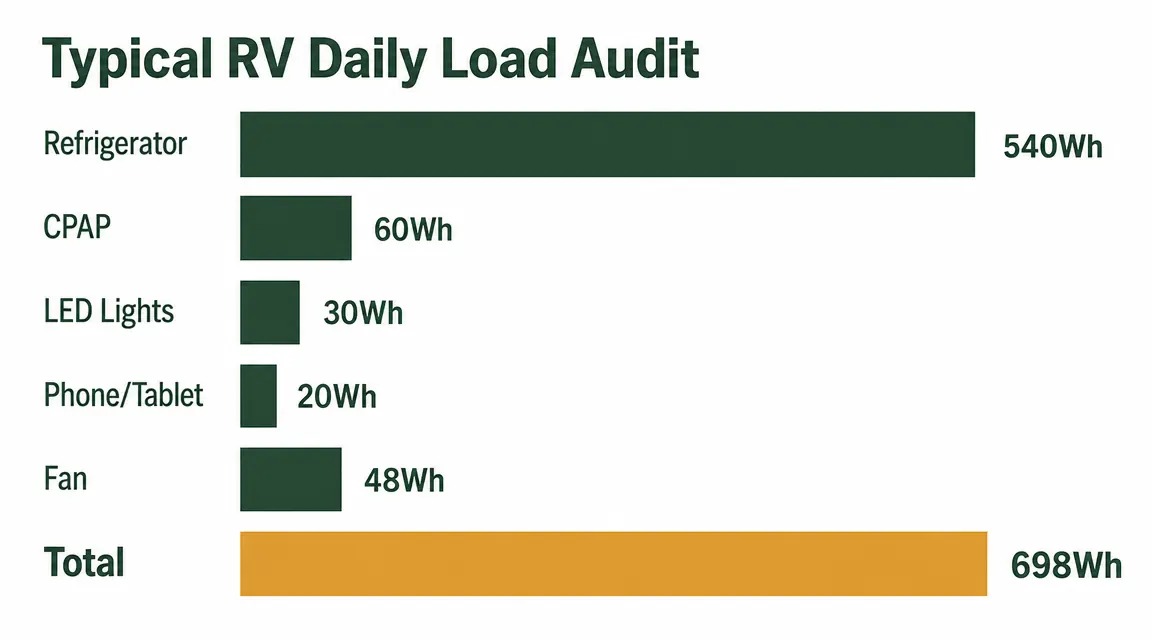
Here is what a real RV load audit looks like for me. A 12V compressor refrigerator running 50 percent duty cycle: 45 watts times 12 hours equals 540 Wh. A CPAP machine on lowest pressure, no humidifier: 30 watts times 8 hours equals 240 Wh. Four LED lights at 10 watts each, three hours per night: 40 watts times 3 hours equals 120 Wh. A 12V fan running all night: 6 watts times 8 hours equals 48 Wh. Phone and tablet charging: roughly 20 Wh. That totals 968 Wh per day. A small laptop adds another 60-90 Wh on top. Most RV setups I have seen fall between 600 and 1,200 Wh per day. A weekend cabin with a few lights, a small fan, and phone charging is usually 300 to 500 Wh per day.
A note on the refrigerator: it is almost always the single largest load and the one people underestimate most. A 12V compressor fridge rated at 45 watts does not run continuously. Duty cycle depends on ambient temperature and how often you open it. I use 50 percent as a conservative estimate. If you are camping in 90-degree heat, use 60 percent.
Step 2: Apply a Depth-of-Discharge Factor
LiFePO4 chemistry can technically be discharged to 100 percent of its rated capacity without immediate damage. But regularly discharging to zero still shortens cycle life. My personal rule, and the rule LiTime uses in their own sizing guidance, is to plan for 80 percent depth of discharge. That means if you buy a 100Ah battery at 12 volts, you are working with 960 Wh of usable energy, not 1200 Wh.
Some people push to 90 percent without issue. I stay at 80 percent because it preserves more of those 15,000 rated cycles and gives me a buffer when it is cloudy and I am not fully recharging each day. The math is straightforward: your daily load in watt-hours divided by 0.80 equals the minimum battery capacity you need in watt-hours. If your load is 968 Wh per day, you need at least 1,210 Wh of nameplate capacity. One 100Ah battery at 12V gives you 1,200 Wh nameplate, which is close but not quite enough for a single day with no buffer.
The math is not complicated. Daily load in watt-hours, divided by 0.80, tells you the minimum nameplate capacity you need before you ever think about days of autonomy.
Step 3: Multiply by Your Days of Autonomy
Days of autonomy means: how many days can you run without recharging at all? For an RV with solar panels, one or two days of autonomy is usually fine. If it is cloudy for three days, you are stuck regardless of battery size. For a cabin with no solar and no generator, you want to size for the full trip length plus one extra day.
The formula: (daily load in Wh divided by 0.80) times days of autonomy equals total watt-hours of nameplate capacity needed. For my RV running 968 Wh per day and wanting two days of autonomy: (968 divided by 0.80) times 2 equals 2,420 Wh. At 12 volts that is 201.7 Ah of capacity needed. Two LiTime 100Ah batteries wired in parallel gives 200Ah, which is essentially a match. For a cabin with a 400 Wh per day load and a three-day trip: (400 divided by 0.80) times 3 equals 1,500 Wh, or 125Ah at 12V. One 100Ah LiFePO4 battery almost covers it. Two covers it with comfortable margin.
If you have solar, subtract the expected daily solar harvest from your daily load before running this math. Two 200W panels in full sun produce roughly 800-1,000 Wh on a clear day. That can offset most of your load, reducing the battery capacity you need to store. Just do not count on full sun every day in your sizing calculation.
Step 4: Decide Between Parallel and Series Wiring
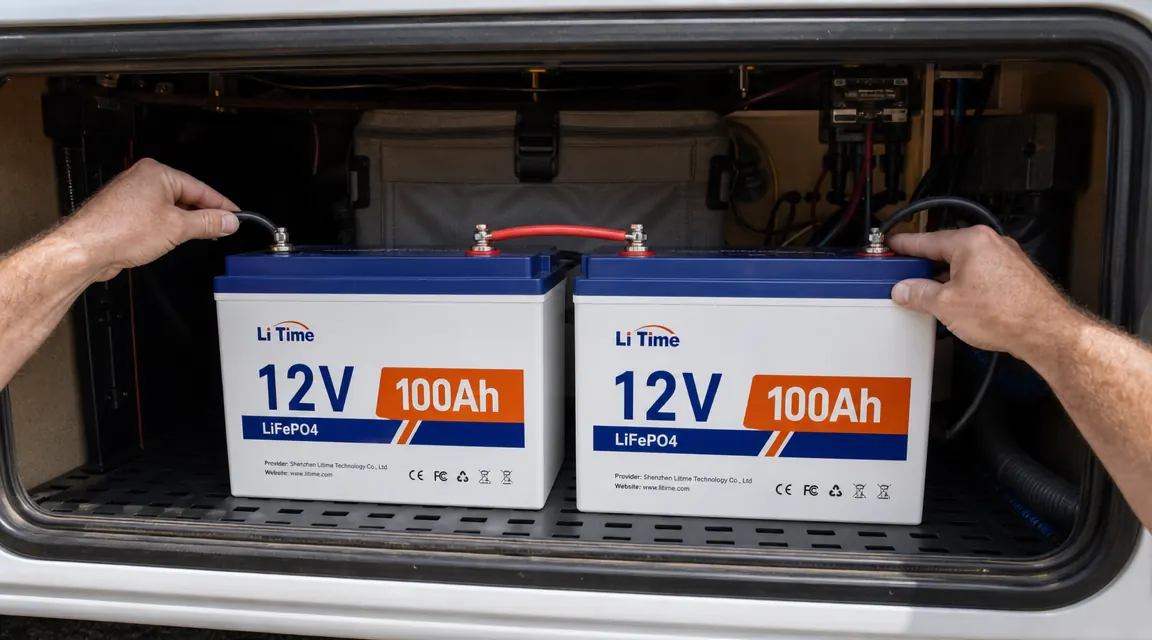
Once you know how many watt-hours you need, you have to decide how to get there. Most RV and cabin systems run at 12V. To add capacity at 12V, you wire batteries in parallel: positive to positive, negative to negative. Two 100Ah batteries in parallel give you 200Ah at 12V. Three give you 300Ah. The voltage stays at 12V throughout. This is the most common setup for RV house banks because all the components, inverters, charge controllers, DC loads, are already sized for 12V.
Series wiring doubles the voltage, not the capacity. Two 12V 100Ah batteries in series give you 24V at 100Ah. This is used when you have a 24V inverter or a 24V solar charge controller. The advantage is lower current for the same power, which means thinner wire and less heat. If you are running a 24V system, series makes sense. If you are running a 12V system, stick with parallel. Never mix series and parallel unless you know exactly what you are doing and have a battery management system designed for it.
One practical note on parallel banks: use the same battery model, the same age, and ideally batteries from the same batch. Mixing an old battery with a new one can cause the new one to carry disproportionate load and shorten its life. The LiTime 100Ah batteries I run in my RV are both from the same Amazon order, same production date. Two years in, state-of-charge readings between them stay within two percent of each other.
Step 5: Convert to Amp-Hours and Pick Your Battery Count
The final step is converting your watt-hour target into amp-hours at your system voltage, then dividing by the battery you want to use. The formula: watt-hours divided by volts equals amp-hours. At 12V, 2,400 Wh divided by 12 equals 200Ah. Two LiTime 100Ah batteries in parallel covers it exactly. At 12V, 1,500 Wh divided by 12 equals 125Ah. Two LiTime 100Ah batteries in parallel gives 200Ah, which is more than you need, but that margin is not wasted. More usable capacity means you discharge less deeply on average, which extends cycle life significantly.
For most RV and cabin systems I have worked with, the answer lands between one and four 100Ah batteries. A simple weekend camper with minimal loads can get by on one. A full-time liveaboard with a big fridge, inverter loads, and a CPAP needs three or four. The math always tells you where you land. Do not guess.
What Else Helps
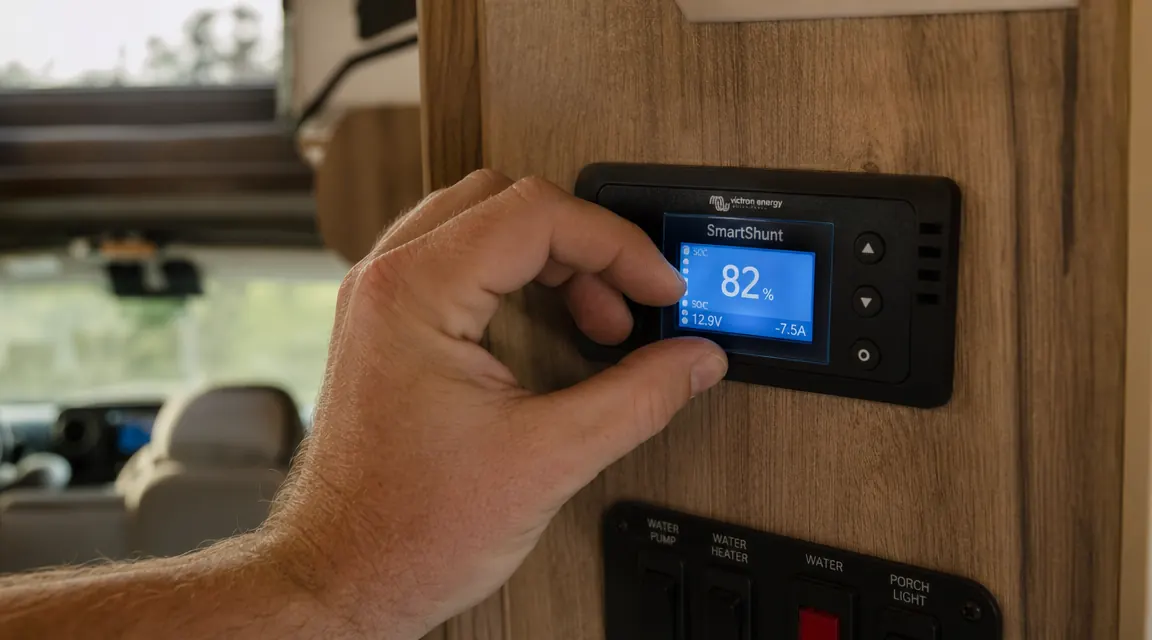
A battery monitor changes everything once you have a bank sized correctly. I run a Victron SmartShunt in my RV. It counts amp-hours in and out, shows me state of charge as a percentage, and logs to my phone over Bluetooth. Without it, you are relying on voltage as a proxy for state of charge, which is unreliable under load. With it, you know exactly how much capacity is left at any moment. Budget $50-$80 for one and install it before you rely on your bank for anything critical.
Charge source matters too. A LiFePO4 battery charges fastest and most completely from a charger that has a LiFePO4 profile, not an AGM or gel profile. The charging voltages are different. Using the wrong profile will leave you 10-20 percent undercharged each cycle, which means you will think you have less capacity than you actually bought. Check your converter, shore power charger, and solar charge controller settings before assuming your battery is fully charged.
Cold weather requires one more adjustment. LiFePO4 chemistry cannot be charged below 32 degrees Fahrenheit without damaging the cells. Most quality batteries, including the LiTime 100Ah, have a built-in BMS that cuts off charging when the cell temperature drops too low. This is a protection feature, not a flaw. If you are camping in winter, a battery with a self-heating function is worth the extra cost. The standard LiTime 100Ah does not have self-heating. The LiTime 12V 100Ah Self-Heating version does. Know which one you need before you buy.
Two of these wired in parallel covers most RV and cabin setups without overbuilding.
The LiTime 12V 100Ah LiFePO4 battery is the building block I used for my own RV bank. Rated for up to 15,000 cycles, with a BMS that protects against overcharge, over-discharge, and short circuit. Check today's price and see if it fits your system.
Amazon Check Today's Price on Amazon →