
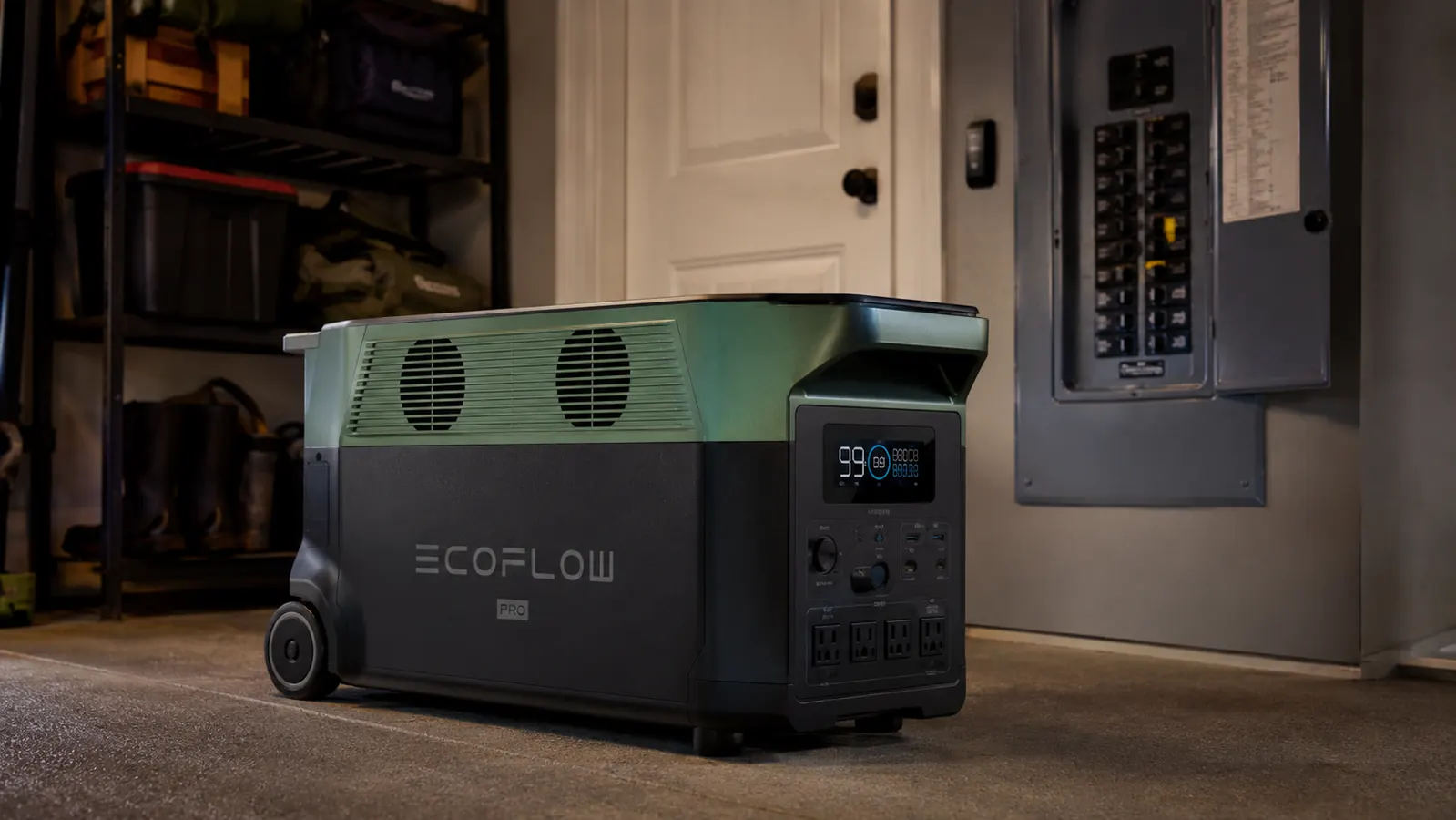
If you are spending $1,500 or more on a portable power station, you are not buying a camping toy. You are buying a serious piece of emergency infrastructure, and the difference between a good choice and a frustrating one becomes very clear when the power is out at 2 a.m. and you are trying to keep a refrigerator and a CPAP running at the same time. The EcoFlow Delta Pro and the Bluetti AC300 both live in that high-stakes tier. I have used the Delta Pro for over a year across four real blackouts and several camping trips. Here is how it actually stacks up against the AC300.
The short answer: the Delta Pro wins for most buyers because of its self-contained expandability, faster AC recharge, and a more reliable app. The AC300 has one meaningful edge in solar input that matters to a specific subset of buyers. I will lay out where each station wins and who belongs in each camp.
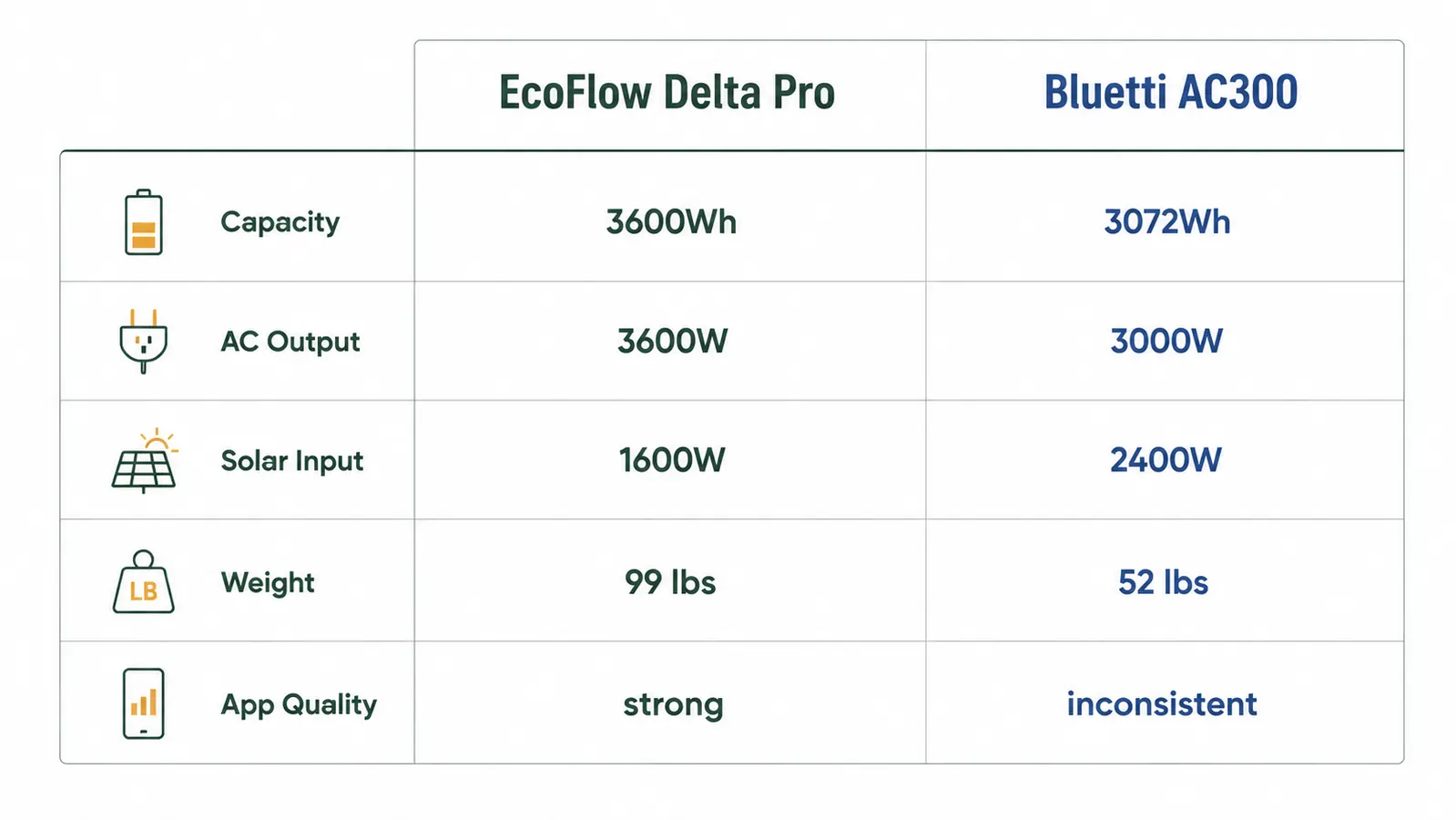
| Feature | EcoFlow Delta Pro | Bluetti AC300 |
|---|---|---|
| Base Capacity | 3,600 Wh | 3,072 Wh (requires B300 battery module) |
| AC Output (continuous) | 3,600W | 3,000W |
| AC Output (surge) | 7,200W | 6,000W |
| Max Solar Input | 1,600W | 2,400W |
| AC Recharge Time (0-80%) | ~1.6 hours | ~2.5 hours |
| AC Recharge Time (0-100%) | ~2.7 hours | ~3.5 hours |
| Weight (base unit) | 99 lbs | 52 lbs |
| Expandable Storage | Yes (up to 25 kWh) | Yes (up to 6 B300 modules) |
| App Quality | Consistent, good UI | Inconsistent, frequent complaints |
| Price (base unit, Amazon) | ~$1,699 | AC300 requires B300 module to hit 3kWh+ |
| LiFePO4 Chemistry | Yes | Yes |
| EV Charging Input | Yes (up to 3,000W) | No |
Where the EcoFlow Delta Pro Wins
The Delta Pro's most underrated advantage is that the 3,600 Wh you see on the label is what you actually get out of the box. The AC300 is a modular system that ships with zero battery storage and requires you to add at least one B300 battery module to function as a power station at all. That is not a knock on the system design, but it means the price comparison you see advertised is not apples to apples. By the time you configure an AC300 with a B300 module to get roughly 3,072 Wh, the total cost is typically higher than the Delta Pro's Amazon price for the fully self-contained 3,600 Wh unit.
The AC recharge speed is also not close. The Delta Pro will take itself from empty to 80 percent in about 1.6 hours on a standard 120V outlet. I timed this repeatedly during my first winter with it. The AC300 with a B300 runs closer to 2.5 hours for the same 80 percent fill. When a storm is incoming and you have a few hours before the grid goes down, that time difference is real. I ran the Delta Pro through two full recharge cycles in the time an AC300 would have completed one. For emergency prep, faster AC recharge matters more than most buyers realize until they need it.
The EcoFlow app is also noticeably more stable. This is hard to quantify, but I read through several hundred Delta Pro owner reports and AC300 owner reports over the past year. Delta Pro users occasionally complain about firmware updates that change behavior, which is fair. AC300 users report Bluetooth dropout, failed remote sessions, and the app simply not connecting, at a meaningfully higher rate. When I am trying to monitor battery draw from another room during a blackout, an unreliable app is not a minor inconvenience. On the Delta Pro, the app has worked every time I needed it.
Running the Delta Pro through its fourth blackout this year. Still zero failures.
The EcoFlow Delta Pro is the self-contained, fastest-recharging option at this capacity tier. If you want 3,600 Wh that is ready when the grid is not, this is the station to buy.
Amazon Check Today's Price on Amazon →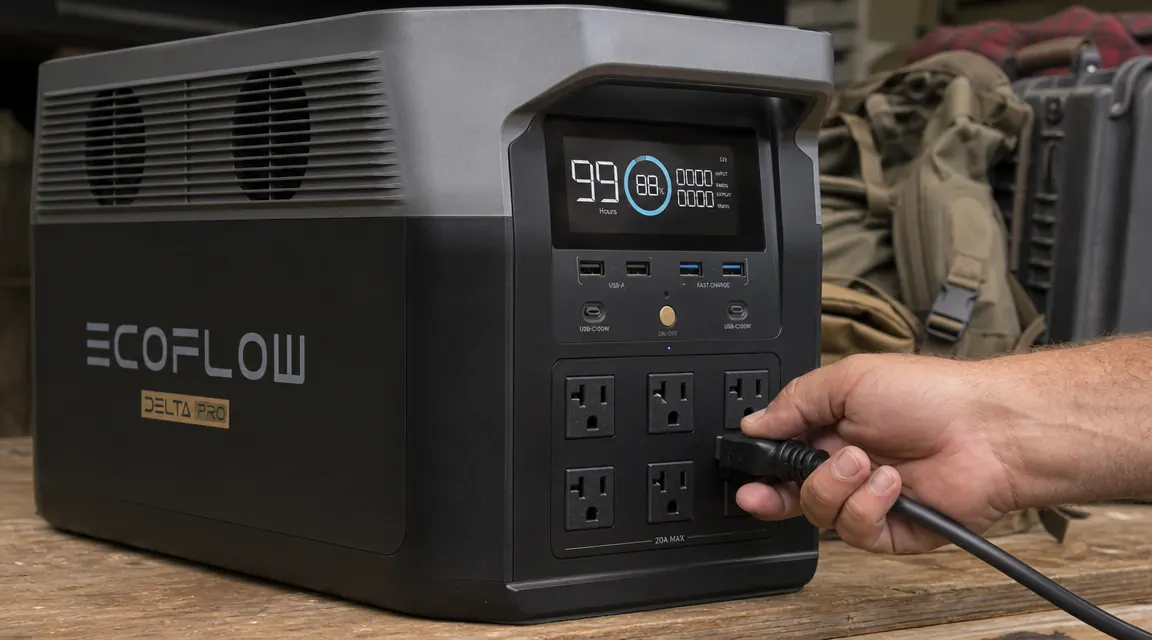
Where the Bluetti AC300 Wins
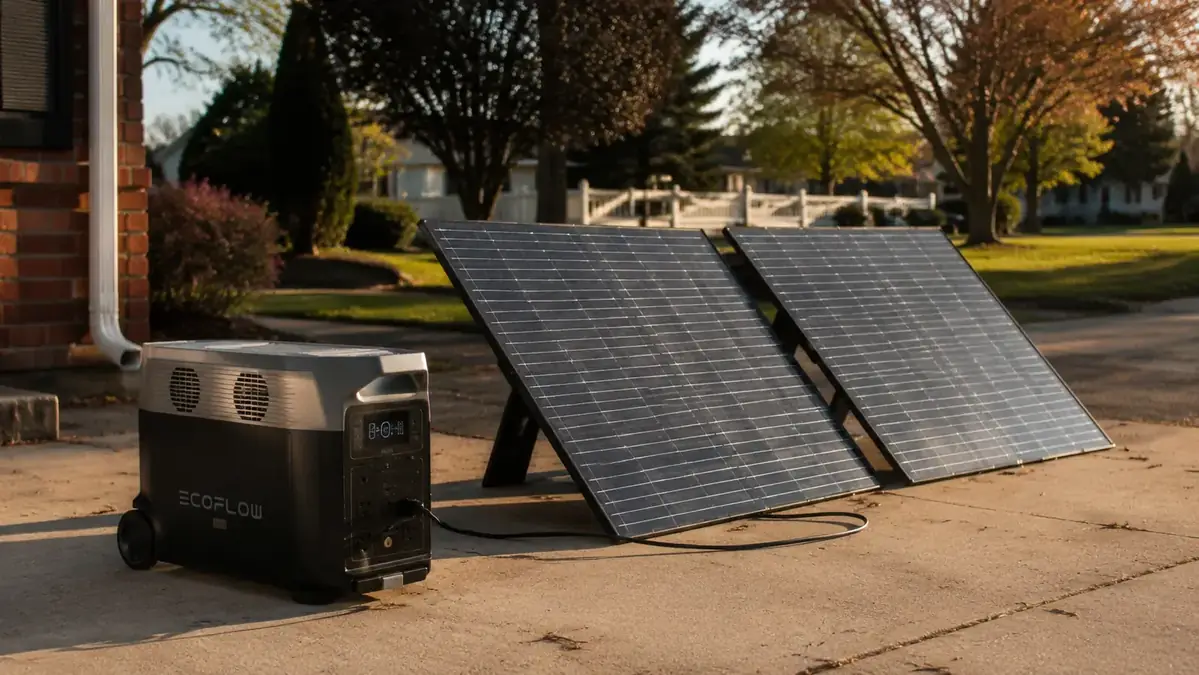
The AC300's one genuine advantage is maximum solar input: 2,400W versus the Delta Pro's 1,600W. If you have a large panel array already set up, or if you are building a solar charging setup where speed of solar replenishment is the priority, the AC300 architecture lets you pull more watts from the sun per hour. For someone running a large stationary array of six or more 400W panels, that ceiling matters. At full solar input, the AC300 can refill its battery bank faster than the Delta Pro can, assuming your panel array can actually deliver 2,400W of clean input, which requires ideal conditions and a well-configured setup.
The AC300 is also substantially lighter as a base unit at 52 lbs versus the Delta Pro's 99 lbs. If you need to move the unit regularly, whether loading it into a truck, carrying it upstairs during a flood warning, or repositioning it on a camping trip, that weight difference is significant. The modular battery design means you can carry the AC300 unit and its battery separately, spreading the load. With the Delta Pro, you have 99 lbs in one piece, and there is no separating it. That said, if you are using it primarily as a home backup unit parked in a closet or garage, the weight difference does not come up often.
Expandability: Both Go Big, But Differently
Both stations support significant capacity expansion. The Delta Pro can connect to EcoFlow's Extra Batteries and Smart Generator, scaling up to 25 kWh in a full setup. The AC300 can take up to six B300 modules, topping out around 18.4 kWh. For most homeowners who are not building a full off-grid solar system, neither ceiling is practically limiting. What matters more is cost per added kilowatt-hour, and on that front, EcoFlow's expansion battery pricing has historically been more competitive. Prices shift, so check current listings before making a decision based on expansion plans.
The Delta Pro also supports EV charging as an input source, which means you can use a Level 2 EV charger to push up to 3,000W of charge into the station. If you have a home EV charger installed, this is a fast and convenient way to top off the Delta Pro that the AC300 simply does not support. It is a niche feature, but for EV owners it is genuinely useful.
The AC300's 2,400W solar input ceiling is the one real spec where it beats the Delta Pro. If you are building a large stationary panel array, that matters. If you are not, it does not.
Battery Chemistry, Cycle Life, and Long-Term Reliability
Both units use LiFePO4 chemistry, which is the right call at this price point. LiFePO4 runs cooler than NMC lithium, handles deep discharge better, and is rated for 3,500 or more cycles before capacity drops to 80 percent on both platforms. That translates to roughly 10 years of daily cycling, which is long enough that neither station should feel like a consumable purchase. I have not had any cell-level issues with my Delta Pro in a year of real use, including several full discharge and recharge cycles during blackouts.
One thing worth noting about the AC300: because it is a modular system, the battery modules are a separate component from the inverter unit. In theory, if a B300 module fails, you replace the module and not the whole system. In practice, owners have reported that diagnosing which component is failing can be complicated, and Bluetti's warranty service is inconsistent in speed and quality according to recent reports. EcoFlow's support has a better reputation in the user community as of this writing, though both are consumer-grade companies and not industrial UPS providers.
Who Should Buy Which
Buy the EcoFlow Delta Pro if your primary use case is home backup during grid outages and you want the simplest, most ready-to-go setup. You get 3,600 Wh in a single self-contained unit, faster AC recharge than any competitor at this tier, a functional app, and EV charger input as a bonus. The 99-lb weight is the real tradeoff. If your station lives in a garage or utility room and moves maybe twice a year, it is a non-issue.
Buy the Bluetti AC300 if you already have a large solar panel array rated at more than 1,600W and your core use case is solar-first charging rather than AC grid backup. The higher solar input ceiling and the lighter base unit are the AC300's genuine advantages. If neither of those conditions apply to your situation, the Delta Pro covers everything else better.
If you are on the fence, ask yourself two questions. First, how fast does your station need to recharge from the grid before a storm? If the answer is as fast as possible, the Delta Pro wins. Second, do you already have more than 1,600W of solar panels configured? If no, the AC300's solar advantage is theoretical, not practical, for your current setup.
The Delta Pro is the better all-around home backup station at this price tier.
Faster AC recharge, more usable capacity out of the box, stable app, and EV charger input. For most buyers facing real blackout risk, this is the right call.
Amazon Check Today's Price on Amazon →