
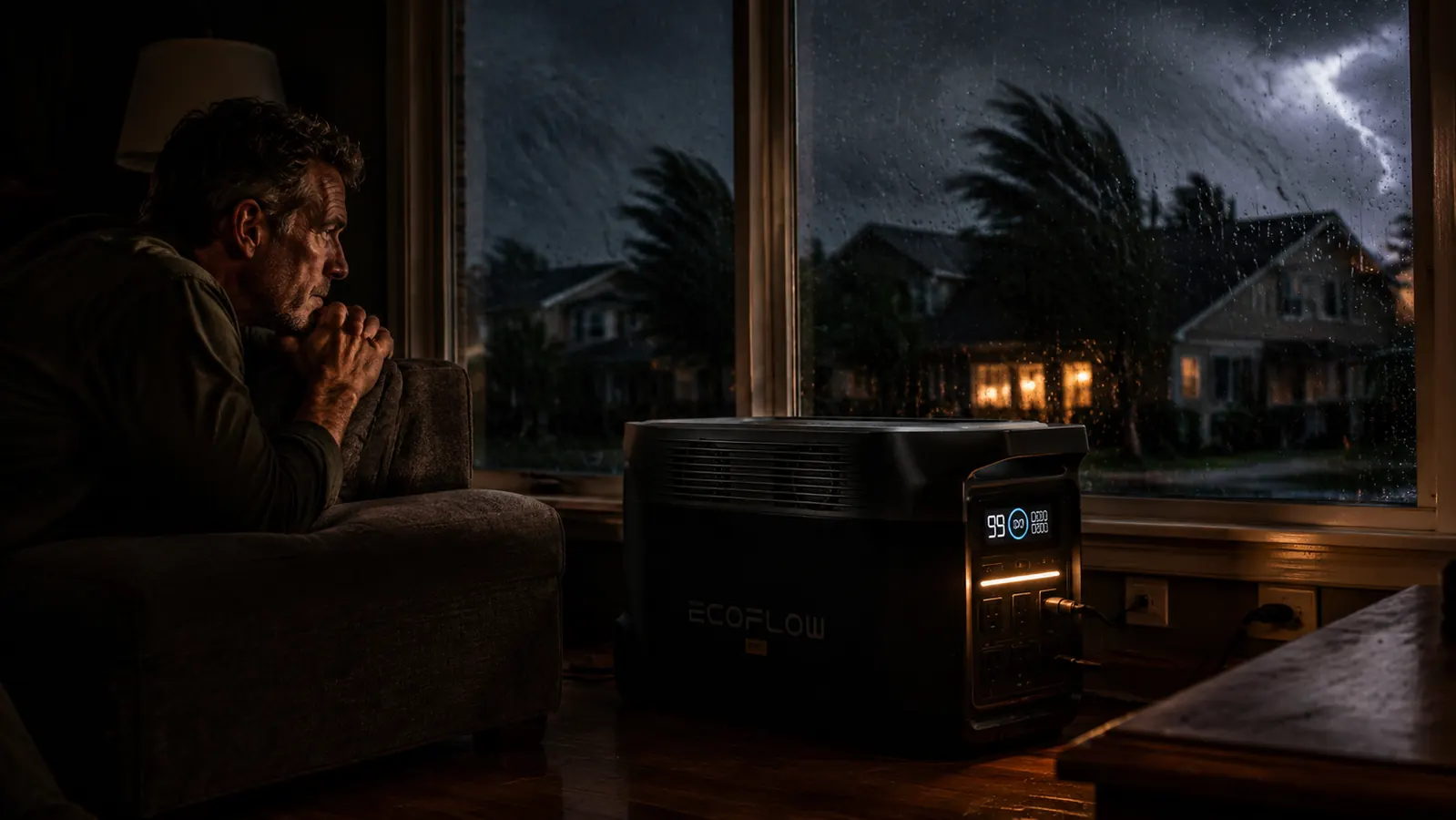
The storm made landfall on a Tuesday. By 2 a.m. Wednesday, the transformer at the end of our street was gone, and the house went dark. I had just finished a 12-hour shift, my wife had a CPAP to run, we had two kids under ten, and the forecast called for four more days of tropical activity before the utility crews could even get into our neighborhood. I am an ER nurse. I have seen what happens when people improvise under pressure without the right equipment. I had bought the EcoFlow Delta Pro three weeks before the storm after watching a friend's neighborhood go dark for six days the previous year. I am glad I did not wait.
I charged the Delta Pro to 97 percent the morning before the storm hit. That gave me 3,492Wh of usable capacity, which on paper sounds like a lot. In practice, you learn fast what that number actually means when you are drawing from it continuously. The first thing I plugged in was the refrigerator, a 17 cubic foot side-by-side that cycles on and off every 15 to 20 minutes. The startup surge was 1,100 watts, then it settled to around 150 watts while running. The Delta Pro handled it without flinching. The X-Boost inverter kept everything stable. No flicker, no fault code.
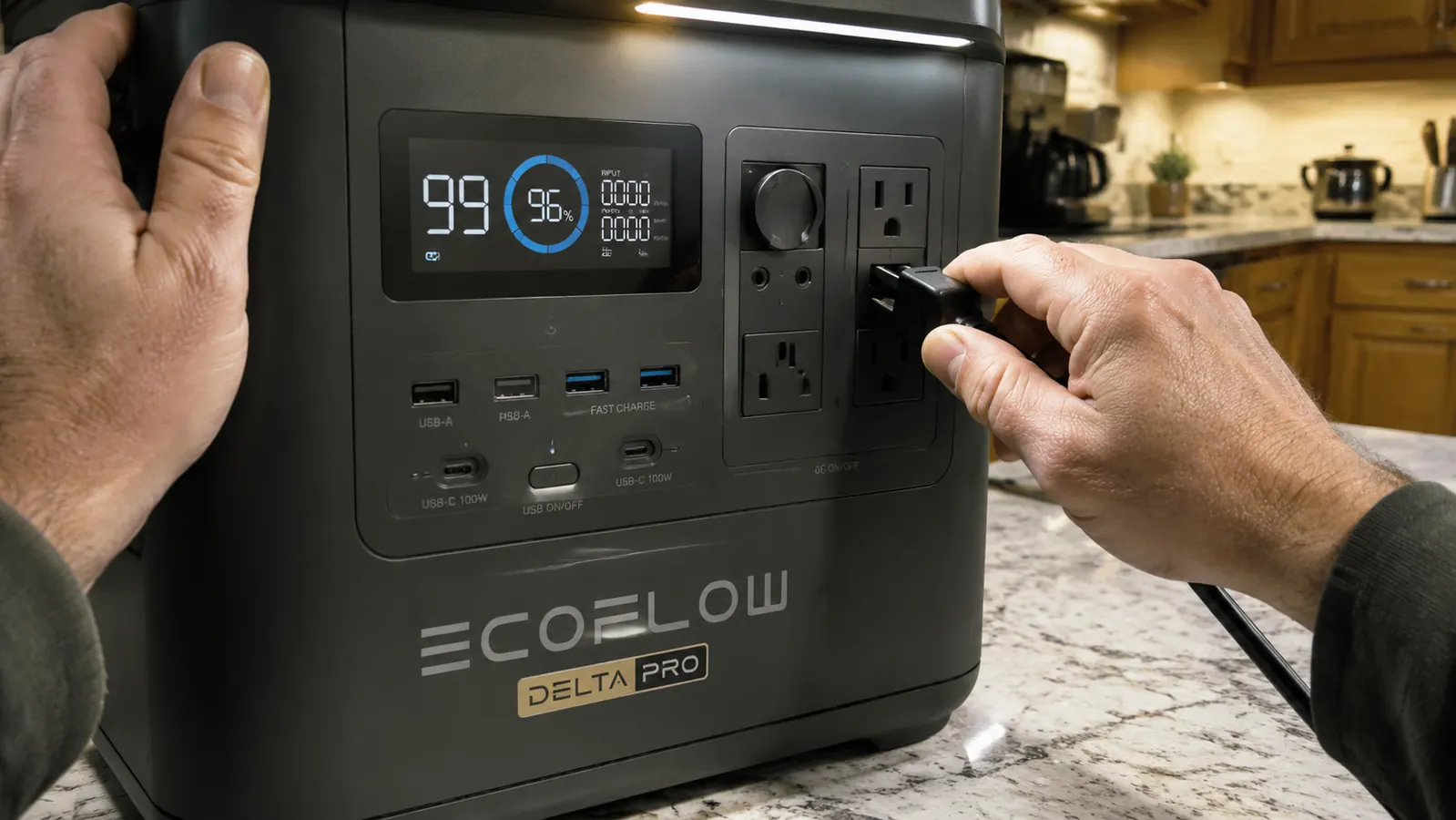
Day one felt almost manageable. We ran the fridge, charged phones and tablets overnight, kept a box fan going in the bedroom for my wife (humidity inside a closed house in August in Florida is not something you negotiate with), and ran the CPAP on its DC adapter through the 12V outlet. The CPAP pulls about 30 watts on DC, so all night that was roughly 240Wh. By morning the Delta Pro was at 71 percent. That math was fine. I had planned for two days of comfortable use. What I had not fully budgeted was that my wife was also running a small air purifier we had forgotten to account for.
By day two I had a spreadsheet open on my phone calculating watts. That is the honest version of emergency preparedness.
Day two the heat became the real issue. We stopped running the fan in favor of battery life, which made sleeping harder. I set the Delta Pro app to push a notification when we hit 50 percent so we could start making decisions. That notification hit around 3 p.m. on day two. We had 1,800Wh left. The fridge stayed on. The CPAP stayed on. Everything discretionary came off. My kids watched downloaded shows on a tablet until that died. I had a 200-watt solar panel I borrowed from a coworker and propped against the south wall, but the cloud cover from the storm's tail was keeping output between 60 and 80 watts for most of the afternoon. Over six hours of daylight, that recovered maybe 360 to 420Wh. It helped. It was not the solar fast-charge situation I had imagined.
Day three we hit 28 percent by early evening. I started unplugging the fridge for four-hour windows to slow the draw, which is something I had read about but hoped I would not need to do. Fridge stayed cold long enough. We ate the most perishable food first. The CPAP kept running every night, which was non-negotiable. My wife's sleep apnea is not severe enough to be dangerous for a single night, but I was not willing to find out what three nights without the machine felt like at 2 a.m. when I was too tired to reason clearly about it.
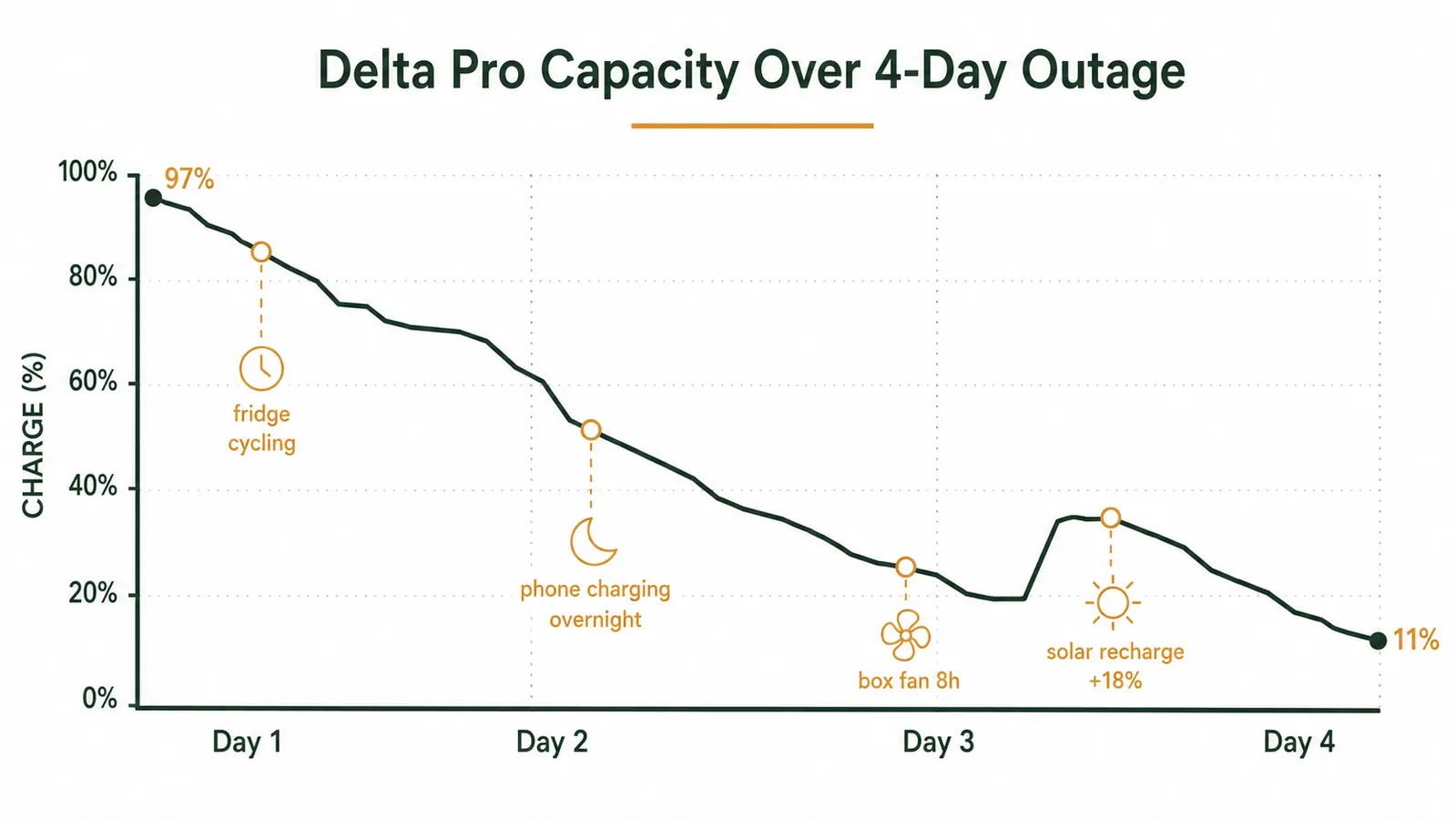
Grid power came back on the afternoon of day four. The Delta Pro had 11 percent left. I will not pretend that was a comfortable margin. It was not. But it got us through. No spoiled food. No missed CPAP nights. Phones and devices charged throughout. The unit ran quietly, which matters when two kids are sleeping ten feet away. And it did not require a single trip to a gas station, which our neighborhood roads would not have safely allowed for the first 36 hours anyway.
What I Would Tell You If We Were Sitting at My Kitchen Table
The Delta Pro did its job. It is a legitimately capable machine: 3,600Wh capacity, 3,600 watts of continuous AC output, five 120V outlets, and a build that feels like it was designed for repeated heavy use rather than a marketing shelf. The app works, the real-time watt display is accurate, and the LiFePO4 chemistry means I am not nervous about leaving it stored at 80 percent indoors for months at a time. Those are real advantages.
What I would tell a friend: one unit is enough for a family of four to get through three or four days comfortably if you are disciplined and the outage happens in spring or fall. In Florida in August, you need to plan for the air handling situation before the storm arrives. Either own a second battery, own a proper solar array for faster recharge, or have a plan for where the family goes if day three gets brutal. A portable AC unit pulls 600 to 900 watts continuously. I have run the numbers. One Delta Pro cannot sustain that alongside a fridge and CPAP across four days without significant solar input.

The one thing I would do differently: buy the 400-watt solar input adapter and keep two 200-watt panels ready before the season starts, not during it. Solar charging the Delta Pro on a clear day at 800 input watts can restore roughly 600 to 700Wh of real capacity per hour. That changes the math entirely. It turns a four-day unit into something that can hold indefinitely if the sun cooperates.
If you are in a hurricane state, or tornado alley, or anywhere that loses grid power for more than 24 hours in a bad year, you are not buying a luxury item when you buy the Delta Pro. You are buying a system. Treat it like one. Know your loads before you need them. Check current pricing below, it fluctuates with seasons and sales.
Your fridge, your CPAP, your family's devices, all running quietly while your neighbors scramble for gas.
The EcoFlow Delta Pro is a 3,600Wh LiFePO4 power station with 3,600W continuous AC output and X-Boost surge handling. It charges to 80% in under two hours via AC. Check today's price on Amazon.
Amazon Check Today's Price on Amazon →The internal links below go to our full long-term review of the EcoFlow Delta Pro and our setup guide for wiring it into your home panel with the Transfer Kit. Both are worth reading before a storm is in the forecast rather than after.
Still researching? Four days without power has a way of making the decision easier.
If you want the full year-long breakdown of how the Delta Pro has held up including cold-weather capacity loss, app updates, and real runtime testing, our long-term review covers it all.
Amazon Check Today's Price on Amazon →