
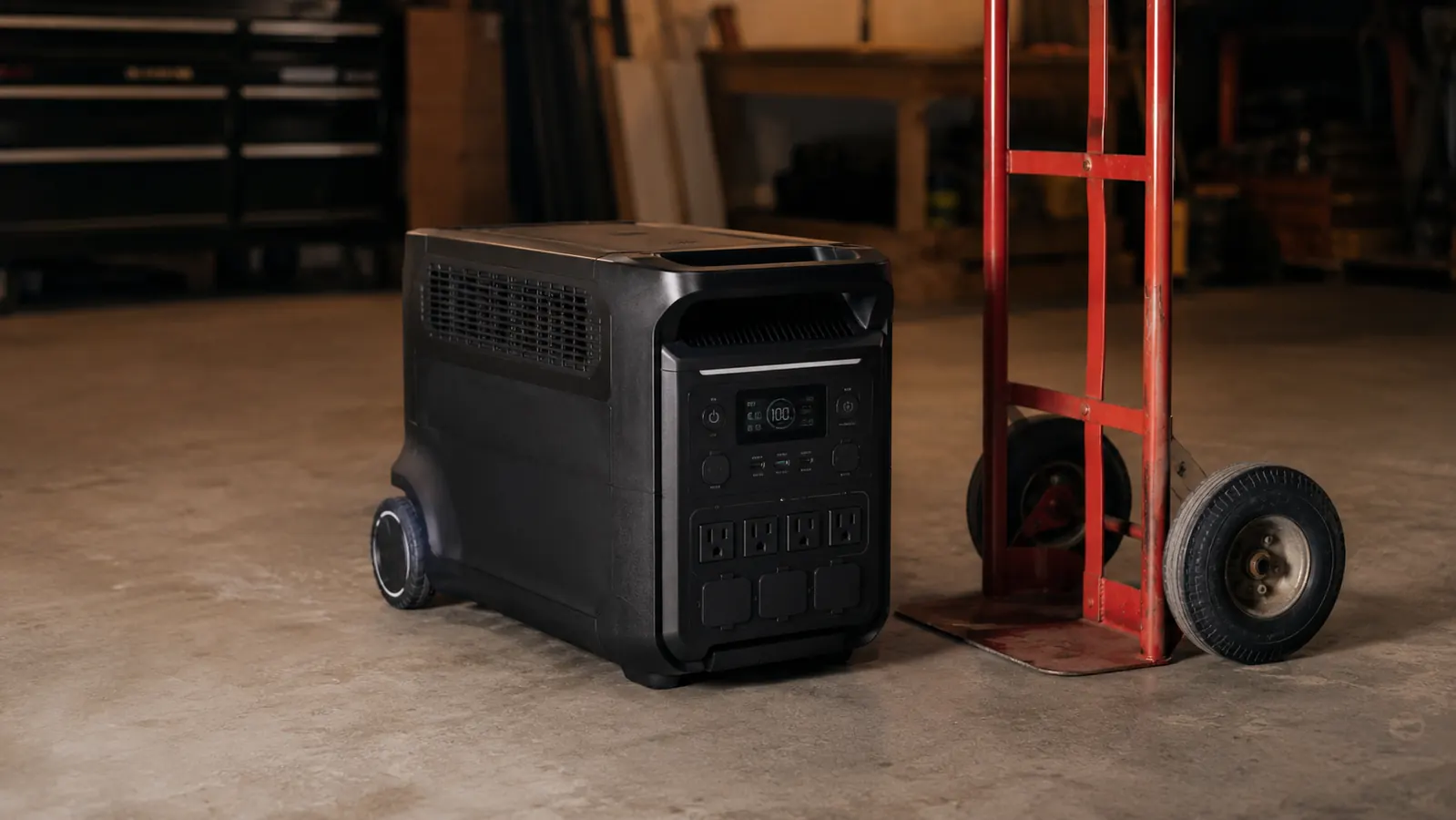
I want to tell you something nobody says in the first thirty seconds of a Delta Pro review: I needed a hand truck to move mine. I work 12-hour shifts in the ER, and I thought I was in reasonable shape. Then I tried to carry the EcoFlow Delta Pro from my truck bed to my garage alone and quickly recalculated that plan. Ninety-nine pounds. That is not a typo, and it is not a complaint you will find on the product page. It is just the physical reality of owning 3600 watt-hours in a single box.
I have owned my Delta Pro for about 14 months now. I bought it after back-to-back hurricane seasons taught me that a 1000Wh station is not enough for more than a day of serious household use. The Delta Pro has earned its place in my garage. But there are at least five things the marketing glosses over that I wish someone had told me before I swiped the card. That is what this review is about.
The Quick Verdict
Best-in-class capacity and expandability for serious home backup, but the weight, fan noise under load, and app instability are real tradeoffs you need to know before you buy.
Amazon Check Today's Price →If you want a power station that can run a full-size refrigerator, a box fan, and your CPAP simultaneously through a multi-day outage, the Delta Pro is the unit to beat at this price.
Check current pricing and availability before EcoFlow runs another limited-time bundle. The price shifts more than you'd expect.
Amazon Check Today's Price on Amazon →The Weight Problem Nobody Warns You About
At 99 lbs, the Delta Pro weighs more than many portable generators rated at similar output. EcoFlow did give it a built-in telescoping handle and two small wheels at the base, which helps on flat surfaces. On anything else, you are asking for trouble. My driveway has a mild slope, and rolling the Delta Pro from the garage to the carport where I connect solar panels takes real effort and a slow pace. Going back up that slope when the unit is fully charged is a two-person job or a hand truck job.
The wheels are the other part of this conversation nobody has honestly. They are small, narrow, and built for smooth concrete. Gravel, grass, or any kind of lip between a door threshold and the outside world will stop them cold. If you plan to use the Delta Pro exclusively indoors on flat flooring, the wheels are adequate. If you want to move it between your house, your truck, and a campsite, budget $35 for a proper folding hand truck and save yourself the back strain. I say this as someone who has treated more than a few patients for acute back injuries sustained moving heavy items. Do not be that person.
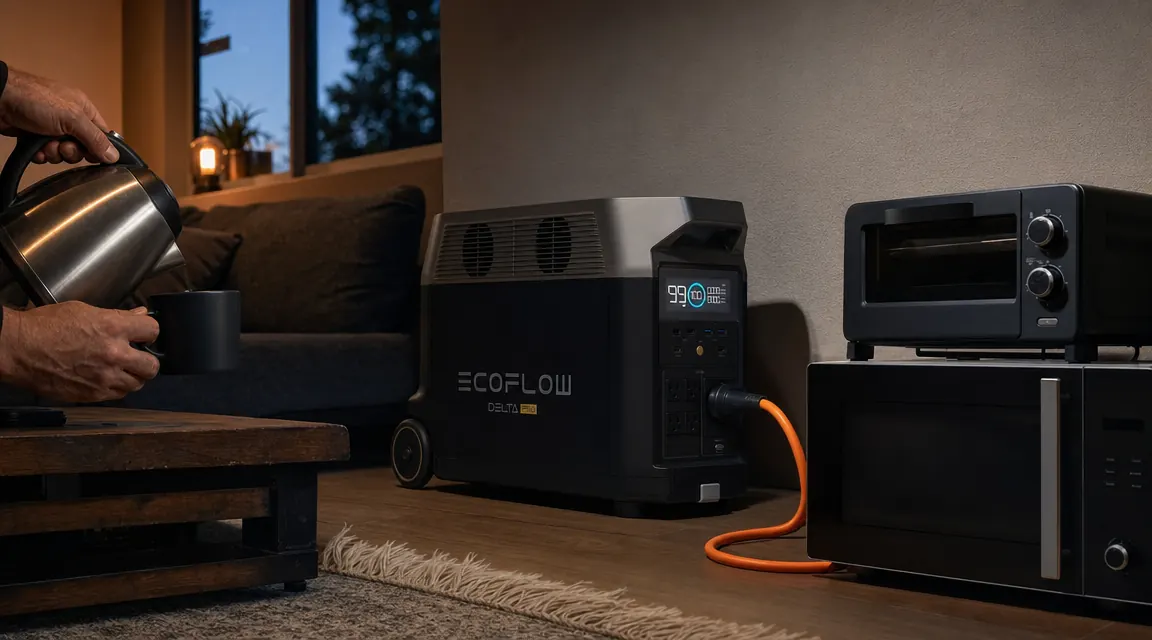
Fan Noise Under Load: Worse Than the Spec Sheet Suggests
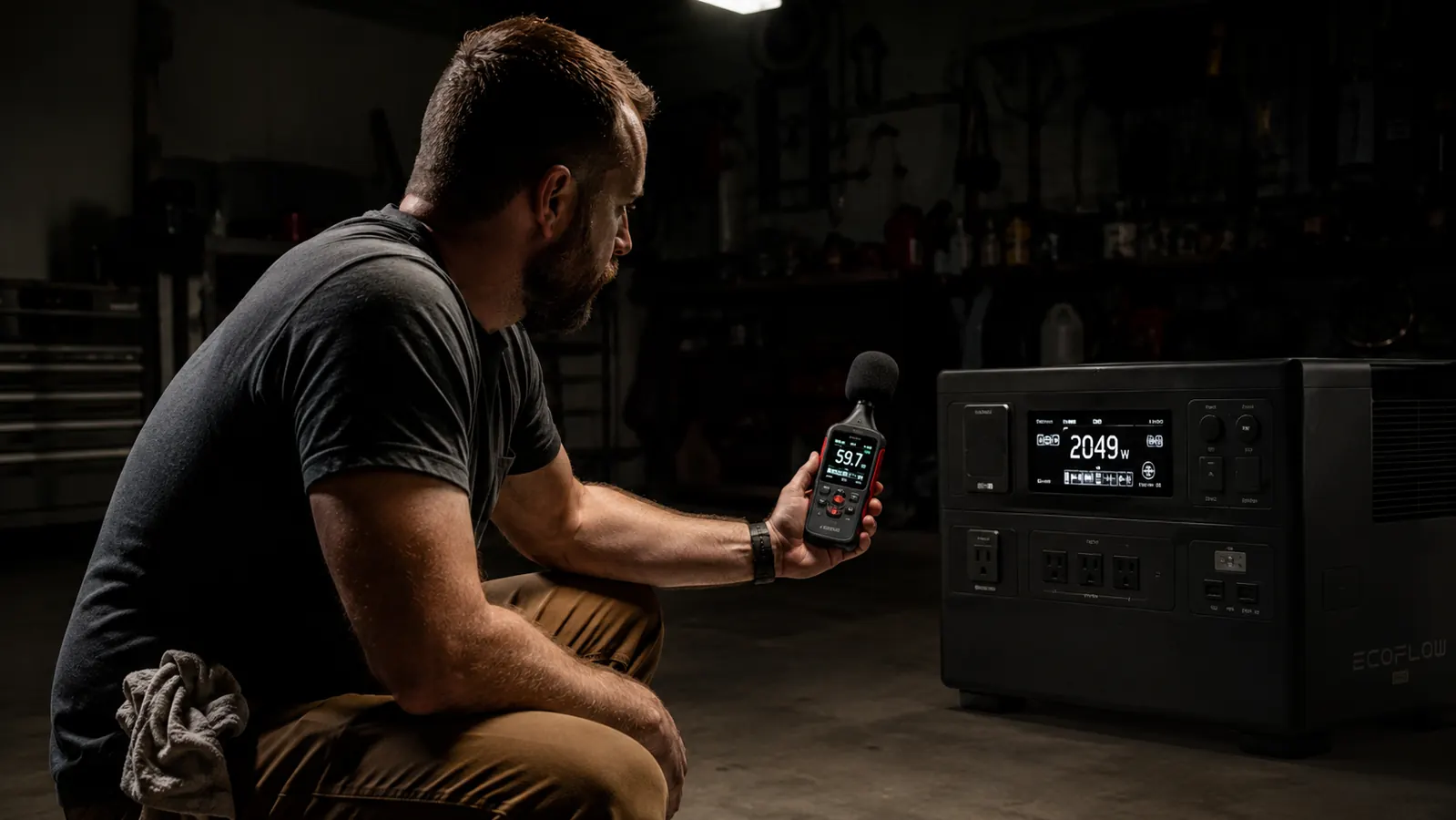
EcoFlow publishes a noise figure of under 45 dB for the Delta Pro at light loads. That is accurate when you are pulling 200 watts or less from the AC outputs. Pull 1200 watts or more and the cooling fans ramp up noticeably. I measured between 55 and 62 dB at about three feet from the unit while running a 1500-watt load, which is in the range of a dishwasher or a window AC unit on low. It is not alarming. But if you planned to keep the Delta Pro in a bedroom for nighttime backup of a CPAP and a phone charger, that fan noise will reach you. At 100 watts of CPAP draw, the fans stay quieter. At 400 watts if you add a dehumidifier, they spin up.
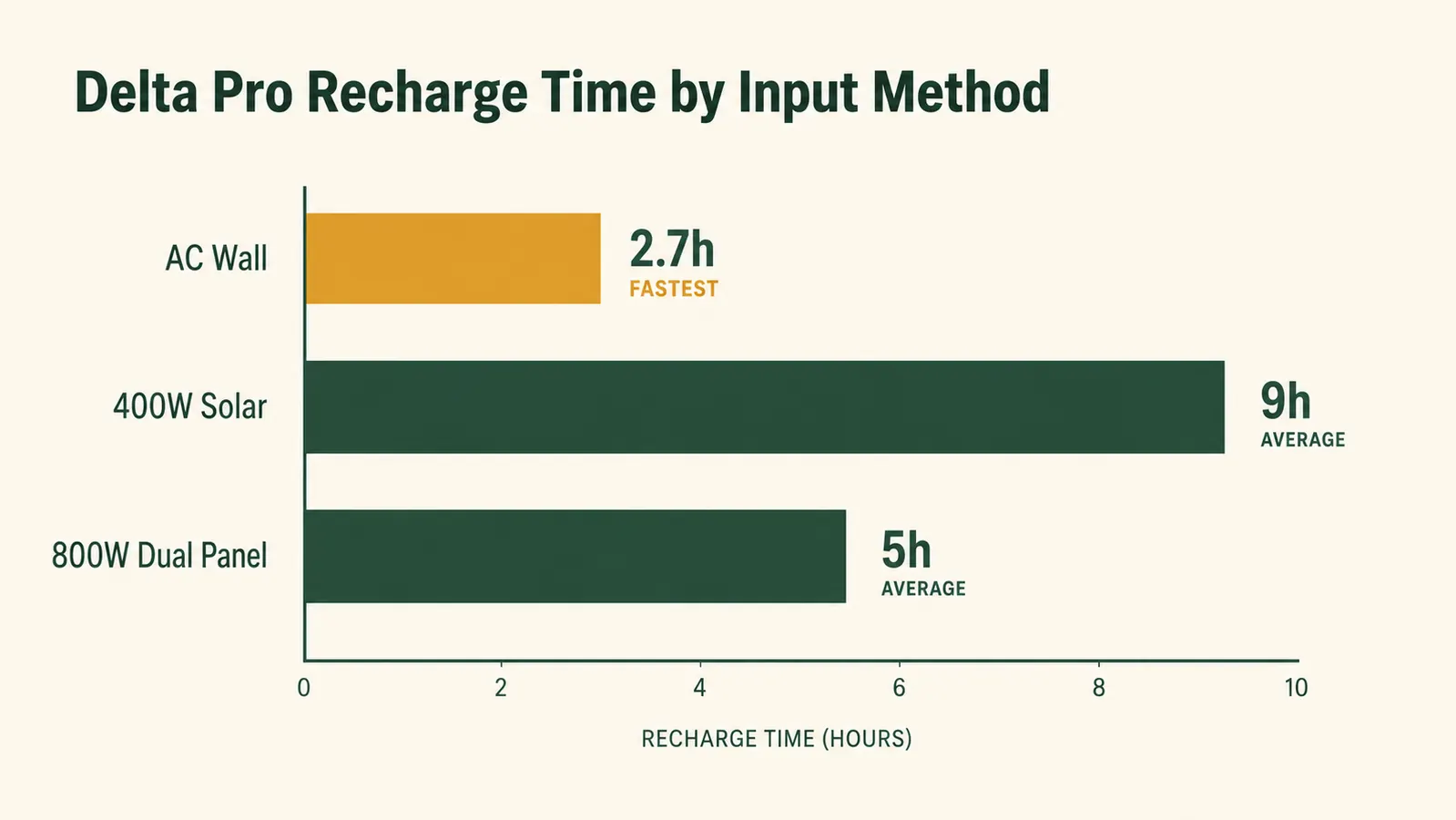
The more important fan note is about recharging via AC wall outlet. The Delta Pro's 2.7-hour fast-charge mode is legitimately fast, pulling around 1800 watts from the wall to refill from empty. While it is charging at that rate, the fans run continuously at a moderate-to-high speed. If the unit is in a living room or open space, the noise is background-level. If it is in a closet or small room with the door closed, the heat and sound build. I keep mine in the garage for recharging for exactly this reason.
Real Recharge Times from Solar vs AC: What the Brochure Skips
The Delta Pro supports up to 1600 watts of solar input, which EcoFlow markets with the phrase 'recharge from 0% to 80% in 1.8 hours via solar.' That figure assumes a perfect 1600W of actual solar output hitting the MPPT controller at exactly the right voltage range. In practice, I have run two 400W panels (800W total rated) connected in series and seen peak input of around 680 to 720 actual watts on a cloudless Florida afternoon in July when the sun angle was optimal. That is real-world solar. At that input rate, a full recharge from 10% takes roughly five to six hours of good sun, not the 1.8-hour figure on the spec sheet.
If you run a single 200W panel, which is a reasonable starting kit for most buyers, plan on a full recharge taking 18 to 22 hours across two or three days of sun. That is fine for a slow top-up strategy between camping days or as a supplemental input during a multi-day outage. It is not a same-day solution. The AC wall recharge is the genuinely fast path: 2.7 hours to full from empty. If you have grid power available even briefly, use it and let solar do the maintenance charging.
X-Boost: What It Actually Does and Where It Falls Short
X-Boost is EcoFlow's name for a power-regulation feature that lets the Delta Pro run appliances rated up to 4500 watts by capping their draw at 3600 watts. The way this works in practice is that the station digitally limits the power delivered to the appliance, which means it runs slower or cooler than it would on grid power. A hair dryer rated at 1875 watts runs fine on the Delta Pro without X-Boost, well within the 3600W AC output. X-Boost kicks in for things like an electric skillet rated at 1800 watts that might surge to 2200 on startup, or a small window AC unit rated at 4000 watts.
Where X-Boost gets complicated is with inductive loads that do not like being current-limited. Some shop vacs, some power tools, and certain older window AC units will either stall on startup or trip their thermal protection when the Delta Pro throttles their startup surge. I tried to run a 2-horsepower shop vac on X-Boost during a garage cleanup and it tried to start, bogged down, and cut off twice before I gave up and plugged in the smaller vac. This is not a defect in the Delta Pro. It is just physics. Inductive motors need that surge current, and capping it at 3600W does not always satisfy them. Know your appliances before you depend on X-Boost for them.
At 1200 watts of load, I measured between 55 and 62 decibels at three feet. That is closer to a dishwasher than a quiet library. Plan the placement of this unit accordingly before an outage forces the decision.
The App: Three Versions in Fourteen Months
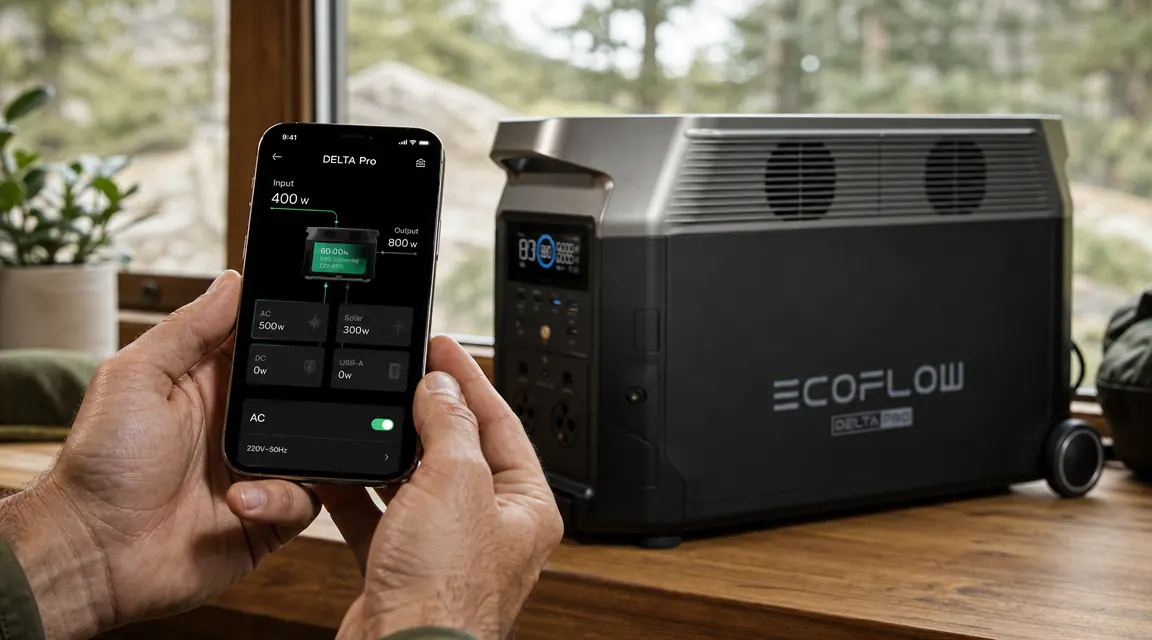
I have lived through three distinct versions of the EcoFlow app on iOS in the roughly 14 months I have owned the Delta Pro. The current version is the most stable, and the power flow display with its real-time watts-in and watts-out visualization is genuinely useful. Seeing the solar input, battery percentage, and AC draw all on one screen helps me manage consumption during a multi-day outage. I use this feature regularly.
But I have also experienced two firmware updates that temporarily broke Bluetooth pairing, one app update that reset my charging schedule preferences, and a stretch of about three weeks where the iOS app and the Delta Pro's firmware were out of sync and the unit would show as offline even while operating normally. EcoFlow support resolved it eventually, but the process involved a firmware rollback that I had to execute manually via USB. That is not a user experience I would call polished. If you are not comfortable with the idea of occasionally troubleshooting firmware on a power station, factor that into your comfort level with this product.
Cold Weather Capacity Loss: The Number the Spec Sheet Buries
The Delta Pro uses a LiFePO4 (lithium iron phosphate) battery cell, which is a better chemistry choice than NMC for safety and long-term cycle life. LiFePO4 is also less prone to thermal runaway, which matters when you are running a large-capacity unit indoors. But LiFePO4 does lose usable capacity in the cold, and the Delta Pro is no exception. EcoFlow specs the operating temperature range as 14 to 113 degrees Fahrenheit (negative 10 to 45 Celsius). At the low end of that range, the battery management system will throttle output and charging rate to protect the cells.
I tested mine on a January morning in my garage with an ambient temperature of 38 degrees Fahrenheit. The BMS allowed the unit to discharge but capped recharging rate at about 400 watts until the internal temperature climbed. Full capacity was available, but the effective usable capacity felt reduced because I could not top off quickly in the cold. In Florida, this is a rare edge case. In northern states where power outages often happen in winter, this is a planning variable. Store the unit indoors, let it reach room temperature before charging, and factor this in if you are sizing backup power for a cold-climate home.
What the Delta Pro Gets Undeniably Right
I have spent most of this review on the things nobody tells you, so let me be clear about the areas where the Delta Pro genuinely earns its price. The 3600Wh usable capacity is real and reliable in normal temperatures. I have pulled it from 100% to under 5% multiple times and the actual output closely matches the rated capacity once you subtract the small inverter conversion losses. The five 120V AC outlets all run simultaneously without issue. The 30A RV outlet is a legitimate feature for RV owners who want to back-feed their rig during an outage.
The expandability is also the best in class at this price point. Two Extra Batteries can be daisy-chained to bring total capacity to 10.8 kWh. No other station at this price offers that upgrade path without buying a whole new unit. And when the system is working correctly, the EcoFlow app is the most informative power-station interface I have used. The real-time wattage display for every input and output port, the time-to-empty and time-to-full estimates, and the ability to set scheduled charging windows are all genuinely useful for managing a multi-day outage.
What I Liked
- 3600Wh usable capacity closely matches the rated spec in normal temperatures
- Five simultaneous 120V AC outlets plus a 30A RV port
- Expandable to 10.8 kWh with two Extra Batteries, best upgrade path at this price
- LiFePO4 chemistry is safer and longer-lived than NMC alternatives
- 2.7-hour AC fast charge is legitimately fast when grid power is available
- Real-time app power-flow display is the most informative I have used in this category
- 1600W solar input ceiling gives genuine same-day recharge potential with a full panel array
Where It Falls Short
- 99 lbs requires a hand truck on anything other than flat smooth flooring
- Built-in wheels are undersized for outdoor or uneven terrain
- Fan noise reaches 55 to 62 dB at high load, too loud for a bedroom
- App history includes firmware incompatibilities and at least two Bluetooth pairing failures in 14 months
- Solar recharge math rarely hits the marketed 1.8-hour figure in real-world single-panel setups
- X-Boost does not reliably start high-surge inductive loads like large shop vacs
- Cold weather slows recharging rate below 14 degrees Fahrenheit
Who This Is For
The Delta Pro is the right buy if you have a fixed location where it will live most of the time, like a garage or utility room, and you need genuine multi-day home backup capacity. It works best for people who experience multi-day outages, have at least two or three appliances they cannot go without (refrigerator, medical equipment, fans or heat), and want a solution that does not require gasoline, exhaust ventilation, or a pull cord at 2 a.m. The expandability path to 10.8 kWh also makes it a strong anchor for anyone building a more serious off-grid cabin or RV setup over time.
Who Should Skip It
If you need to carry your power station from a truck to a campsite without a dolly, the Delta Pro is the wrong tool. At 99 lbs, it is a garage-anchor unit, not a camping companion. If you plan to charge exclusively from solar without grid access and expect same-day recharges from a single 200W panel, the math will disappoint you. And if app instability or firmware troubleshooting is not something you are willing to tolerate even occasionally, look at simpler units like the Jackery Explorer series that have more mature and stable app ecosystems. The Delta Pro rewards technically patient buyers and punishes anyone who expects it to be plug-and-forget.
If you have read this far and none of the tradeoffs disqualified it, the Delta Pro is the strongest 3600Wh station at this price point for home backup.
Check current pricing on Amazon before buying elsewhere. EcoFlow runs bundles that include solar panels or an Extra Battery at meaningful discounts, and those deals come and go quickly.
Amazon Check Today's Price on Amazon →