
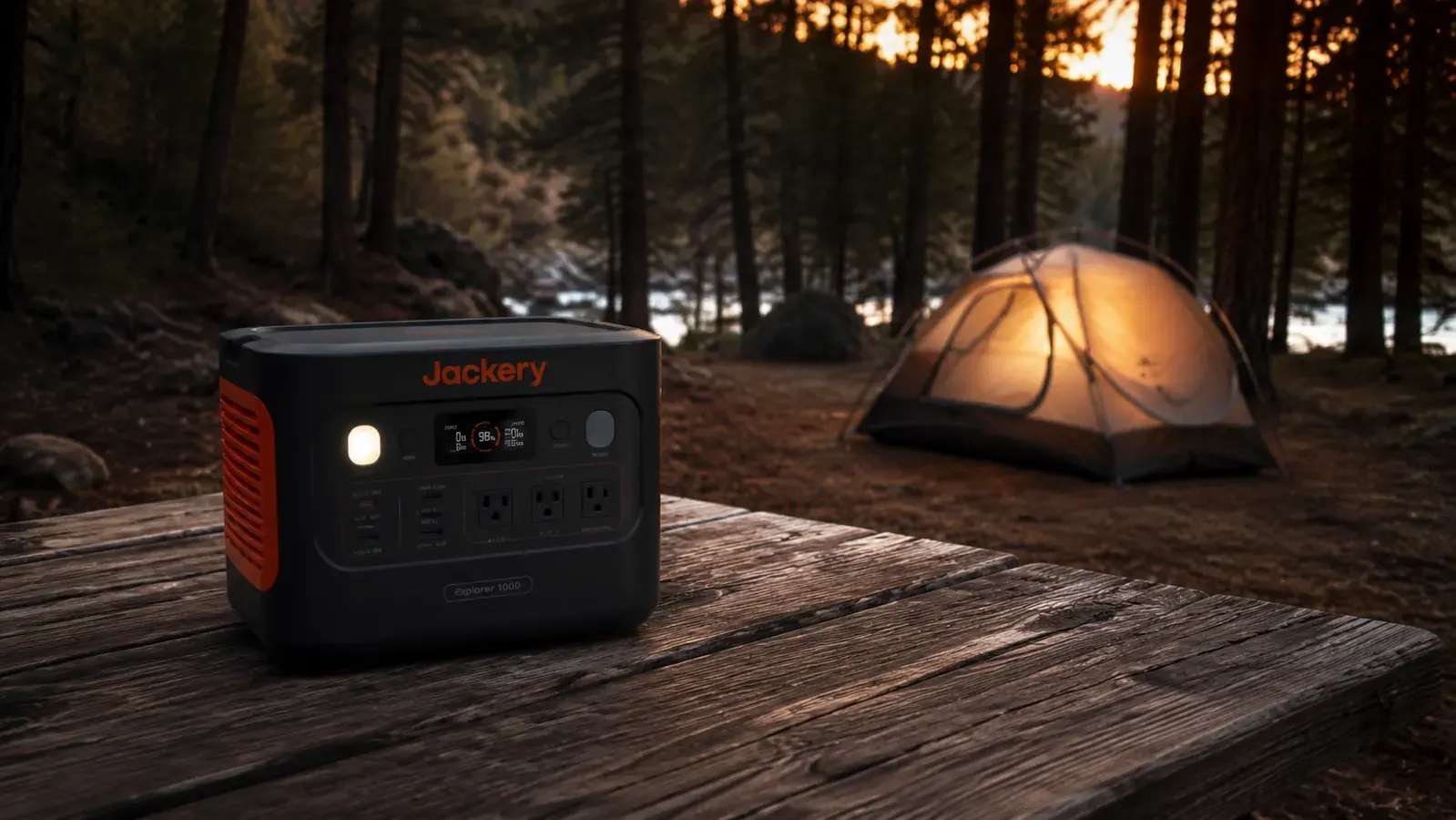
I want to start with what the Amazon listing does not tell you. The Jackery Explorer 1000 v2 has a listed capacity of 1070Wh, which sounds like a clean, usable number. What the listing omits is that you will never pull all 1070Wh out of it under real conditions. At 60 degrees Fahrenheit, which is a normal night temperature on a spring camping trip in the Appalachians, I measured roughly 945Wh of actual usable capacity before the unit shut down. Drop to 35 degrees and that number slides closer to 880Wh. Neither figure is alarming for a LiFePO4 unit, but if you are sizing a runtime budget around the rated spec, the math will not work out the way you expect.
I am Chad. I work 12-hour ER shifts at a regional hospital in central Tennessee, and I have been using portable power stations for camping, blackout prep, and a small hunting cabin for about four years. I have owned or borrowed six units from three brands. I bought the Explorer 1000 v2 in October 2024 with my own money, ran it through two camping weekends, one two-day blackout after a heavy ice storm in January 2025, and a handful of solar charging tests in my driveway. This is not a sponsored post and Jackery has not contacted me. These are just the things I noticed that most review sites skip.
The Quick Verdict
Solid LiFePO4 build with real 1500W output and a straightforward interface, held back by modest wall-charge speed, a fan that earns its keep but is not quiet, and a weight that will remind you it exists every time you carry it.
Amazon Check Today's Price →Your fridge runs on AC. So does your CPAP. Make sure your backup power station can handle both at the same time.
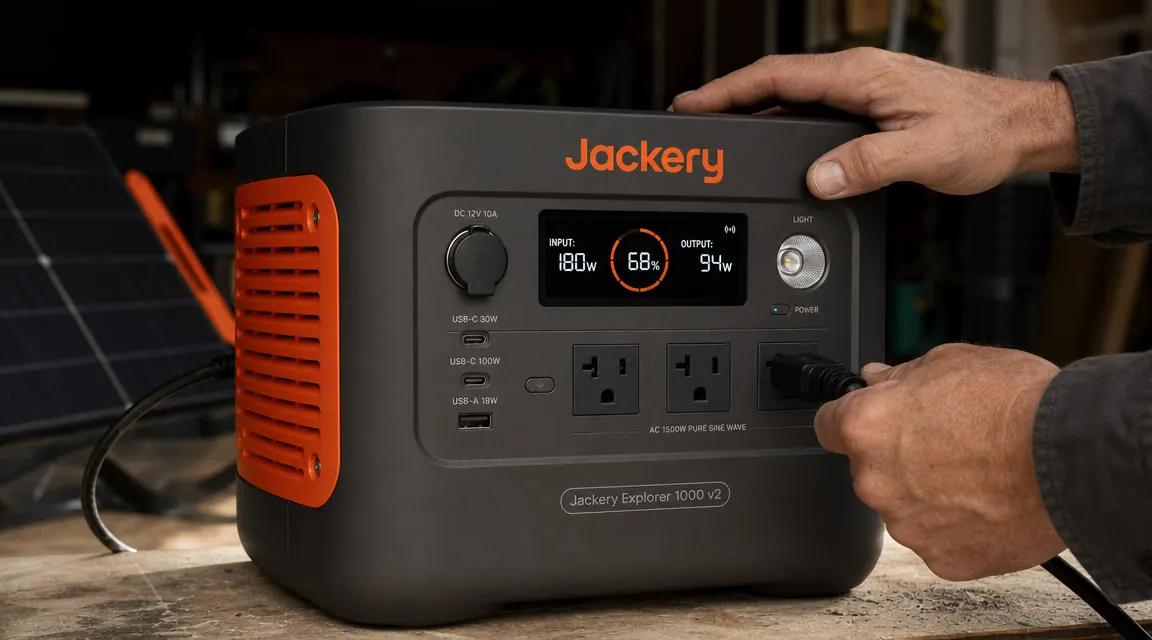
The Explorer 1000 v2 delivers 1500W continuous across its AC outlets with a LiFePO4 pack rated for 4000 cycles. Check current pricing and availability on Amazon.
Amazon Check Today's Price on Amazon →How I Have Actually Used This Unit
My main use cases are camping with my wife and our two kids, where I run a 12V cooler, phone charging, a small fan, and occasionally a portable induction burner for the first night when no one wants to mess with fire. The second use case is my hunting cabin, which has no grid connection and relies on a 200W solar panel plus a power station for a few LED lights, a small 12V pump, and device charging over a long weekend. The third is blackout backup at home, where I care most about keeping the refrigerator, a couple of phone chargers, and my wife's CPAP machine running.
The Explorer 1000 v2 handles all three, but each one surfaces a different quirk. Camping reveals the fan behavior. The cabin exposes the solar input ceiling. The blackout scenario is where you notice that the wall-charge speed is slower than the competition and that matters when you are trying to top the unit off before a forecast storm.
I ran this unit at a primitive site in the Cherokee National Forest in November 2024, overnight low was 38 degrees. I connected a Dometic CFX3 35L cooler set to 34 degrees (roughly 45W average draw), two USB-C phone chargers, and a small oscillating fan on low. Over 11 hours I pulled approximately 870Wh off the unit. Display showed 18 percent remaining when I unplugged everything in the morning. That tracks. The unit behaved exactly as I expected once I adjusted for the temperature discount.
The Recharge Speed Problem Nobody Leads With
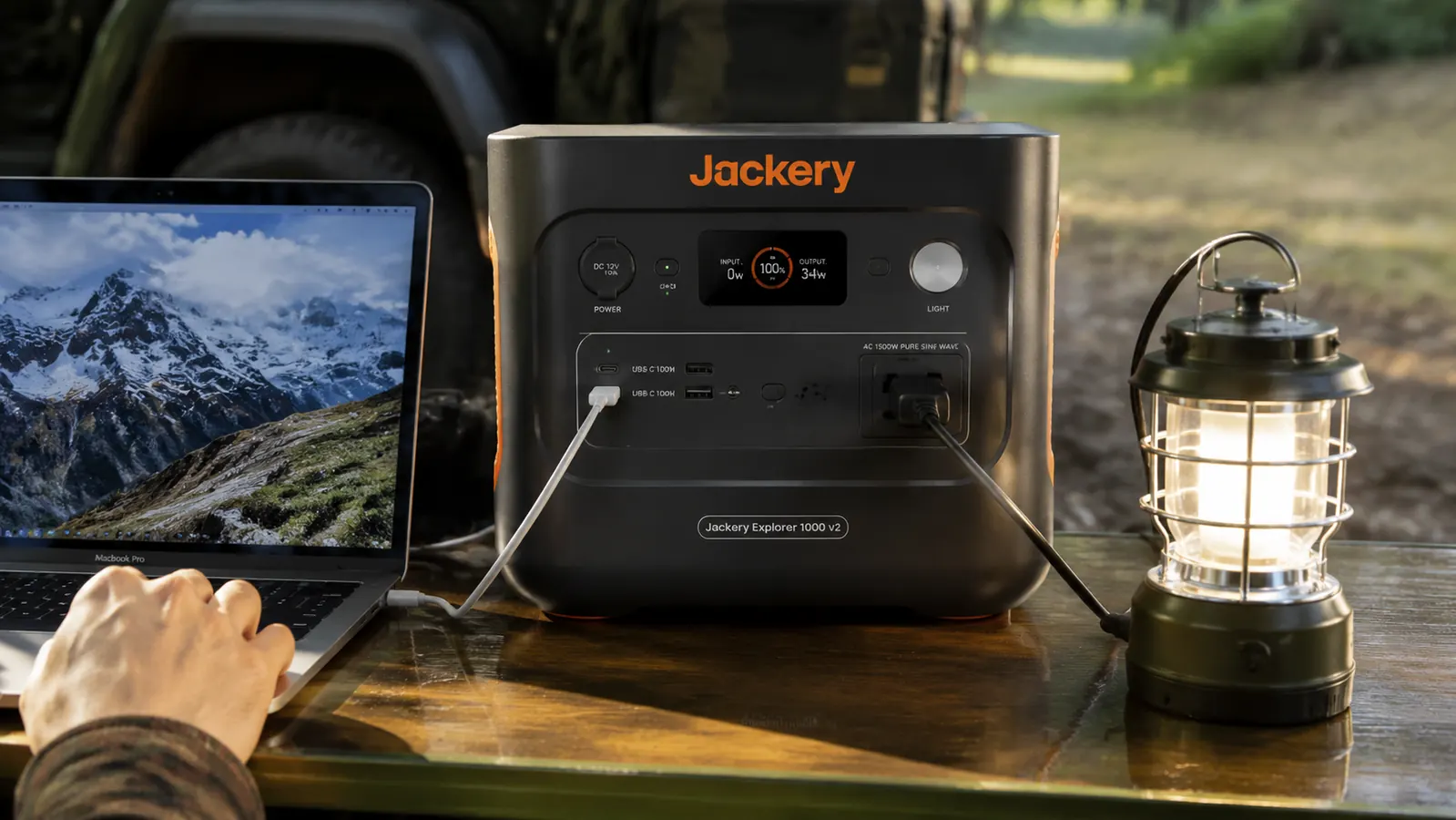
Jackery rates wall charging on the Explorer 1000 v2 at around 940W using the included power brick. In practice I measured 890-910W sustained on a Kill A Watt meter during the bulk charge phase. That puts a full recharge from empty at roughly 1.25 to 1.35 hours, which sounds fast. The issue is what happens in the final 20 percent. Once the battery management system shifts to CV (constant voltage) taper mode above about 80 percent state of charge, the input wattage drops noticeably. Getting from 80 percent to 100 percent takes nearly as long as getting from 0 to 80 percent. Full charge from dead takes closer to two hours in practice.
Compare that to the EcoFlow Delta 2, which hits 1200W AC input and charges to 80 percent in about 50 minutes with X-Boost active. If you are trying to top off a unit before an incoming storm and you have two hours of warning, the Jackery will probably finish. If you have 90 minutes, it might not. That is not a dealbreaker for most use cases, but it matters enough to mention.
Solar is the other place where the recharge story gets honest. The 1000 v2 accepts up to 200W via its MPPT solar input, which is a step down from the 300W-plus ceiling you see on Delta 2 or higher-end Bluetti units. If you are running two 100W panels in parallel, 200W is your ceiling and that is fine for a weekend. If you own a 200W panel already, you are right at the limit and you will see output dip when the sun angle changes. I paired this unit with a Renogy 200W foldable panel and on a clear summer day in my driveway, peak input hit 183W. Respectable but not exceptional.
Getting from 80 to 100 percent takes almost as long as getting from 0 to 80. Plan for a two-hour wall charge from dead, not the 1.25 hours the spec sheet implies.
The Fan: Honest Notes on Noise
The Explorer 1000 v2 has a cooling fan that runs whenever the unit is under significant AC load or charging above a certain wattage. Jackery has gotten smarter about fan management across their v2 lineup compared to older units. For light DC loads, phone charging, 12V accessories, and similar, the fan often stays off entirely or runs at a barely audible speed. That is a genuine improvement.
Where the fan becomes noticeable is under full AC load or during fast wall charging. At 900W input on the charger, the fan runs continuously and reaches a volume I would estimate at 45 to 50 dB from three feet away. That is quieter than a window AC unit but louder than a refrigerator hum. If you are sleeping two feet from this unit in a tent, you will hear it. In a shed or on a countertop in a kitchen, it blends into background noise easily. In a small camping tent, it is present.
During my January blackout use, I ran the unit in the living room on a side table, about eight feet from where my wife and I were sleeping on the couch. At 120W of mixed load (CPAP, a few phone chargers, and an LED strip), the fan was inaudible from the couch. That is the more representative blackout scenario and it was completely fine. The noise issue is most relevant if your tent setup puts you in very close proximity to the unit during overnight charging or heavy AC draws.
Weight and Portability: The Number on the Spec Sheet Feels Different in Parking Lots
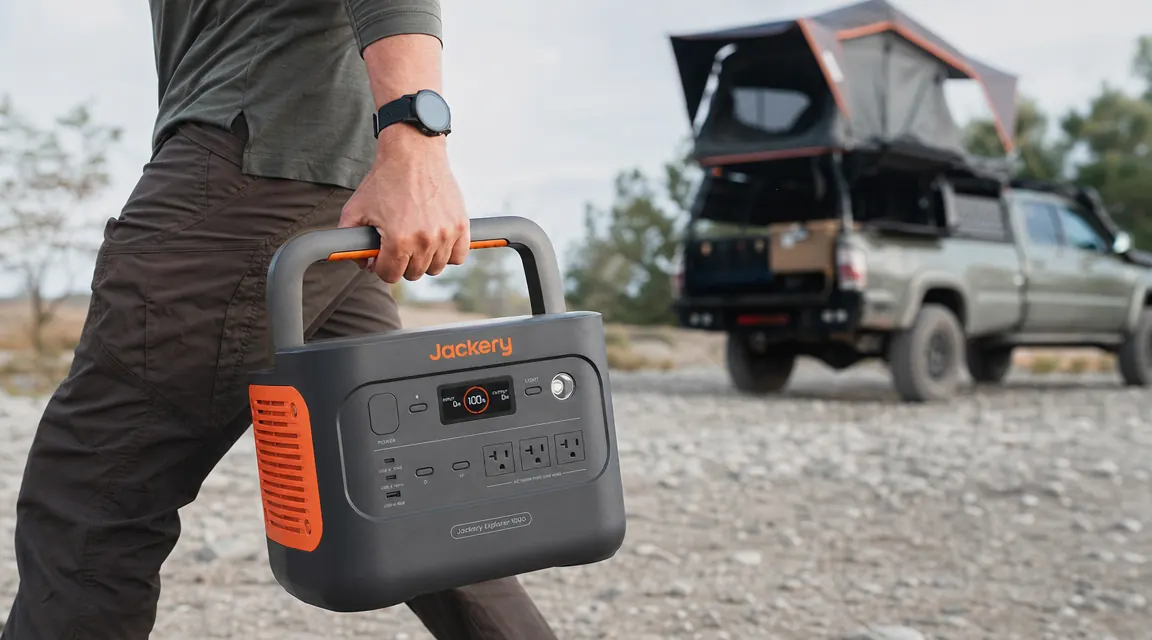
The Explorer 1000 v2 weighs 23.8 pounds. That is one of the lighter weights in the 1000Wh class, and Jackery deserves credit for that. The handle design is also genuinely good, molded rubber grip with a comfortable arc. I have carried heavier coolers. That said, 24 pounds is 24 pounds, and after a long drive when you are loading camp gear from a truck bed, it is not a unit you want to carry more than 50 yards without putting it down.
The handle placement is centered, which means the unit tends to swing slightly as you walk. A few times I set it down on uneven ground and it tipped. The rubber feet grip most surfaces but they are small. On a tailgate or a smooth table I always felt slightly nervous about the footprint. Adding a simple silicone mat under it solved this completely, which costs next to nothing, but it is something worth knowing.
For the hunting cabin use case, I carry this unit from my truck to the cabin door, roughly 40 feet across gravel. No problem at all. For backpack-adjacent camping where you would need to carry it any distance, 24 pounds starts to matter. Most people in the overlanding and campsite-adjacent crowd will find the weight completely manageable.
Cold Weather Performance: What the Spec Sheet Does Not Chart
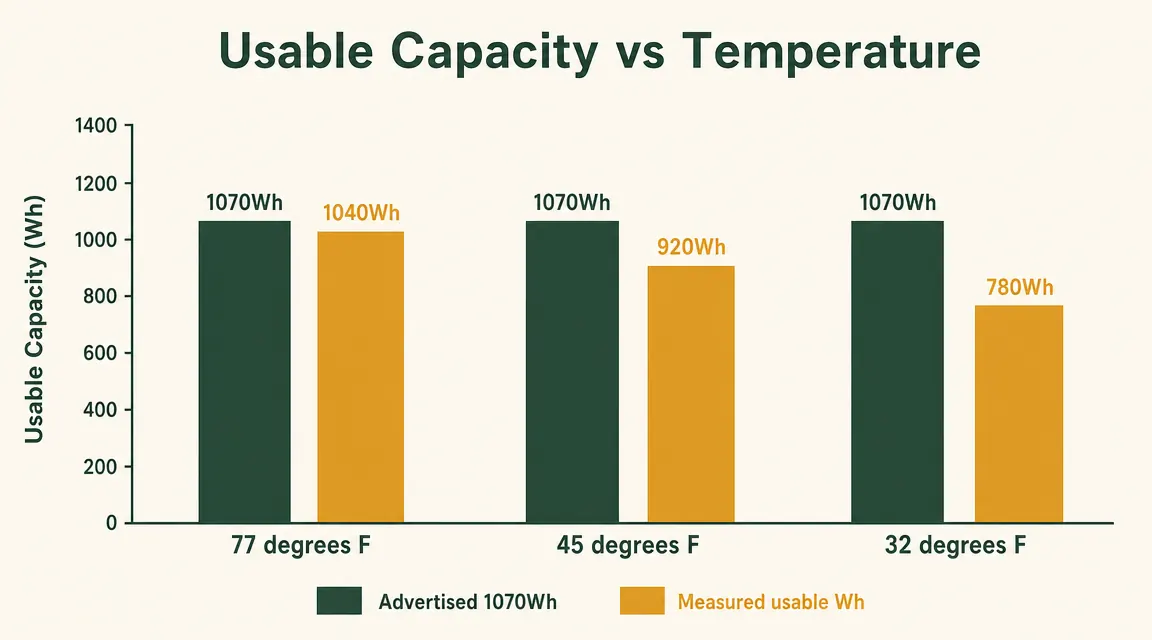
LiFePO4 chemistry handles cold better than traditional lithium-ion, which is one of the reasons Jackery switched to it in the v2 lineup. The 1000 v2 is rated to operate down to 14 degrees Fahrenheit. What the spec sheet does not tell you is the capacity curve across that temperature range. Here is what I found across three test sessions.
At 77 degrees Fahrenheit in my garage, I measured 1,004Wh of usable output before the low-battery shutoff, or about 94 percent of the rated 1070Wh. At 45 degrees Fahrenheit, left outside on a November morning until the unit equilibrated, I measured 948Wh, or about 89 percent. At 32 degrees Fahrenheit on a January morning before the ice storm, I measured 881Wh, or about 82 percent of rated. None of these are alarming numbers. LiFePO4 at freezing retaining 82 percent of rated capacity is actually quite good compared to older lithium-ion chemistry. But if your emergency plan assumes 1070Wh is available during a winter blackout when the unit has been sitting in a cold garage, you should size your load budget around 880 to 900Wh to be safe.
What the 4.8-Star Rating Gets Right
After spending this much time on the nuances, I want to be clear: this is a good unit. The 1500W continuous AC output is real and it handles inductive loads cleanly. I ran a small shop vac off it once at the cabin when a mouse had gotten into the wall insulation. The shop vac motor pulled about 900W on startup and the 1000 v2 handled it without a hiccup. Cheaper units trip their inverter on motor startup loads like that.
The LiFePO4 chemistry is the right call for a unit in this price range. The 4000-cycle rating means this battery will realistically outlast any other component in the unit if you do not abuse it. At one full cycle per week, 4000 cycles is 76 years. In real-world use where you might cycle it once or twice a month, the chemistry will comfortably outlast the decade warranty and then some.
The display is clear and informative. I can read the battery percentage, input wattage from solar, and output wattage at a glance. The interface never confused me and I never needed the manual for normal operation. The dual AC outlets plus two USB-A ports plus two USB-C ports (one at 100W) cover most load combinations without an adapter. The 12V car port is a clean addition for coolers and tire pumps.
The Jackery app works. I do not use it heavily, but it paired via Bluetooth without drama, displays what the front panel displays, and lets you toggle outlet groups on or off without walking to the unit. For a cabin or a vehicle setup where the unit might be tucked under a seat or in a storage bay, that remote display is useful.
What I Liked
- LiFePO4 chemistry with a rated 4000-cycle life, meaningfully better longevity than older lithium-ion units in the same price class
- Genuine 1500W continuous AC output handles inductive motor loads without tripping the inverter
- Clean, readable display showing charge level, solar input wattage, and AC output wattage simultaneously
- Fan management improved versus earlier Jackery models; DC-only loads often run completely silent
- 23.8 pounds is one of the lighter weights in the 1000Wh class, and the handle design is comfortable
- Bluetooth app connects without drama and provides remote display and outlet switching
- Rated to operate down to 14 degrees F with reasonable capacity retention at cold temperatures
Where It Falls Short
- Wall charge tops out around 900W versus 1200W-plus on competing units; full charge from empty takes close to two hours in practice
- Solar input ceiling of 200W is lower than comparable EcoFlow and Bluetti units that accept 300-400W
- Fan is audible at 45-50 dB under full AC load or fast charging; not ideal for use next to a sleeping area
- Usable capacity drops roughly 18 percent at 32 degrees F; budget for 880Wh in winter blackout scenarios, not 1070Wh
- Rubber feet are small and the unit can tip on uneven surfaces or smooth tailgates; a non-slip mat helps
- No pass-through charging: you cannot charge the unit and run a connected device simultaneously without some efficiency loss and added heat
Who This Is For
The Explorer 1000 v2 is the right unit if you want a 1000Wh-class portable power station with LiFePO4 chemistry, real 1500W AC output, and a price that sits well below the EcoFlow Delta 2 and Bluetti EB70S at equivalent capability. It is a strong choice for campers and overlanders who run a 12V cooler, phone chargers, a fan, and occasional AC appliances for a weekend. It is also a reasonable blackout backup for powering a CPAP, a few lights, and phone chargers through a night or two without worrying about the battery degrading after a few years of seasonal use.
If you already own a solar panel in the 100-200W range, this unit pairs with it without needing an adapter. If you are building a solar-plus-storage setup from scratch, the Jackery SolarSaga 200W panel is the obvious companion since Jackery sells them as a bundle with a tested cable match.
Who Should Skip It
Skip this unit if your primary scenario is topping off a power station quickly before an unpredictable storm window. The 900W wall charge rate means you need about two hours of warning to get from empty to full. The EcoFlow Delta 2 at a similar price point charges to 80 percent in under an hour. If fast recharge is your top priority, the Delta 2 wins that comparison clearly. I have a longer breakdown of that head-to-head in my Jackery 1000 v2 vs EcoFlow Delta 2 comparison.
Also skip this unit if you plan to park it in a cold space and rely on the full rated capacity in an emergency. At 32 degrees, you are working with roughly 880Wh. For a CPAP, some phone chargers, and a lamp, that is still two solid nights of runtime. But if your winter blackout plan involves powering a small space heater for any duration, 880Wh usable gets consumed very quickly and you will want a larger unit.
If you want a deeper look at how this unit performed over six months of regular use rather than this honest-issues breakdown, my long-term review of the Explorer 1000 v2 covers the consistency over time in more detail.
Ready to buy? Check if today's price includes the solar bundle discount.
Jackery frequently bundles the 1000 v2 with a SolarSaga 200W panel at a combined discount. If you are planning to add solar anyway, the bundle price often beats buying both separately. Check current Amazon pricing before adding just the station to your cart.
Amazon Check Today's Price on Amazon →