
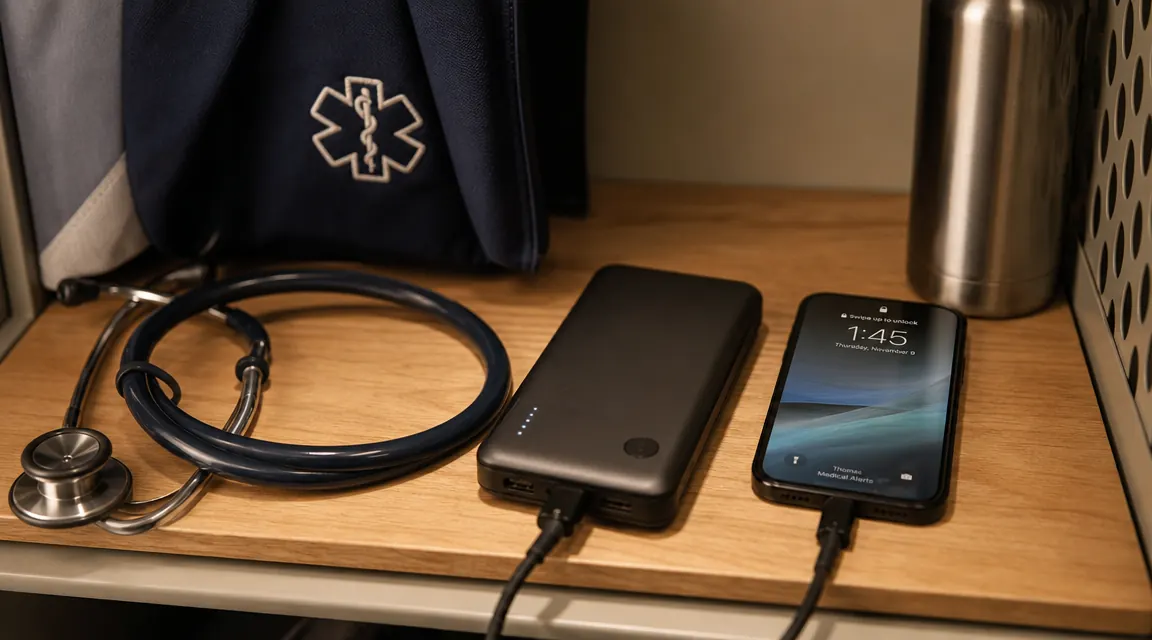
It was about 9 p.m. on a Tuesday, somewhere around hour ten of twelve, and I was charting at a workstation in the hall because every bay was full. My phone hit 8 percent. The nursing station charger was occupied. I had a patient in bay four who needed me to pull up his medication reconciliation on my phone because our EMR was lagging. Eight percent is not a number you want to see in that moment.
I had been through this before. I kept a cheap 10,000mAh bank in my bag for about two years, and it was fine for light days. But ER shifts are not light days. I am documenting in Epic on my phone, taking pictures of wound sites, texting the attending, coordinating with pharmacy. By hour eight, 10,000mAh was already gone. I needed something that could realistically carry me through a double if it came to that.
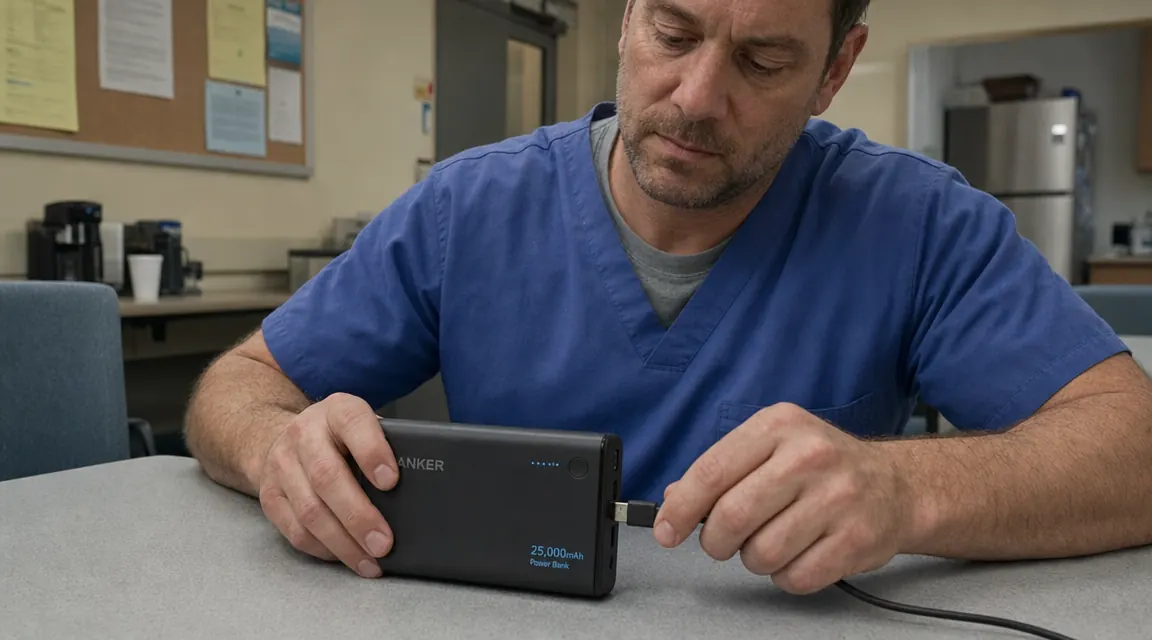
I picked up the Anker 25,000mAh laptop power bank about fourteen months ago. The one with three USB-C ports, each rated at 100W, and a built-in retractable cable so I am not fishing through my bag for a cord at 2 a.m. At 4.5 stars across more than 9,000 reviews, it had the track record I was looking for. Here is how it has actually held up.
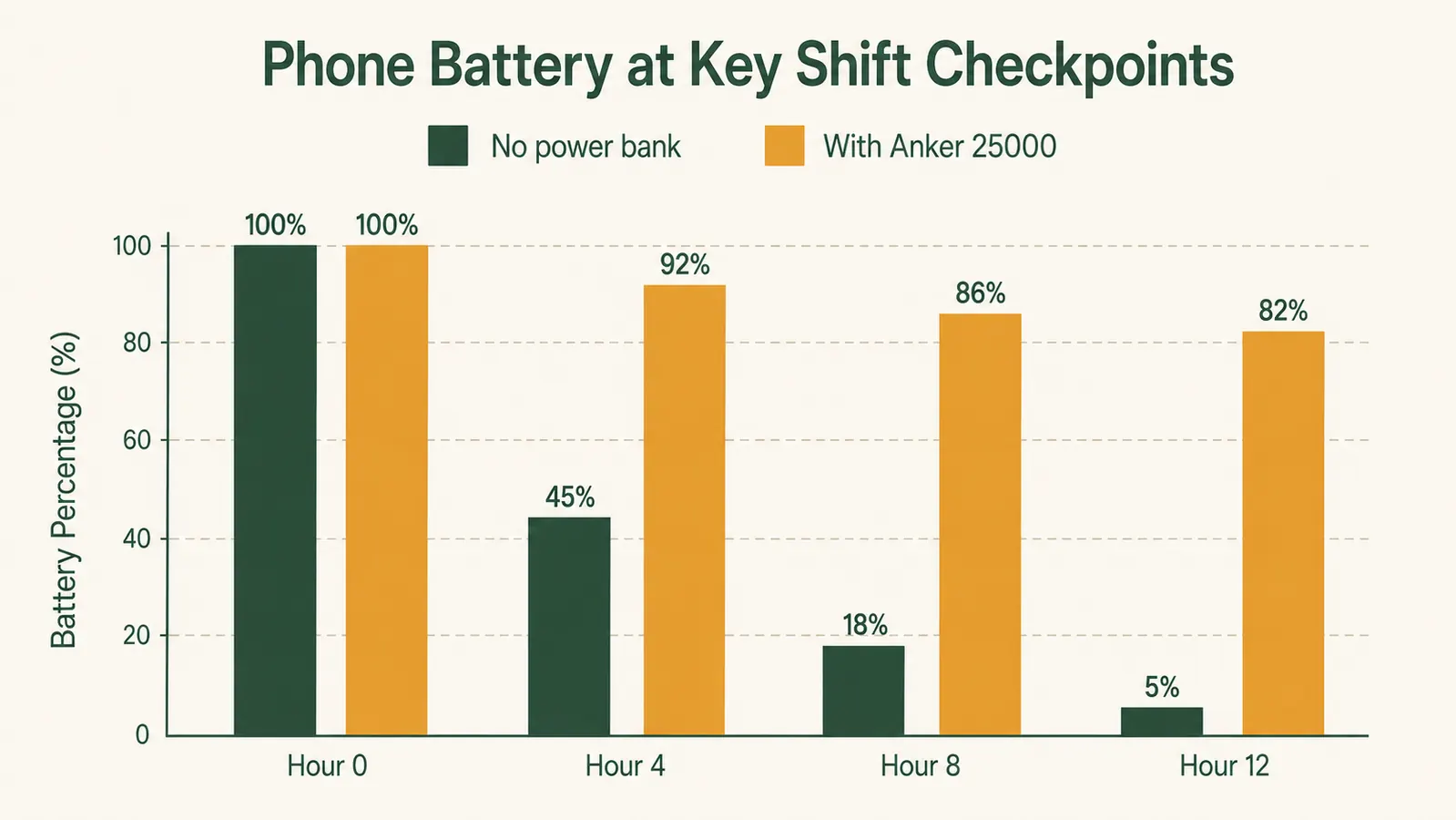
Twenty-five thousand milliamp-hours sounds like a spec-sheet number until you are on hour ten with a full patient load and your phone is still at 74 percent.
The first thing I noticed was the built-in cable. It is a USB-C to USB-C retractable that tucks flush into the body of the unit. I have three cables in my bag that I will probably never use again. On a shift, I pull the bank out, pop the cable, plug in. Done. When I am grabbing things in a dark supply room or a dimly lit family consultation room, one less thing to fumble with matters more than you would expect.
The 25,000mAh capacity works out to roughly 90 watt-hours at 3.6V nominal. My iPhone 15 Pro has an approximately 13.6Wh battery. In pure math, that is six-plus full charges from zero. In real use, accounting for conversion losses and the fact that I am charging from 20 percent rather than zero, I get four solid top-offs over a shift, which means I leave for work at 100 percent and come home the next morning still above 40 percent on both the phone and the bank. It has never run out on me during a shift.
The three 100W USB-C ports also let me charge my laptop on the rare occasion I bring it in for a presentation or a continuing-ed module. A single port pushes 100W, which is enough to run my MacBook Air and slowly charge it at the same time. Two ports simultaneously will split power, so if I need to charge both a phone and a laptop fast, I use the two fastest ports rather than all three. The bank is smart enough to negotiate the right output for each device without me thinking about it.
Your phone dying at hour ten is a logistics problem with a $96 fix.
The Anker 25,000mAh power bank with triple 100W USB-C and a built-in retractable cable. 4.5 stars across 9,206 reviews. Check the current price on Amazon.
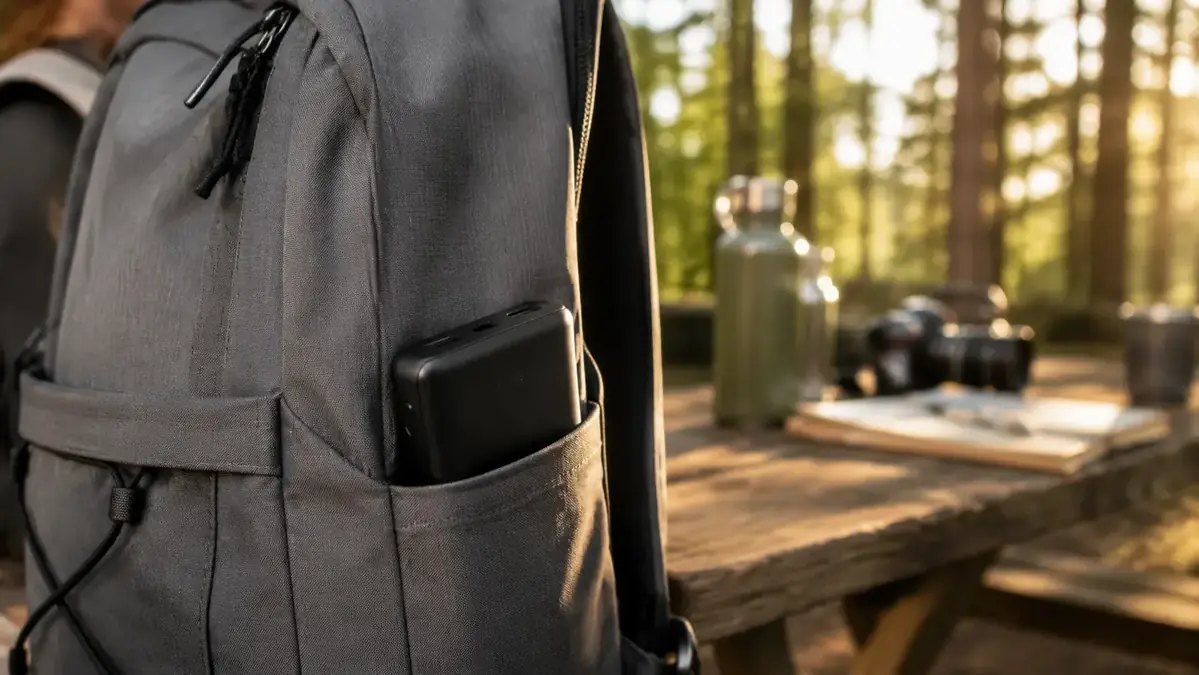
Amazon Check Today's Price on Amazon →I also use this bank outside of work. I took it on a four-day camping trip to the Ocala National Forest last fall. My wife and I between us were running two phones and a Bluetooth speaker off it. We got through day three before it needed a recharge, and we plugged it into our Jackery solar setup to top it off in about two hours. The bank charges in via USB-C at up to 65W, so a 100W solar pass-through charges it reasonably fast when the sun is out.
There are two honest limitations worth naming. First, it is not small. It weighs about 1.3 pounds and is roughly the size of a large paperback. If you are used to carrying a slim 10,000mAh bank in your back pocket, this is not that. It goes in a bag, not a pocket. For my purposes, that is fine. I carry a small backpack to every shift. But if you need something pocketable, this is the wrong tool. Second, the body can get warm during simultaneous fast charging, not hot, but warm. Nothing that has ever concerned me, and it has never tripped any kind of thermal shutoff, but it is worth knowing.
What I Would Tell You If We Were Sitting at My Kitchen Table
If you work long shifts, travel a lot, or spend time away from outlets for any reason, the question is not whether you need a power bank. You already know you do. The question is whether the one you have is actually up to the job. Most cheap banks are not. They are fine for a short flight or a day at the park. They are not fine for twelve hours in a building where you cannot just find a free outlet whenever you want one.
The Anker 25,000 is the one I stopped thinking about. That is the highest praise I can give a piece of gear. It sits in my bag, it charges whatever I plug into it, and I never walk into a shift wondering whether it has enough left to get me through. At its current price, it is less than a pair of nursing shoes and it lasts longer. I replaced mine after fourteen months only because I bought a second one for my wife's travel bag. The original is still working fine.
That is the honest version. No drama, no inflated claims. Just a power bank that does exactly what it says it will do, every single shift.
Fourteen months of 12-hour shifts and it has never run out on me.
Anker 25,000mAh, triple 100W USB-C, built-in retractable cable. Rated 4.5 stars by 9,206 buyers. See today's price on Amazon.
Amazon Check Today's Price on Amazon →